
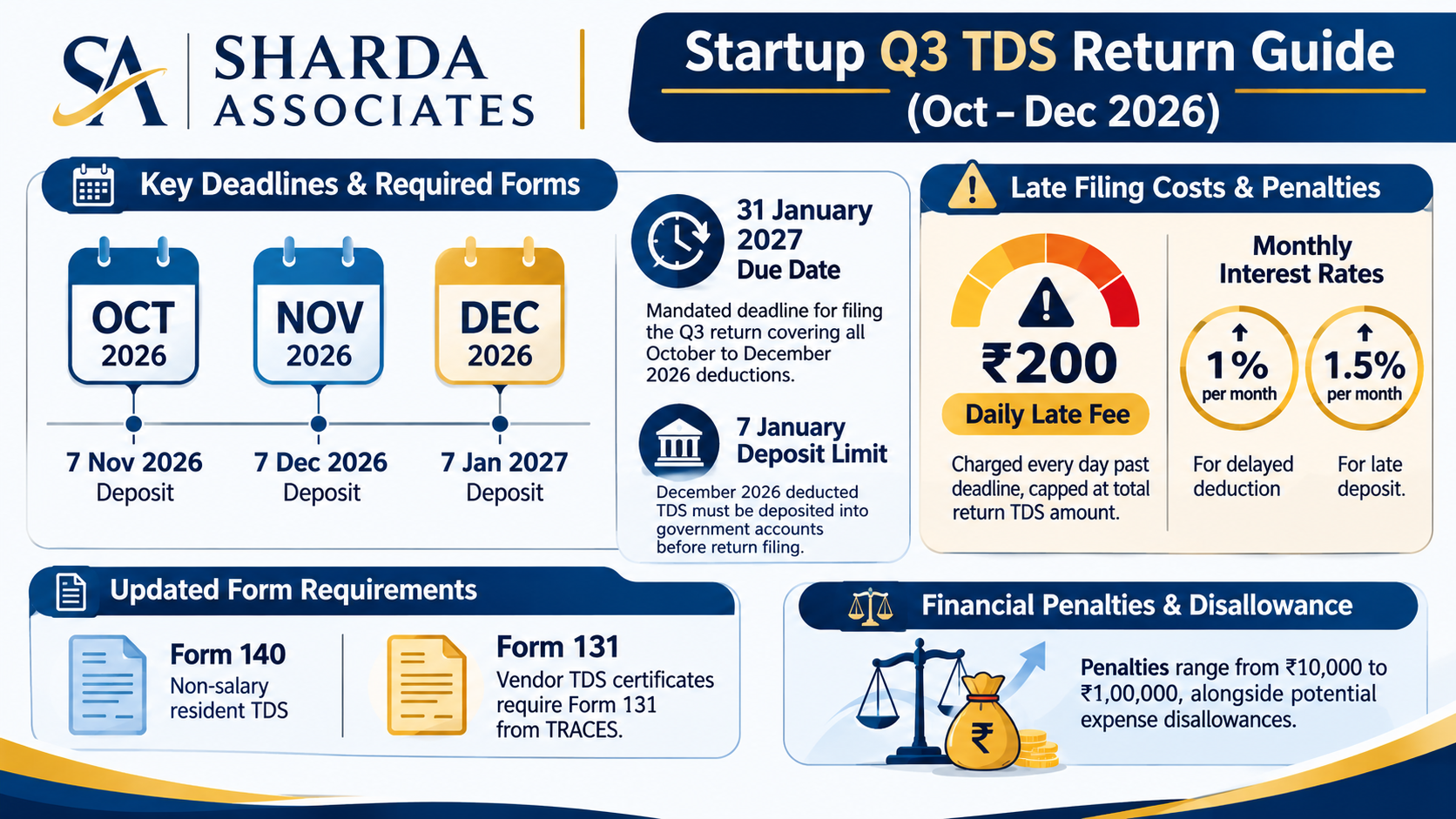
Short Answer: The TDS return filing due date for October–December 2026 (Q3 of FY 2026–27) is 31 January 2027. TDS deducted in December must generally be deposited by 7 January 2027. Late filing attracts a fee of ₹200 per day under Section 234E, subject to the TDS amount.
Sharda Associates helps businesses, startups and employers with TDS calculations, challan verification, quarterly TDS return filing and TDS certificate compliance. Our team also assists in correcting TDS returns and responding to compliance notices.
This guide explains who needs to file a TDS return, which form to use, important deadlines, late filing fees and common mistakes to avoid.
What is the due date of the Q3 TDS return?
The due date is 31 January 2027. It covers all TDS deducted from 1 October to 31 December 2026.
| Month of deduction | Deposit TDS by | File return by |
| October 2026 | 7 November 2026 | 31 January 2027 |
| November 2026 | 7 December 2026 | 31 January 2027 |
| December 2026 | 7 January 2027 | 31 January 2027 |
The other quarterly dates are 31 July, 31 October and 31 May. No extension of the 31 January date was found at the time of writing. Check the income tax portal before the date.
Who must file a TDS return?
Anyone who deducts TDS must file it. For a startup, this means you if you pay:
- Salary above the exemption limit
- Fees to a CA, lawyer, developer, or designer
- Contractors and freelancers
- Office rent above the limit
- Commission, brokerage, or interest above the limit
- Partners of an LLP
If you deducted no TDS in the quarter, you do not need to file for that quarter. Check your ledger first.
Which form do I use?
- Salary TDS: salary statement (earlier Form 24Q)
- Non-salary TDS to residents: Form 140 (earlier Form 26Q)
- TDS certificate for vendors: Form 131 (earlier Form 16A), made on TRACES after your return is processed
If you pay both salary and professional fees, you file two returns.
The Income Tax Act, 2025, applies from 1 April 2026. Form and section numbers changed, but the quarterly dates did not.
What is the penalty for filing late?
There are four costs. They can add up.
- Late fee: ₹200 per day until you file. The fee cannot be more than the TDS amount.
- Penalty: ₹10,000 to ₹1,00,000 can apply for late or wrong filing. Under the earlier law, it was not charged if you deposited the TDS, paid the fee and filed within one year. Check the current rule.
- Interest: 1% per month if you did not deduct on time, and 1.5% per month if you deducted but did not deposit on time. A part month counts as a full month.
- Expense disallowance: if TDS was not deducted or deposited, part of the expense (30% in the earlier law) can be disallowed, so your tax goes up.
Example 1: TDS is ₹50,000 and you file 40 days late. Fee = 40 × ₹200 = ₹8,000.
Example 2: TDS is ₹3,000 and you file 30 days late. Fee would be ₹6,000, but the cap is the TDS amount, so it is ₹3,000.
Example 3: You deduct ₹10,000 on 1 November and deposit on 7 January. That is 3 months at 1.5%. Interest = ₹450.
(Examples are for understanding only.)
What is different for a startup?
- Founder salary and ESOPs: TDS on salary applies. When employees exercise ESOPs, the perquisite is taxed as salary, so TDS may be due even if no cash is paid.
- Freelancers: every payment above the limit needs TDS under the correct section. Do not pay in full first and check later.
- No PAN: if a vendor gives no PAN, TDS is cut at a higher rate. Collect PAN before the first payment.
- LLP startups: payments to partners can attract TDS.
- Loss-making startup: loss does not remove the TDS duty. TDS depends on what you pay.
- Tax holiday startup (80-IAC): you still deduct TDS on payments to others.
How do I file the TDS return?
- Collect payee name, PAN, date, amount, section, rate and TDS.
- Collect challan details: BSR code, date and serial number.
- Prepare the statement in TDS software and make the FVU file.
- Upload it on TRACES or the income tax portal with your TAN login.
- Save the acknowledgement.
- After processing, check the Justification Report for short deduction, interest or late fee.
- Download Form 131 and send it to your vendors.
Made a mistake? File a correction statement on TRACES. Do not ignore a default notice.
Why does accuracy matter?
Your vendor sees the TDS in Form 26AS and AIS only after your return is processed. A wrong PAN, section or challan means the vendor does not get credit, and they will ask you. Repeated mismatches can bring notices on your TAN.
7-step checklist before 31 January 2027
- Close the books for October, November and December.
- List every payment where TDS applies. Check section and rate.
- Match TDS in your ledger with challans.
- Check PAN of every vendor and employee.
- Deposit December TDS by 7 January.
- File the return before 31 January. Save the acknowledgement.
- Download certificates and share them with vendors.
Conclusion
TDS is a quarterly routine: deduct, deposit, file and give certificates. The 31 January 2027 return is the one that catches most startups, because the year is busy and the ledger is rarely matched with challans. Do this one check this week and you will avoid ₹200 a day, interest, and vendor follow-ups.
Sharda Associates can do the full job for you. We review every payment for the correct section and rate, prepare the return, file it before the due date, and send Form 131 to your vendors. We also review your last quarters, so any old mistake is fixed before it becomes a notice. Our CA team stays with you till the return is processed.
Call Sharda Associates on or +91 89899 77769, or contact us online. Share your TDS ledger and challans, and we will tell you exactly what is due and what is pending.
Frequently asked questions
What is the due date for the Q3 TDS return?
The TDS return for the quarter from 1 October to 31 December 2026 is due on 31 January 2027. TDS deducted in December 2026 must be deposited by 7 January 2027.
Which form is used for non-salary TDS now?
Non-salary TDS on payments to residents is reported in Form 140, which replaces Form 26Q under the Income-tax Act, 2025. Salary TDS uses a separate salary statement, earlier called Form 24Q.
What is the late fee for a TDS return?
The late fee is ₹200 per day, counted from the day after the due date until you file. The total fee cannot be more than the TDS amount of that return.
By when must the December 2026 TDS be deposited?
December 2026 TDS must be deposited by 7 January 2027. Deposit it before filing the return, because the return is matched with challan details and December entries may not match without it.
Do I need to file if I deducted no TDS?
No. If you deducted no TDS in the quarter, you do not need to file a return for it. Check your ledger first, because small payments can cross yearly limits.
Where do vendors get their TDS certificate?
Vendors get the TDS certificate as Form 131 on TRACES after your TDS return is processed. It replaces the earlier Form 16A. Salary employees receive a separate salary certificate.
Can I correct a return after filing?
Yes. You can correct a filed TDS return by submitting a correction statement on TRACES. Use it for wrong PAN, section, amount or challan details, and do not ignore a default notice.
Is the 31 January 2027 date extended?
No extension of the 31 January 2027 due date was found at the time of writing, 21 November 2026. Check the income tax portal for any notification before the date