
A strong business credit profile isn’t something you can put together the week before a loan application — it’s built over months of consistent financial behaviour, and lenders can generally tell the difference between a business that’s always managed credit carefully and one that’s scrambling to look good just before applying. Whether you’ve faced a rejection before or you’re preparing for your first loan,
the good news is that every factor lenders actually check — your CIBIL MSME Rank (CMR), credit utilisation, repayment history, and the quality of your financial documentation — is something you can influence directly, starting now.
At Sharda Associates, this is a big part of what we help clients with before they even approach a bank: not just preparing a project report, but making sure the credit profile behind it can actually support the numbers. Here’s exactly what strengthens a business credit profile, and what a lender is really looking at when they pull your file.
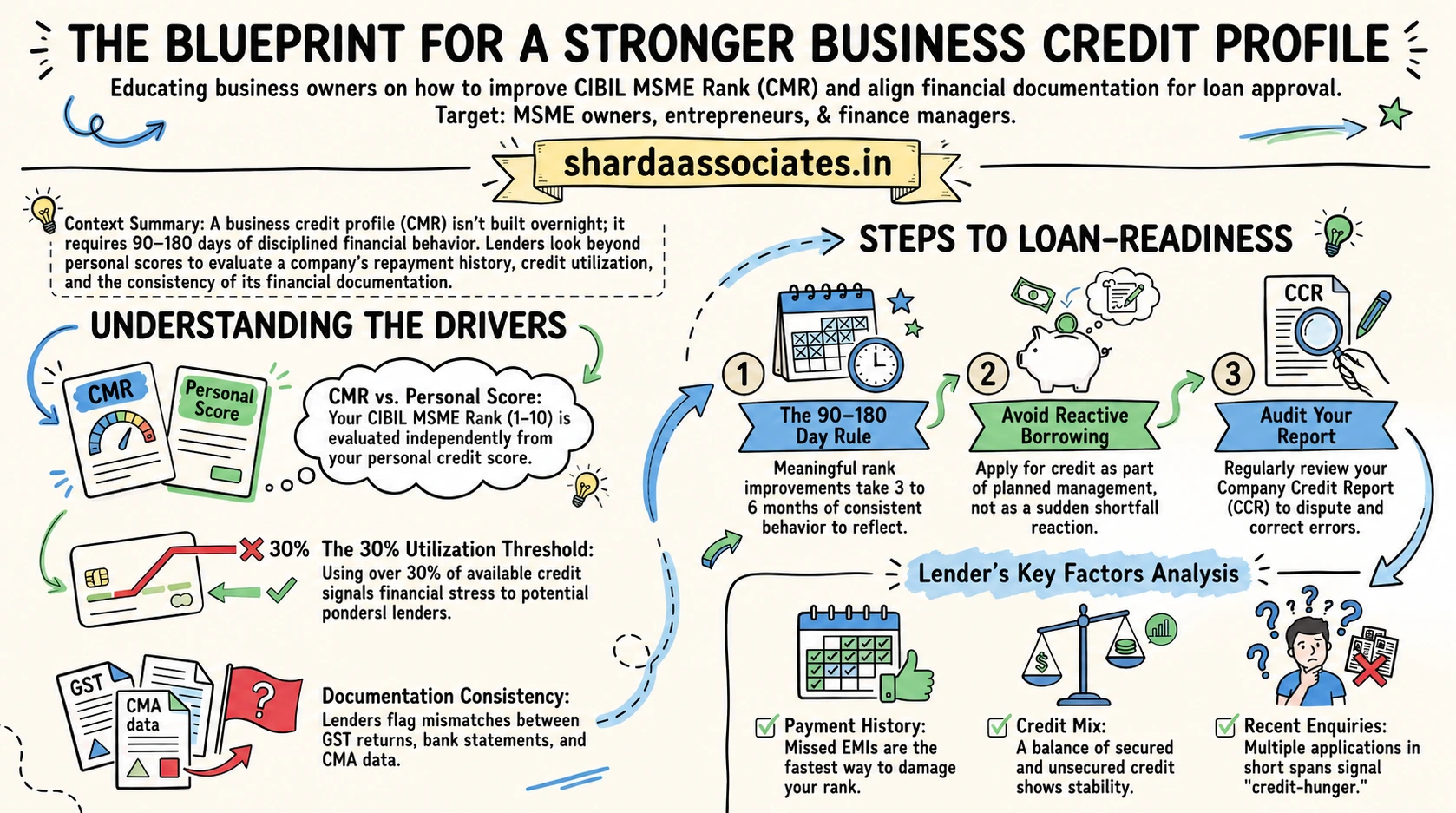
Understand What Lenders Are Actually Looking At
Businesses in India are evaluated on more than just the promoter’s personal CIBIL score. Most lenders also check the CIBIL MSME Rank (CMR)—a business-specific rank from 1 to 10, where 1 indicates the lowest risk—generated from your Company Credit Report. A good personal score does not automatically carry over into a good CMR, since the two are evaluated independently — which is why a business owner with excellent personal credit can still see their company’s application struggle if the business’s own credit behaviour hasn’t been as disciplined.
What Actually Drives Your Credit Profile
| Factor | Why It Matters |
| Payment history | Missed EMIs or late payments are the single fastest way to damage your rank |
| Credit utilisation | Using more than 30–40% of your available credit limit signals financial stress to lenders |
| Outstanding debt | Total amount owed, and how it’s structured, affects perceived repayment capacity |
| Credit mix | A healthy balance between secured (equipment finance) and unsecured (working capital, cards) credit |
| Business vintage and consistency | Age of the business, entity type, and consistency of operations all factor into the assessment |
| Recent credit enquiries | Multiple loan applications in a short span can be read as credit-hungry behaviour |
Practical Steps to Strengthen Your Business Credit Profile
1. Pay Every EMI and Obligation on Time
This is the single biggest lever. Setting up auto-debit for EMIs and credit card dues removes the risk of a missed payment slipping through simply due to oversight.
2. Keep Credit Utilisation Below 30%
Using a large share of your available credit limit — even if you repay it in full each month — can still signal reliance on credit. Paying down balances before your statement date, or requesting a credit limit increase without additional borrowing, both help bring utilisation down.
3. Clear Overdue Payments, Starting with the Oldest
Older dues typically carry more weight in how lenders assess risk. Prioritising and clearing these first has a more meaningful impact than spreading small payments across several accounts.
4. Review Your Company Credit Report (CCR) Regularly
Errors in your credit report — an account that isn’t yours, an incorrect overdue marking — can drag down your CMR without you realising it. Reviewing your CCR periodically and disputing genuine errors is a low-effort way to protect your rank.
5. Avoid Multiple Loan Enquiries in a Short Period
Applying to several lenders at once creates multiple hard enquiries, which can be read as financial stress even if each individual application is reasonable on its own. Researching and applying selectively works better than a scattershot approach.
6. Build a Track Record with Smaller, Well-Managed Credit
If your business credit history is thin or damaged, a small, well-repaid credit line — a modest NBFC loan or a business credit card used responsibly — can help rebuild a positive payment pattern over time, which shows up favourably in later assessments.
7. Maintain a Healthy Credit Mix
Relying entirely on unsecured credit (personal loans, credit cards) can look riskier to lenders than a mix that includes some secured, asset-backed credit alongside it, where relevant to your business.
8. Keep Financial Documentation Clean and Consistent
Beyond your credit report, lenders also look at whether your GST returns, bank statements, and project report or CMA data tell a consistent story. Mismatched turnover figures across these documents are read as a red flag, independent of your actual credit score.
9. Avoid Reactive Borrowing
One pattern lenders specifically flag is reactive borrowing — applying for credit only when a shortfall has already occurred, rather than as part of planned financial management. Structured, forward-looking borrowing is generally viewed as a sign of a more reliable business.
10. Give Genuine Improvements Time to Reflect
Noticeable improvement in a credit profile typically takes around 90–180 days to show up meaningfully, depending on your prior history. This is exactly why the businesses that succeed on a second attempt are usually the ones that paused, fixed the underlying issue, and waited before reapplying — rather than resubmitting immediately with the same profile.
How This Connects to Your Loan Documentation
A strong credit profile and a strong project report work together, not separately. Even a business with a clean repayment history can see its application stall if the financial projections in its project report or CMA data don’t reconcile with its actual bank statements and GST filings — and conversely, an excellent project report can’t fully offset a credit profile with unresolved overdue accounts. Lenders assess both together, which is why it’s worth treating credit discipline and documentation quality as one combined effort rather than two separate boxes to tick.
Conclusion
None of this is about finding a shortcut — a genuinely strong business credit profile is just consistent, disciplined financial behaviour that shows up clearly once a lender looks at your file. If you already know your credit side is solid but you’re not sure your project report, CMA data or GST figures would hold up to the same scrutiny, that’s exactly the kind of thing worth checking before you apply, not after a rejection.
Call or WhatsApp our CA team at +91 89899 77769 and send us what you have, and we’ll tell you plainly what needs to change before you put the application back in.
Frequently Asked Questions
1. What is a CIBIL MSME Rank (CMR) and how is it different from a personal CIBIL score?
CMR is a business-specific credit rank from 1 to 10 based on your company credit report, evaluated independently of your personal CIBIL score — a business owner can have a strong personal score and a weaker CMR, or vice versa.
2. How long does it take to see improvement in a business credit profile?
Noticeable improvement generally takes around 90–180 days of consistent, disciplined financial behaviour, depending on how significant the prior issues were.
3. Does credit utilisation matter even if I pay my balance in full every month?
Yes — utilisation is typically measured against your balance at the statement date, so consistently high usage can still affect your profile even with full repayment.
4. Can multiple loan enquiries in a short time actually hurt my chances?
Yes — each hard enquiry is visible on your credit report, and several in a short period can be interpreted as financial stress by lenders reviewing a fresh application.
5. Is it better to close old accounts to simplify my credit profile?
Not necessarily — a longer, well-managed credit history generally supports a stronger profile; closing accounts can sometimes reduce your available credit and push utilisation higher.
6. Can errors in my credit report be corrected?
Yes — reviewing your company credit report periodically and raising a dispute for genuine inaccuracies is a standard and often effective step.
7. Should I take a small loan just to build credit history?
It can help if your business credit history is thin, provided it’s repaid diligently — the goal is demonstrating disciplined repayment, not simply having more accounts.
8. Does my business’s financial documentation matter as much as my credit score?
Yes — lenders look at both together; a strong credit profile paired with weak, inconsistent financial documentation can still result in a reduced or rejected application.
9. Can a rejected loan application permanently damage my credit profile?
Not permanently—the associated hard enquiry has a small, temporary impact, and a business that addresses the underlying issue can rebuild its profile over subsequent months.
10. What’s the most common mistake businesses make with their credit profile?
Reactive borrowing — applying for credit only after a cash flow problem has already emerged, rather than maintaining structured, planned financial management throughout the year.