
Quick answer: If your supplier does not deposit GST after you claim Input Tax Credit (ITC), the GST department can deny or reverse that credit from you, charge interest at 18% a year and issue a notice under Section 73, 74, or 74A of the CGST Act. At Sharda Associates, our GST and project report consultants help businesses with ITC reconciliation, notice replies and bank-ready project reports, and this guide explains the law, the risks and the steps that protect your credit.
You bought goods or services, received a valid tax invoice, paid your supplier in full and claimed Input Tax Credit (ITC) in your GSTR-3B. Everything looks compliant. Then a notice arrives: your supplier never deposited the GST with the government, and the department wants the credit back from you.
This is one of the most common and most frustrating GST disputes faced by Indian businesses. Here is what the law says, what the risks are and how you can protect yourself.
The Legal Position: ITC Is a Conditional Right
Under Section 16 of the CGST Act, 2017, ITC is not automatic. Among other conditions, you must:
- hold a valid tax invoice or debit note;
- have received the goods or services;
- ensure the supplier’s invoice details appear in your GSTR-2B (Section 16(2)(aa));
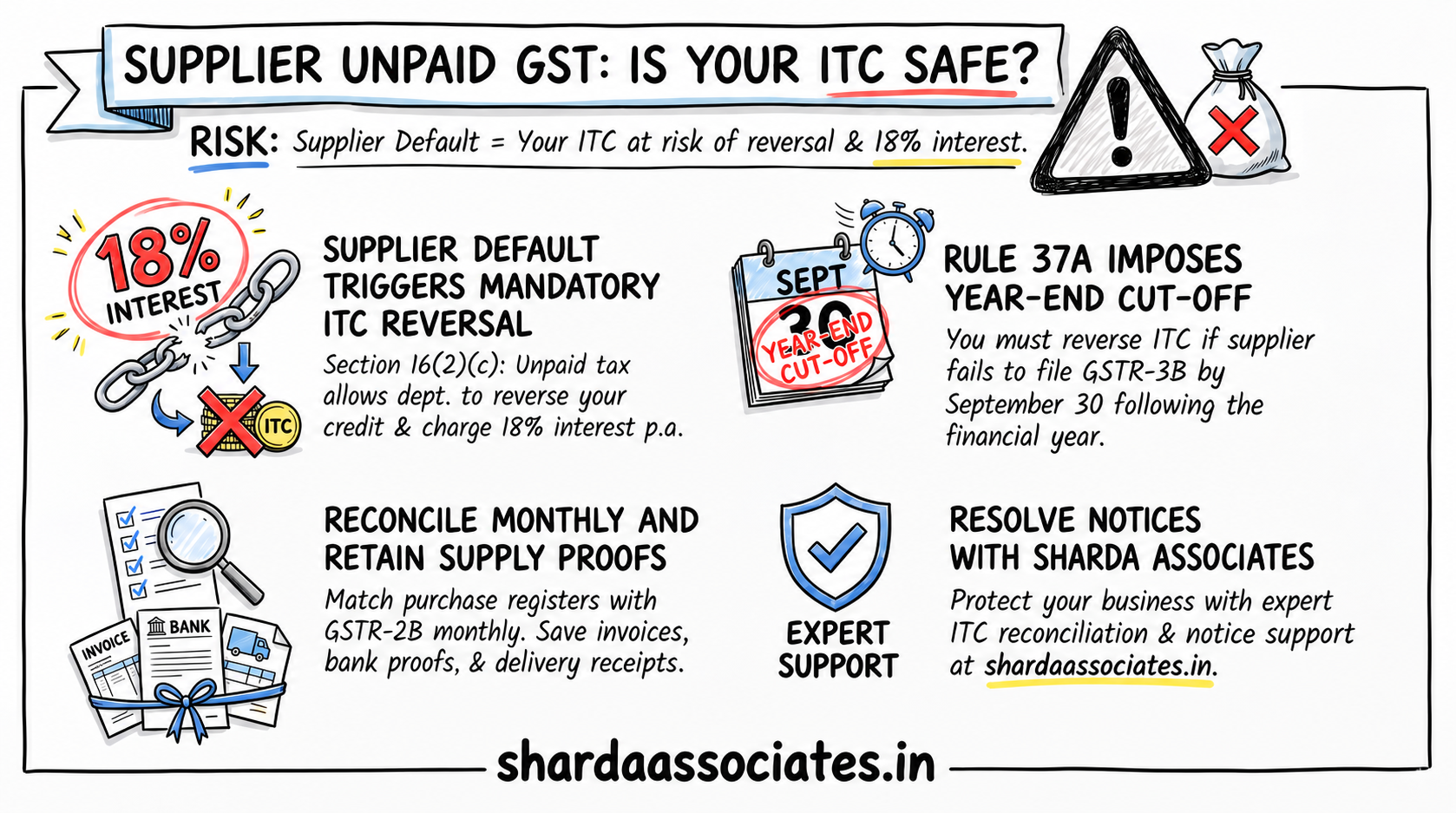
- ensure the tax charged has actually been paid to the government by the supplier, in cash or through ITC (Section 16(2)(c));
- file your return under Section 39; and
- claim the credit within the time limit under Section 16(4).
The condition in Section 16(2)(c) is where trouble starts. The department treats the supplier’s non-payment as a ground to deny or recover the credit from the buyer, because the government should not lose revenue at both ends of the chain.
Supplier Default vs. Your ITC: At a Glance
| Supplier scenario | Is your ITC safe? | Risk level and what to do |
| Supplier files GSTR-1 and GSTR-3B and pays the tax | Yes, invoice shows in your GSTR-2B | Low. Claim the credit and keep records |
| Supplier files GSTR-1 but not GSTR-3B | Shows in GSTR-2B, but tax is unpaid | Medium to high. Rule 37A reversal applies if the default continues past 30 September after the financial year |
| Supplier does not file GSTR-1 | No, invoice is missing from GSTR-2B | Do not claim. Ask the supplier to file or amend |
| Supplier is fake, non-existent or cancelled | Likely denied | High. Notice under Section 74 or 74A is possible; proof of genuine supply is critical |
| Supplier registration cancelled with retrospective effect | Department may deny the credit | Medium to high. Keep proof of payment and receipt of goods, and contest the demand |
What Can Happen to You as the Buyer?
1. Reversal of ITC. The officer may ask you to reverse the credit already claimed, along with an explanation of how it was utilised.
2. Interest. Interest under Section 50 applies on wrongly availed and utilised ITC, currently at 18% per annum. A higher rate applies in certain cases of excess claims.
3. Demand notice and penalty. The department may issue a show cause notice under Section 73 or 74 (or Section 74A for FY 2024-25 onwards). Penalties are much heavier where fraud, wilful misstatement or suppression is alleged.
4. Rule 37A reversal. Since the introduction of Rule 37A, if the supplier has not filed their GSTR-3B by 30 September following the end of the financial year, you may be required to reverse the corresponding ITC with interest. You can re-claim it once the supplier files and pays the tax.
5. Blocked ITC and cash flow impact. Mismatches in GSTR-2B can lead to scrutiny, blocked credit ledgers and delayed refunds.
Is It Fair? What Courts Have Said
The industry’s main argument is simple: a buyer cannot verify what a supplier deposits with the government. Several High Courts have held that a bona fide purchaser who has paid tax to the supplier and holds valid documents should not be penalized for the supplier’s default, and that the department should first proceed against the defaulting seller. Other courts have upheld the department’s right to deny credit where the statutory conditions are not met, and the burden of proving eligibility rests on the person claiming ITC (Section 155).
The law is not fully settled and outcomes depend heavily on facts. That is why documentation and diligence matter so much.
How to Protect Your Business
- Reconcile every month. Match your purchase register with GSTR-2B before claiming ITC and claim only what appears there.
- Verify your suppliers. Check GSTIN status, registration date, filing history and whether returns are filed regularly.
- Keep complete proof. Retain tax invoices, e-way bills, transport records, delivery receipts, bank payment proofs and contracts to show the transaction was genuine.
- Pay through banking channels. Avoid large cash payments and be cautious of unusually cheap pricing.
- Build contract safeguards. Include clauses requiring timely filing and payment of GST, indemnity for loss of ITC and the right to withhold the GST component if the supplier defaults.
- Follow up on mismatches. If an invoice is missing from GSTR-2B, ask the supplier to file or amend their GSTR-1 before you claim.
- Track Rule 37A. Review supplier filing status before the year-end cut-off and reverse proactively where needed.
What to Do If You Receive a Notice
- Do not ignore it; respond within the stipulated time.
- Collect proof of payment, receipt of goods and supplier details.
- Show that you acted in good faith and request that recovery be first initiated against the defaulting supplier.
- Raise the matter at the adjudication stage and, if needed, in appeal. Consider an informed decision on reversal with interest under protest to stop further interest.
Facing a supplier-default notice? Sharda Associates reviews your invoices, GSTR-2B data and supplier history, drafts the reply and represents you before the department. If you are planning a new venture, a loan or an expansion, we also prepare a project report that reflects your real GST, working capital and cash-flow position.
Conclusion
Claiming ITC on a valid invoice does not guarantee the credit is safe. If your supplier fails to pay GST, you may face reversal, interest and penalties, even though you did nothing wrong. Regular reconciliation, careful supplier selection and strong documentation are your best defence.
At Sharda Associates, we help businesses with GST reconciliation, ITC review, notice replies and litigation support, along with project report preparation for loans and business expansion. If you have received a notice or want to audit your ITC exposure, contact our team.
Contact Sharda Associates at +918989977769
Frequently Asked Questions (FAQs)
1. Can I claim ITC if my supplier has not paid GST?
You can claim it if the invoice appears in your GSTR-2B, but the credit is not safe. Under Section 16(2)(c), ITC depends on the supplier actually paying the tax, so the department can deny or reverse it later.
2. How do I check whether my supplier has paid GST?
Match the invoice with your GSTR-2B, then check the supplier’s return filing status on the GST portal using the Search Taxpayer option. For high-value purchases, ask for the supplier’s GSTR-3B copy and tax payment details.
3. What is Rule 37A of the CGST Rules?
Rule 37A requires you to reverse ITC if the supplier has not filed GSTR-3B by 30 September following the financial year. You can claim the credit again once the supplier files the return and pays the tax.
4. What interest applies if ITC is reversed?
Interest under Section 50 is generally 18% per annum on ITC wrongly availed and utilised. A higher rate of 24% applies in specific cases of undue or excess claims.
5. Can the department recover tax from me instead of the supplier?
Yes, the department can proceed against the buyer when the ITC conditions are not met. Several High Courts have held that a bona fide buyer with valid documents should not be penalised, and that action should first be taken against the defaulting supplier.
6. Can I claim ITC again after reversing it?
Yes, in many cases. If the supplier later files the return and pays the tax, you can re-avail the credit, subject to the time limit in Section 16(4) and the conditions of Rule 37A.
7. What should I do if I receive a GST notice for supplier non-payment?
Reply within the due date with invoices, proof of payment and receipt of goods. Request that recovery first be made from the defaulting supplier, and consult a GST professional such as Sharda Associates before filing the reply.
8. Which documents should I keep to protect my ITC claim?
Keep the tax invoice, e-way bill, transport and delivery records, bank payment proof, purchase order or contract, and a monthly GSTR-2B reconciliation. These documents show that the supply was genuine.