
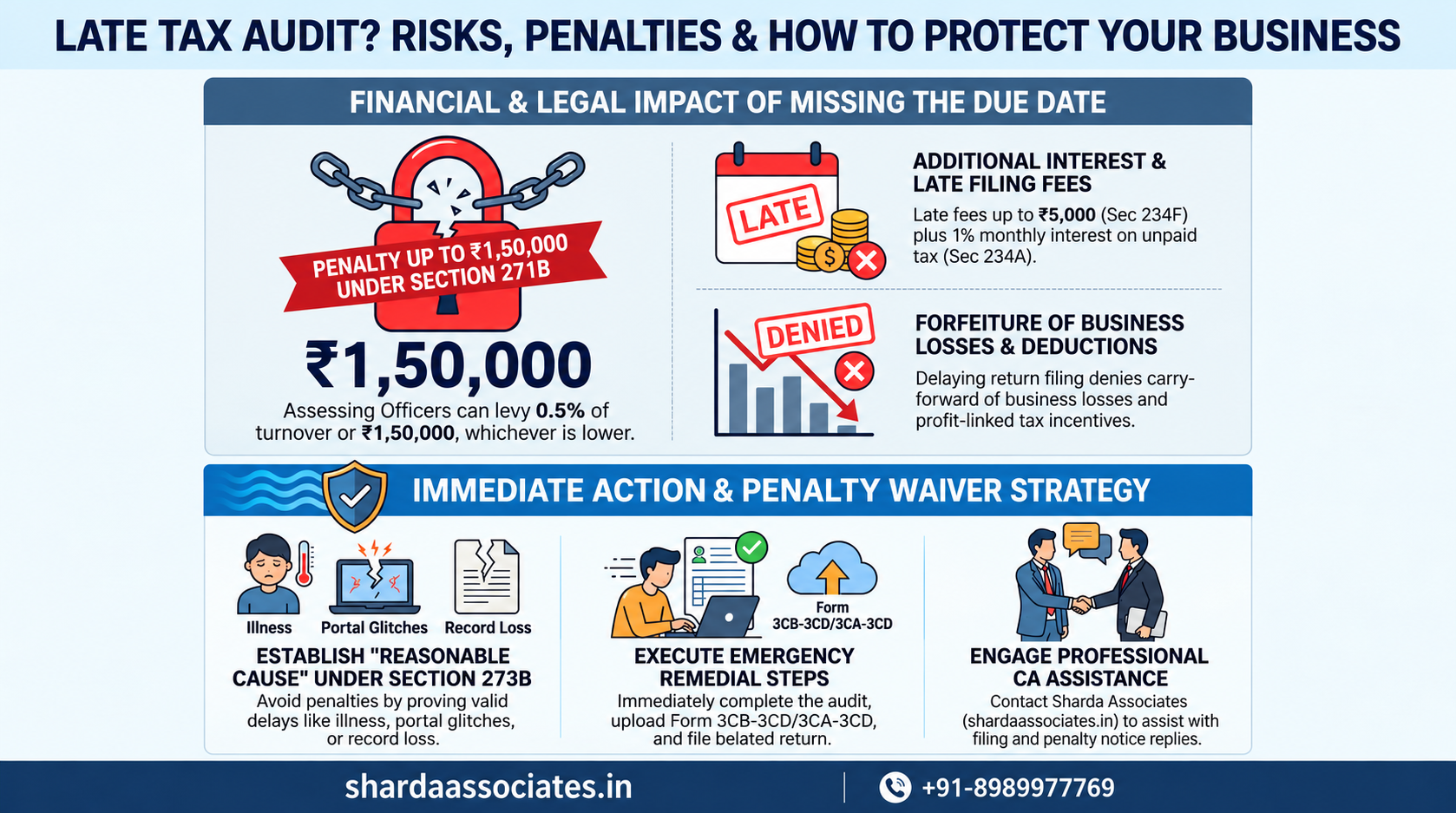
Quick answer: If your tax audit report is not filed by the due date, you can face a penalty under Section 271B of 0.5% of turnover or ₹150,000, whichever is lower. A delayed audit also delays your income tax return, which can lead to a late fee, interest and loss of carry-forward of business losses and certain deductions.
At Sharda Associates, our Chartered Accountants (CA) complete tax audits, file Form 3CB-3CD or 3CA-3CD, prepare income tax returns and reply to penalty notices for proprietors, firms, LLPs and companies, and also prepare CA-certified project reports for bank loans and business funding. If you have already missed the date, quick and correct action can reduce the damage.
What Is the Due Date for Tax Audit?
Under Section 44AB of the Income Tax Act, the tax audit report must generally be furnished by 30 September following the end of the financial year. The income tax return of an audit case is generally due by 31 October, and by 30 November where transfer pricing reporting applies. The government can extend these dates, so always check the latest notification.
Consequences of Missing the Tax Audit Due Date
- Penalty under Section 271B. The Assessing Officer can levy a penalty of 0.5% of total turnover or gross receipts, or ₹1,50,000, whichever is lower. The penalty is not automatic, because a notice and a chance to explain must be given.
- Delay in filing the return. The return of an audited taxpayer cannot be properly filed until the audit report is uploaded. A late audit therefore pushes the return past its due date.
- Late fee under Section 234F. A late return attracts a fee of up to ₹5,000, and ₹1,000 if total income is up to ₹5 lakh.
- Interest under Section 234A. Interest at 1% per month or part of a month applies on unpaid tax from the due date of the return until payment.
- Loss of carry-forward of losses. Business losses, other than house property loss, generally cannot be carried forward if the return is filed after the due date.
- Denial of certain deductions. Deductions under specified provisions, such as profit-linked incentives, can be denied for a late return under Section 80AC.
Consequences at a Glance
| Consequence | Provision | Impact |
| Penalty for missing audit | Section 271B | 0.5% of turnover or ₹1,50,000, whichever is lower |
| Late filing fee | Section 234F | Up to ₹5,000 (₹1,000 if income up to ₹5 lakh) |
| Interest on unpaid tax | Section 234A | 1% per month or part of a month |
| Loss carry-forward | Section 80 | Business loss may not be carried forward if the return is late |
| Certain deductions | Section 80AC | Specified deductions can be denied |
| Loan and credit review | Bank policy | Banks may delay or refuse loan proposals without audited accounts |
Can the Penalty Be Avoided?
Yes, in genuine cases. Section 273B says that no penalty applies if you show reasonable cause for the failure. Examples can include serious illness of the proprietor or auditor, loss of records due to fire or flood, technical problems on the portal, or a bona fide delay in getting information. Mere busy schedule or lack of funds is usually not accepted, so prepare a clear reply with supporting documents.
What to Do If You Have Missed the Due Date
- Appoint a CA immediately and complete the audit as fast as possible.
- Upload the audit report on the income tax portal and get the acknowledgement.
- File the belated return at the earliest, and generally before the last date for belated returns in the assessment year.
- Pay tax and interest to stop further interest from running.
- Keep proof of the reason for delay, in case you receive a penalty notice.
- Reply to the notice on time if the officer starts penalty proceedings.
How to Avoid Delay in Future
Start closing the books soon after 31 March, reconcile GST returns and bank statements every month and keep TDS and expense records organised. Share data with your CA by July or August, not at the last minute, so that the report is ready well before the due date.
Conclusion
Missing the tax audit due date can lead to penalty, late fee, interest and loss of important tax benefits. The penalty can be avoided only with a genuine reason supported by proof.
If the date has passed, finish the audit, upload the report and file the return immediately. A prompt response and a well-prepared reply to any notice can limit the impact.
For tax audit, belated return filing, penalty notice replies and CA-certified project reports, contact Sharda Associates at +91-8989977769.
Frequently Asked Questions (FAQs)
1. What is the penalty for not getting a tax audit done?
It is 0.5% of turnover or ₹1,50,000, whichever is lower, under Section 271B.
2. Is the penalty levied automatically?
No. The officer must issue a notice and consider your explanation before levying it.
3. Can I file a tax audit report after the due date?
Yes. You can still file it, though a penalty and late return consequences may apply.
4. Can I file my ITR without the audit report?
No. For an audit case, the report must be uploaded before the return is filed.
5. What is a reasonable cause for delay?
Examples are serious illness, natural disasters, loss of records or portal issues, supported by proof.
6. Will I lose my business loss if the return is late?
Generally yes, a business loss cannot be carried forward if the return is filed after the due date.
7. Does delay affect my bank loan?
It can, because banks usually need audited accounts and filed returns for loan assessment.
8. Until when can I file a belated return?
Generally until the date prescribed under Section 139(4), subject to the current law.