
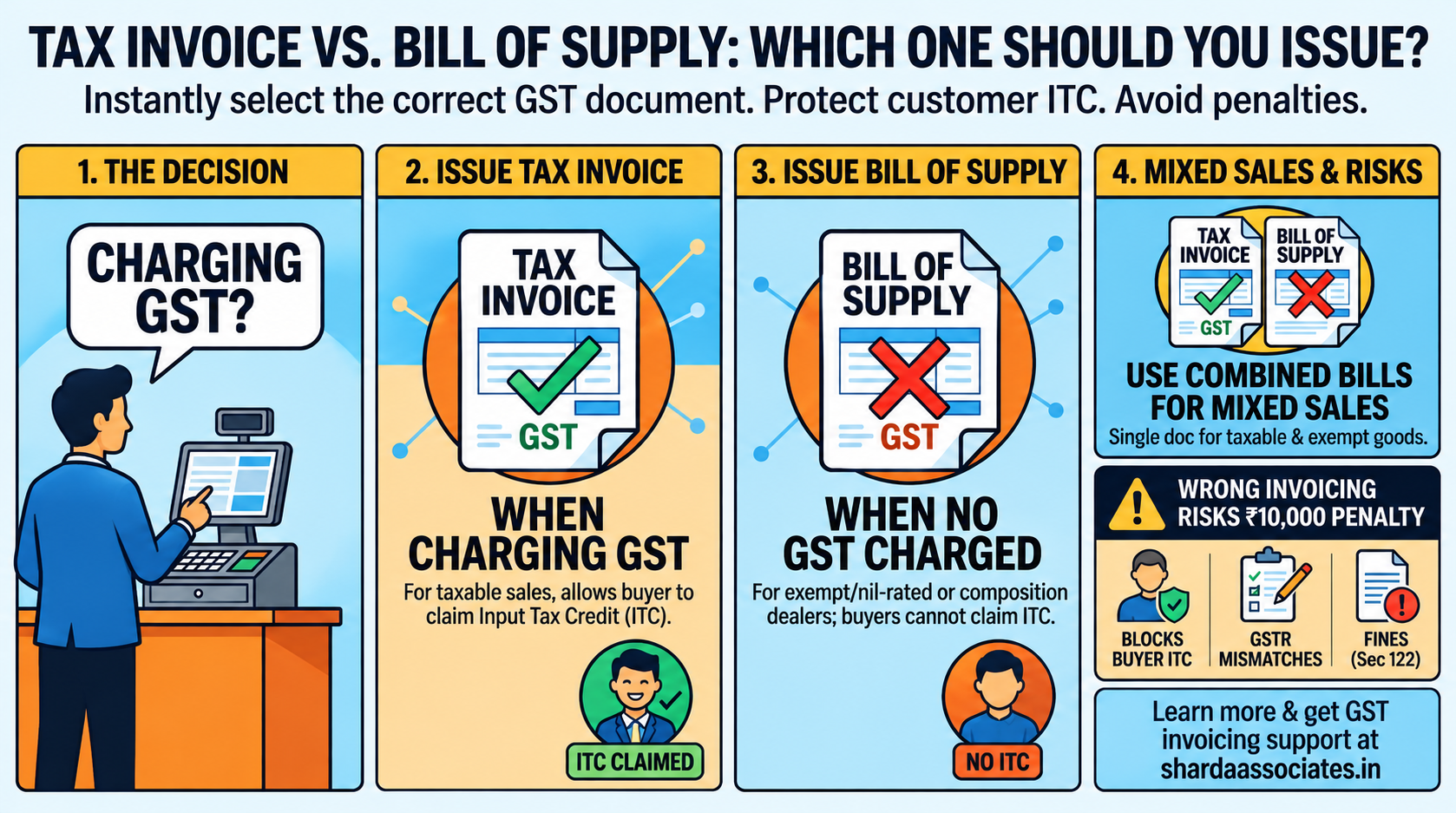
Short answer: Issue a tax invoice when you charge GST on a sale. Issue a bill of supply when you do not charge GST, which means you are a composition dealer or the goods or services are exempt or nil-rated. Your customer can claim input tax credit (ITC) only on a tax invoice, so choosing the wrong document can cost your buyer money and expose you to a penalty.
Key points
- Tax invoice: regular taxpayers selling taxable goods or services (Section 31(1) of the CGST Act).
- Bill of supply: composition dealers and exempt supplies (Section 31(3)(c)).
- Only a tax invoice gives the buyer ITC.
- Mixed sales can use one invoice-cum-bill of supply.
Find Your Business Type
| If you are… | Issue this |
| A regular trader, manufacturer or service provider selling taxable items | Tax invoice |
| A composition dealer | Bill of supply |
| A seller of exempt items (for example certain unprocessed foods) or nil-rated items | Bill of supply |
| A provider of exempt services, such as notified healthcare or education services | Bill of supply, or no invoice if you are not registered |
| A shop selling both taxable and exempt items in one bill | Invoice-cum-bill of supply |
| Receiving an advance for a service | Receipt voucher first, then invoice |
| Supplying to an unregistered buyer, bill value below ₹200 | Invoice optional if the buyer does not ask, with a consolidated invoice at day end |
What Is the Difference?
- GST on the document: shown on a tax invoice, not charged on a bill of supply.
- Buyer’s ITC: available on a tax invoice, never on a bill of supply.
- Tax rate and amount: must appear on a tax invoice; a bill of supply shows only the value.
- Who issues it: regular taxpayers issue tax invoices; composition dealers issue bills of supply.
- Special wording: a composition dealer must mark the bill “composition taxable person, not eligible to collect tax on supplies”.
What Should a Tax Invoice Contain?
- Your name, address and GSTIN
- A unique serial number and the date
- The buyer’s name, address and GSTIN, if the buyer is registered
- HSN or SAC code, description and quantity
- Taxable value, rate and amount of CGST and SGST, or IGST
- Place of supply and your signature
What Should a Bill of Supply Contain?
- Your name, address and GSTIN
- Serial number and date
- Description, quantity and value of goods or services
- Buyer’s details, where required
- Your signature
- The composition wording, if you are a composition dealer
When Must You Issue It?
- Goods: at or before removal, or at the time of delivery to the buyer.
- Services: within 30 days of supply, or 45 days for insurers, banks and certain financial companies.
- E-invoice: if your turnover is above the notified limit, you must report the invoice on the government portal. Check the current limit.
Real-Life Examples
- Mobile shop (regular dealer): every sale carries 18% GST, so a tax invoice is issued. The business customer claims ITC.
- Small trader under composition: collects no GST, so a bill of supply with the composition wording goes to every customer.
- Grocery store: sells packaged items that attract GST and loose items that are exempt. One invoice-cum-bill of supply handles the whole basket.
- Dairy supplying fresh milk: the supply is exempt, so a bill of supply is used.
Mistakes to Avoid
- A composition dealer collecting GST separately on a bill of supply. This is not allowed.
- A regular dealer issuing a bill of supply for a taxable sale, which blocks the buyer’s ITC.
- Leaving out the HSN or SAC code.
- Issuing service invoices after the 30-day window.
- Skipping serial numbers or repeating them.
What Is the Risk of Using the Wrong One?
- Penalty: under Section 122, failing to issue the correct invoice can attract a penalty of ₹10,000 or the amount of tax evaded, whichever is higher.
- Buyer’s loss: the customer loses ITC and may stop buying from you.
- Return mismatch: wrong documents cause mismatches between GSTR-1 and the buyer’s GSTR-2B.
Conclusion
Use one test every time: am I charging GST on this sale? If yes, issue a tax invoice with the rate and tax amount. If no, because you are a composition dealer or the supply is exempt, issue a bill of supply. For a mixed basket, one invoice-cum-bill of supply is enough.
Getting this right protects your customer’s ITC and keeps your returns clean. For GST invoicing, return filing and CA-prepared project reports for bank loans, call Sharda Associates on +91-8989977769.
Questions People Ask
Q1. Can a composition dealer issue a tax invoice? No. A bill of supply is the correct document.
Q2. Can my buyer claim ITC on a bill of supply? No. ITC needs a valid tax invoice.
Q3. When is a bill of supply used? For exempt or nil-rated supplies and by composition dealers.
Q4. Can one document cover taxable and exempt items? Yes, an invoice-cum-bill of supply.
Q5. Do I need an invoice for sales below ₹200? Not for unregistered buyers who do not ask, but a consolidated invoice is required at day end.
Q6. What is the time limit for service invoices? 30 days from supply, with longer time for some financial entities.
Q7. What is the penalty for not issuing an invoice? Generally ₹10,000 or the tax evaded, whichever is higher.
Q8. Is an e-invoice a different document? It is a tax invoice reported to the government portal, required above the notified turnover limit.