
Have you deducted TDS from a vendor, employee or professional payment but forgotten to deposit it with the government on time? A delay in depositing Tax Deducted at Source (TDS) can create an additional interest liability for your business. Even if the TDS amount has already been deducted from the recipient’s payment, it must be deposited within the prescribed due date.
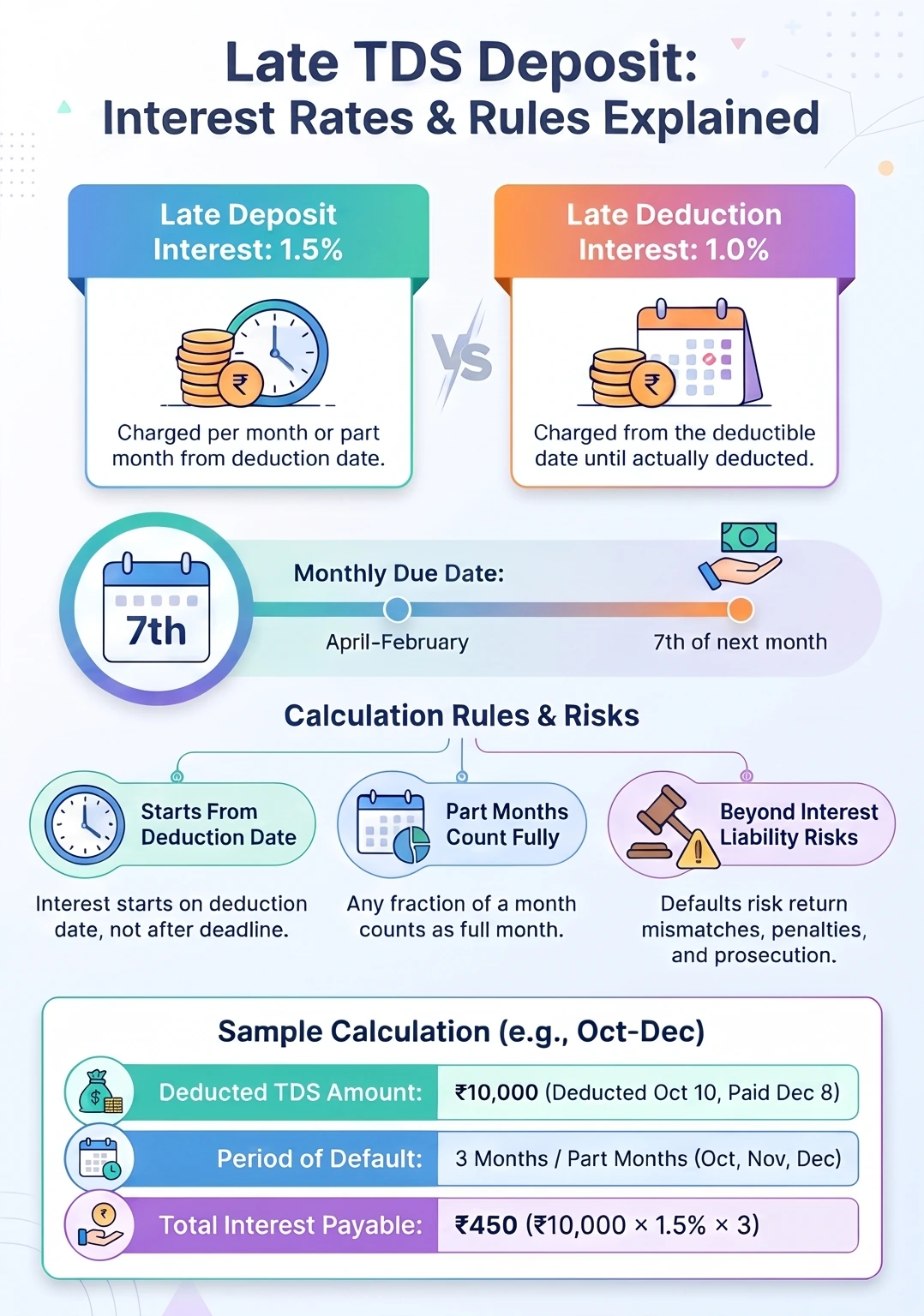
The interest on late TDS deposit is generally calculated at 1.5% per month or part of a month, starting from the date of deduction until the actual date of payment. This means that the interest period is not calculated only from the day after the deposit due date. The date on which TDS was originally deducted is also important.
Understanding the applicable interest rate, calculation method, and deposit deadline can help businesses correct delayed payments and avoid further compliance issues. Sharda Associates helps businesses with TDS calculations, interest verification, challan reconciliation, and tax compliance.
Quick Answer
If TDS has been deducted but deposited after the prescribed due date, interest is generally payable at 1.5% per month or part of a month on the TDS amount. The calculation period starts from the date on which TDS was deducted and ends on the date it is actually deposited with the government.
If TDS was not deducted when it was required, a separate interest provision generally applies at 1% per month or part of a month, from the date on which TDS was deductible until the date it is actually deducted.
For Tax Year 2026–27, these interest provisions are covered under Section 398(3)(a) of the Income-tax Act, 2025. The Income Tax Department has confirmed that the interest rates remain unchanged under the new act. For earlier tax periods, the applicable provisions of the Income-tax Act, 1961, must be considered.
What Is the Due Date for Depositing TDS?
The TDS deposit deadline depends on the nature of the payment and the applicable provision.
For most regular monthly TDS deductions, the general deposit deadlines are:
- TDS deducted during April to February: By the 7th day of the following month.
- TDS deducted during March: Generally by 30 April.
Certain transactions, including specified property and rent-related TDS payments, follow separate challan-cum-statement deadlines. Government deductors may also have different payment procedures depending on the circumstances.
For example, if a business deducts TDS on a professional fee payment during October, the general deposit deadline is 7 November. If the business deposits the amount after this deadline, interest may become payable.
Always verify the applicable due date for the particular TDS provision rather than assuming that every deduction follows the same schedule.
How Much Interest Is Charged on Late TDS Deposits?
The interest rate depends on the type of TDS default.
TDS Deducted but Deposited Late
When you have deducted TDS but failed to deposit it within the prescribed time, interest is generally charged at:
1.5% per month or part of a month
The calculation starts from the actual date of deduction and continues until the date of payment to the government.
TDS Not Deducted on Time
If you were required to deduct TDS but failed to deduct it, interest is generally charged at:
1% per month or part of a month
The period runs from the date on which TDS was deductible until the date on which it is actually deducted.
These are separate defaults. If TDS is first deducted late and is then also deposited late, both applicable interest calculations may need to be considered.
How to Calculate Interest on Late TDS Payment?
The calculation is based on the TDS amount, applicable interest rate and number of months or parts of months in default.
Example: TDS of ₹10,000 Deposited Late
Suppose a business deducts ₹10,000 as TDS on 10 October 2026 but deposits it on 8 December 2026.
For this illustration, the period covers three calendar months or parts of months: October, November, and December.
Interest calculation:
TDS amount = ₹10,000
Interest rate = 1.5% per month
Period of default = 3 months or parts of months
Interest = ₹10,000 × 1.5% × 3
Total interest payable = ₹450
Therefore, the business must deposit the original TDS of ₹10,000 along with the applicable interest of ₹450, subject to the final calculation on the relevant portal.
An important point is that the interest period begins from the date of deduction, not simply from the day after the TDS deposit due date.
What Happens If You Deposit TDS After the Due Date?
Late TDS payment can result in more than just an interest liability. Depending on the nature and duration of the default, additional consequences may arise.
Interest Liability
Interest is payable for the applicable period of delay. The amount increases with the TDS amount and the number of months or parts of months involved.
TDS Return and Challan Mismatch
If the payment is not properly reflected or linked to the relevant TDS statement, the business may face a tax credit or challan reconciliation issue.
Penalty
Depending on the default, penalty provisions may apply. Failure to deduct tax and failure to deposit tax already deducted are treated differently under the income tax law.
Prosecution Risk in Serious Cases
Failure to deposit TDS after deducting it can have serious consequences, including prosecution under the applicable provisions. The actual consequences depend on the facts, statutory conditions, and applicable exceptions.
Businesses should therefore avoid treating TDS as an ordinary payable that can be deposited whenever funds become available.
How to Pay TDS and Interest After a Delay
If you discover that TDS was deposited late, take the following steps:
Step 1: Identify the Delayed TDS Amount : Review your payment records, TDS deduction register and accounting entries to identify the amount deducted but not deposited.
Step 2: Check the Applicable Deposit Due Date : Identify the correct due date based on the type of TDS transaction and the applicable rules.
Step 3: Calculate Interest : Calculate interest at the applicable rate for every month or part of a month from the relevant starting date until actual payment.
Step 4: Make the Payment : Use the applicable Income Tax Department payment facility and select the correct payment category and relevant details. Verify the tax period and payment information before completing the transaction.
Step 5: Reconcile the Challan : After payment, verify the challan details and ensure that the amount is correctly reflected in the relevant TDS records.
Step 6: Check Your TDS Statement : Review the applicable quarterly TDS statement and confirm that the payment has been correctly reported and linked.
How Can Businesses Avoid Late TDS Deposit?
A proper TDS compliance process can prevent unnecessary interest and payment-related errors.
Businesses should:
- Maintain a monthly TDS deduction register.
- Track deposit deadlines for each applicable TDS section.
- Set reminders before the 7th of every month.
- Keep sufficient funds available for TDS payments.
- Reconcile TDS deductions with accounting records.
- Verify challan details before submitting payment.
- Review quarterly TDS statements for outstanding defaults.
- Assign responsibility for TDS compliance to a designated employee or professional.
Businesses making frequent payments to contractors, professionals, landlords and employees should maintain a structured TDS calendar rather than depending on manual reminders.
How Sharda Associates Helps With TDS Compliance
Late TDS deposits can create interest liabilities, challan mismatches and additional compliance work. Identifying the correct default and calculating the applicable interest is important before making the payment.
Sharda Associates provides TDS compliance and consultancy support, including:
- TDS deduction and payment review.
- Interest calculation on delayed TDS deposits.
- Verification of TDS challans.
- TDS return reconciliation.
- Identification of outstanding TDS defaults.
- Assistance with TDS compliance and tax records.
With proper review and timely compliance, businesses can reduce avoidable errors and maintain accurate tax records.
Conclusion
Depositing TDS after the prescribed due date can increase your business’s tax compliance cost through interest and other possible consequences. The applicable interest is generally 1.5% per month or part of a month when TDS has been deducted but deposited late,
While failure to deduct TDS can attract a separate 1% interest provision. Businesses should monitor deduction dates, deposit deadlines, and challan records to avoid repeated defaults. For assistance with TDS interest calculations, challan reconciliation, and tax compliance, consult Sharda Associates.
Frequently Asked Questions
1. What is the interest rate for late TDS deposits?
Interest is generally charged at 1.5% per month or part of a month when TDS has been deducted but deposited late.
2. From which date is interest calculated on late TDS payment?
Interest is calculated from the date on which TDS was deducted until the date on which it is actually deposited with the government.
3. What is the interest rate if TDS is not deducted on time?
Interest is generally charged at 1% per month or part of a month from the date on which TDS was deductible until the date of actual deduction.
4. Is interest payable if TDS is deposited one day late?
Yes. Since interest is calculated for a month or part of a month, even a partial month can be counted for interest calculation.
5. What is the normal due date for depositing monthly TDS?
For most regular monthly TDS deductions, the general deadline is the 7th day of the following month. TDS deducted during March is generally payable by 30 April. Certain transactions have separate deadlines.
6. Can I deposit TDS and interest together?
The applicable tax and interest can be paid through the prescribed payment process. Ensure that the correct payment categories and challan details are selected.
7. Does late TDS deposit affect the TDS return?
A delayed deposit can create a mismatch or outstanding demand if the challan is not correctly reflected in the TDS statement. Reconciliation is important after payment.