
Choosing the correct mutual fund begins with understanding what’s actually available, because “mutual fund” is an umbrella term that encompasses dozens of investment types tailored to very varied aims and risk appetites. Sharda Associates, a Bhopal-based CA-led financial consultancy, offers 45,500+ CA-certified reports delivered across India for an economical ₹2,999. This guide examines each main kind of mutual fund offered to Indian investors.
Key Takeaways
- Funds are categorized by asset class (equity, debt, hybrid) and structure (open/closed-ended, index, ELSS, solution-oriented).
- Equity funds are ideal for long-term growth, while debt funds are ideal for capital preservation. Hybrid funds combine both.
- ELSS provides tax deductions with a 3-year lock-in—the shortest among tax-saving tools.
- Passive (index) funds are less expensive than actively managed funds and merely track a baseline.
- Match the fund type with your investing horizon and risk tolerance, not merely past returns.
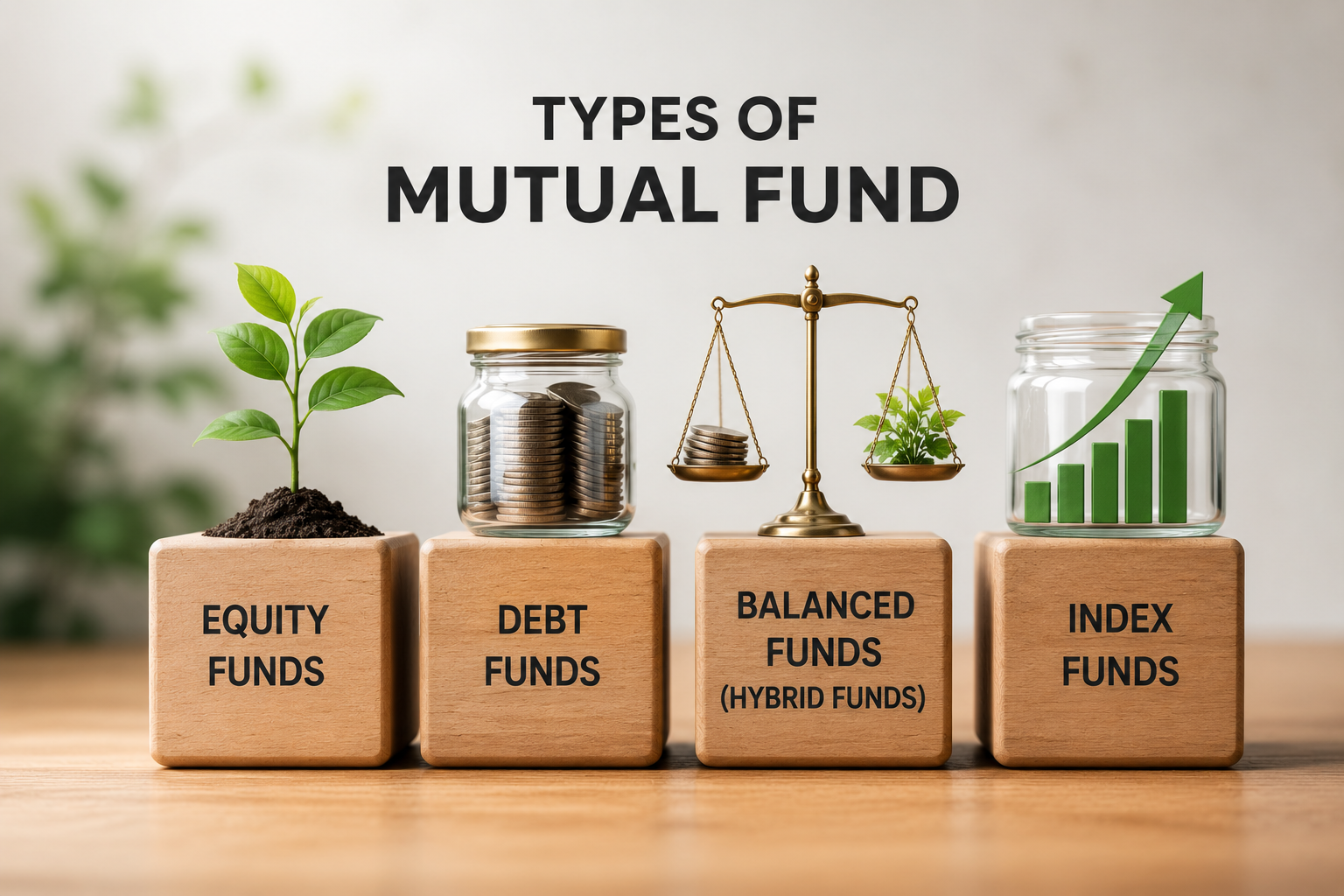
Mutual Funds Classified by Asset Class
The Securities and Exchange Board of India (SEBI) has standardized mutual fund categories based on whether the fund invests in equity, debt, or a combination of the two.
Equity funds invest primarily in stocks and are ideal for long-term wealth creation, albeit with a higher level of market risk. Subcategories include large-cap funds (investing in the top 100 companies by market capitalization); mid-cap and small-cap funds (higher growth potential, higher volatility); multi-cap and flexi-cap funds (diversified across market capitalizations); and sectoral or thematic funds (concentrated in specific industries such as banking, pharmaceuticals, or technology).
Debt funds invest in fixed-income securities such as government bonds, corporate bonds, and money market instruments. They are generally low-risk investments suitable for capital preservation or short-to-medium-term objectives. Subcategories include liquid funds, short-term funds, corporate bond funds, gilt funds, and dynamic bond funds.
Hybrid funds use stock and debt in variable quantities to achieve a balance between growth and stability. This category comprises aggressive hybrid funds (greater equity allocation), conservative hybrid funds (higher debt allocation), balanced advantage funds (dynamically adjusted allocation), and multi-asset allocation funds (equity, debt, gold, and other assets).
Within equities funds, investors should be mindful of dividend yield funds, which focus on firms with a continuous history of dividend payouts, and concentrated funds, which concentrate holdings in a small number of stocks (usually up to 30) for higher conviction bets. On the debt side, groups such as banking and PSU funds, credit risk funds, and floater funds all have distinct sensitivity to interest rate movements and credit quality, so two debt funds might behave very differently even if they are branded as “low risk” in relation to equity.
Mutual Funds Classified by Structure and Purpose
Beyond asset class, mutual funds also differ based on how they are structured and the investment goal they serve.
Fund Type | Structure/Purpose | Best Suited For |
Open-Ended Funds | Can be bought or sold any business day at prevailing NAV | Investors wanting liquidity and flexibility |
Close-Ended Funds | Fixed maturity period; units traded on exchanges | Investors comfortable with a locked tenure |
Interval Funds | Combination of open and close-ended; transactions allowed only during specified intervals | Niche investment strategies with limited liquidity windows |
Index Funds | Passively track a market index like Nifty 50 or Sensex | Low-cost, passive long-term investors |
ELSS (Tax-Saving Funds) | Equity-oriented with a 3-year lock-in, eligible for tax deduction under the old tax regime | Investors seeking equity growth with tax benefits |
Solution-Oriented Funds | Designed for specific goals like retirement or children’s education, with lock-in periods | Long-term goal-based investors |
Fund of Funds (FoFs) | Invest in units of other mutual funds rather than direct securities | Investors seeking diversification across fund managers or asset classes |
Solution-oriented funds, such as retirement and children’s plans, often have a five-year lock-in period or until the designated goal event, whichever occurs first, and are intended to deter premature withdrawal from long-term financial objectives.
Another fundamental factor to consider is the difference between actively managed and passively managed funds. Actively managed funds use a fund manager’s research and stock-picking selections to try to outperform a benchmark index and often have a higher cost ratio as a result. Passive funds, which include index funds and most ETFs, simply copy a specified index and have substantially lower fees, making them appealing to investors who prefer a low-cost, market-matching strategy over depending on manager outperformance. Neither technique is universally “better”; the proper choice is determined by the investor’s faith in active management within a certain market segment and their long-term cost sensitivity.
Choosing the Right Type Based on Risk and Horizon
Choosing a fund type is less about previous performance and more about aligning the fund’s risk profile to your investing horizon and financial goals. Someone investing for a three to five-year goal with a moderate risk tolerance may favor hybrid or short-duration debt funds, whereas someone with a ten-year or longer horizon and a higher risk appetite may prefer equity or index funds for compounding gains. Tax implications are also important—equity funds held for more than a year are subject to long-term capital gains tax at a different rate than debt funds, so the holding duration and category both affect post-tax returns.
It’s also critical to consider the cost ratio, fund manager track record, and portfolio concentration before investing, rather than choosing a fund based solely on recent short-term success, which can be misleading for long-term wealth planning.
Diversification between fund categories, rather than focusing everything in one type, is typically seen as a wise strategy for most retail investors. For example, a young investor with a long time horizon may allocate a bigger amount to equities and index funds while keeping a small percentage in liquid or short-term debt funds for emergencies, gradually increasing the balance toward debt as the goal date approaches. This type of glide path thinking eliminates the possibility of being forced to sell equity investments at a market low merely because the funds are required at a specific period.
Why Choose Sharda Associates
- CA-certified financial advisors specialize in investment planning, taxation, and compliance. They have supplied over 45,500 reports and financial documents across India.
- Our pricing is transparent and affordable, with typical project reports starting at ₹2,999
- Experienced staff assisting individuals and organizations to connect financial decisions with tax efficiency.
- End-to-end assistance, from documentation to advising, under one roof.
- Clients across sectors rely on us to provide accurate and compliant financial guidance.
Conclusion
Choosing the correct sort of mutual fund is critical for meeting your financial objectives while efficiently managing risk. Whether you invest in equities, debt, hybrid, index, or solution-oriented mutual funds, choosing assets that align with your investment horizon, risk tolerance, and financial goals can help you develop long-term wealth and stability.
Sharda Associates provides skilled financial planning, investment paperwork, tax planning, and CA-certified project reports to individuals and enterprises throughout India. Our skilled staff delivers over 45,500 successful reports and offers professional services empowering clients to make confident financial decisions. Call us at 8989977769 for specialized financial and investment advice.
Frequently Asked Questions
- What are the primary types of mutual funds in India?
The four basic types are equity funds, debt funds, hybrid funds, and solution-oriented funds, which are further classed by structure as open-ended, closed-ended, or index funds.
- What form of mutual fund is appropriate for beginners?
Large-cap or index funds are frequently regarded as good beginning points since they have lower volatility than mid-cap or sectoral funds.
- What is the distinction between open and closed-ended funds?
Open-ended funds can be bought and sold on any business day, but closed-ended funds have a predetermined maturity date and are traded on stock exchanges.
- Are ELSS funds superior to other tax-saving instruments?
ELSS funds, unlike other tax-saving choices, provide market-linked returns with a shorter three-year lock-in period, but they are subject to stock market risk.
- What is a hybrid mutual fund?
A hybrid fund invests in a combination of equities and debt securities to strike a balance between growth potential and relative stability.
- How are debt and equity funds taxed differently?
Debt funds and equity funds are taxed differently depending on the holding duration and applicable capital gains regulations, so examine current tax provisions before investing.
- What is a Fund of Funds (FoF)?
A fund of funds invests in units of other mutual funds rather than stocks or bonds, providing diversity among fund managers and asset classes.
- Are SIPs available for all types of mutual funds?
Most open-ended mutual funds, including equity, debt, and hybrid categories, accept Systematic Investment Plans (SIPs).
- How do I choose which form of mutual fund is best for my goals?
The decision is based on your investment horizon, risk tolerance, and financial objectives; professional advice can help you match the fund type to your specific situation.