
Dubai, the commercial heart of the UAE, is known for its thriving business environment and attractive economic policies. For businesses in Dubai, it is essential to understand the regulations surrounding Value Added Tax (VAT), particularly with the mandatory registration requirements for certain businesses. This guide will walk you through the VAT registration process in Dubai, its eligibility criteria, the required documents, and the compliance procedures to ensure your business operates smoothly and remains in line with the law
What is VAT in the UAE?
Value Added Tax (VAT) is an indirect tax imposed on most goods and services sold for consumption in the UAE. Introduced on January 1, 2018, the standard VAT rate in the UAE is 5%. VAT is a consumption tax collected at every stage of the supply chain, with businesses collecting the tax on behalf of the government.
Businesses that are registered for VAT can reclaim the VAT they pay on business-related goods and services, making it crucial to understand and comply with the VAT regulations to ensure a smooth operation.
Who Needs to Register for VAT in Dubai?
Mandatory VAT Registration
According to the UAE Federal Tax Authority (FTA), VAT registration becomes mandatory for businesses in Dubai under the following conditions:
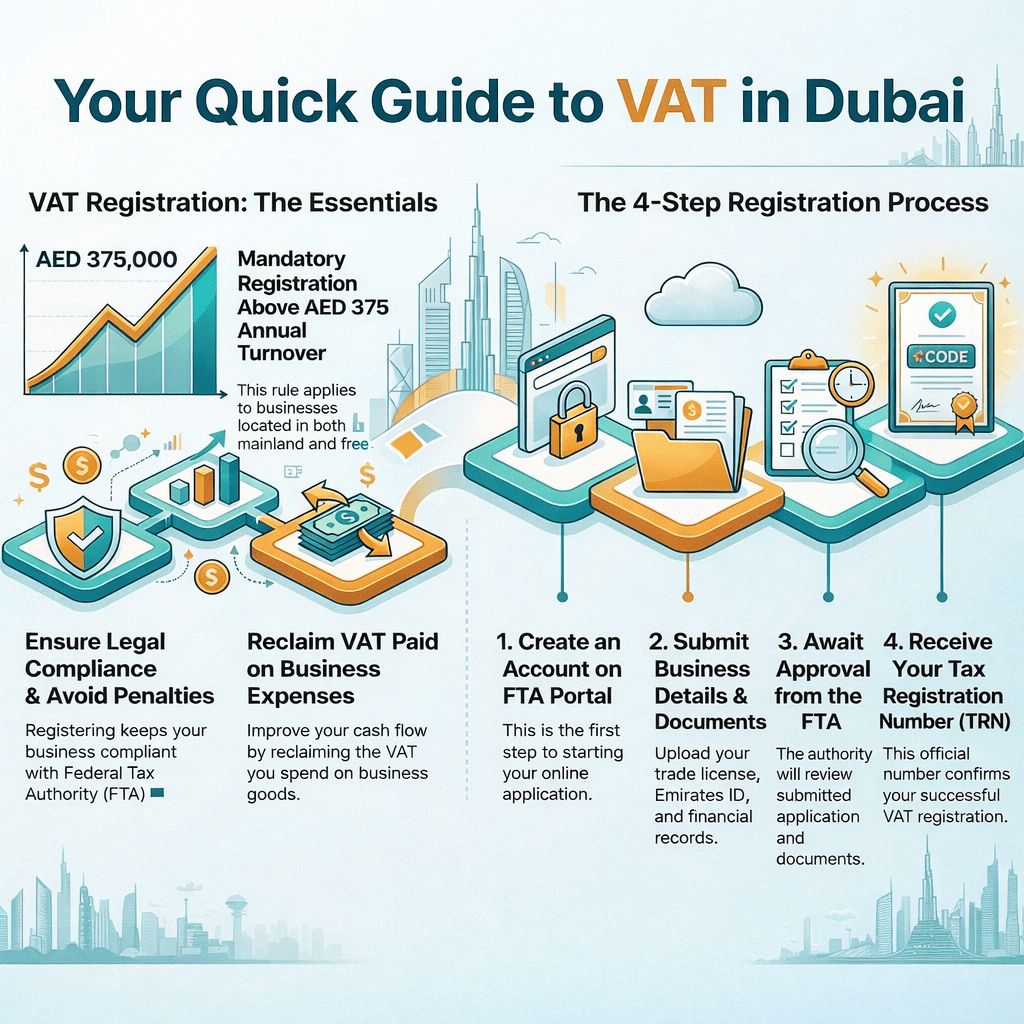
- Annual taxable turnover exceeds AED 375,000: If your business’s annual taxable turnover exceeds this amount, registration for VAT is required. This applies to both mainland and free zone businesses.
- Importing goods into Dubai: Businesses involved in the import of goods into the UAE, regardless of turnover, must register for VAT.
Once VAT registered, businesses must submit regular VAT returns to the FTA and charge VAT on taxable sales.
Voluntary VAT Registration
Businesses whose taxable turnover does not exceed AED 375,000 but is above AED 187,500 may still voluntarily register for VAT. While not required by law, voluntary registration can be beneficial, especially for businesses that incur VAT on expenses, as it allows them to reclaim the tax paid.
Do Free Zone Companies Need VAT Registration?
Yes, businesses in Dubai’s Free Zones (such as DMCC, DIFC, JAFZA, DAFZA, etc.) must also register for VAT if they meet the turnover threshold. Free zone businesses may be eligible for certain tax benefits, but VAT registration is mandatory if their taxable turnover exceeds AED 375,000 or if they are engaged in activities like importing goods into the UAE.
Step-by-Step Process for VAT Registration in Dubai
Step 1: Create an Account on the FTA Portal
The first step in the VAT registration process is to create an account on the Federal Tax Authority (FTA) portal. To do this, visit the FTA’s official website and click on the “e-Services.” section. Choose “Tax Registration” and complete the registration process using a valid business email address.
Once you have created an account, log in to access the VAT registration application form.
Step 2: Complete the VAT Registration Application
The next step is to fill out the VAT registration form on the FTA portal. Here, you will need to provide comprehensive details about your business, including:
- Business trade name
- License number
- Economic activity (the nature of your business)
- Business address
- Contact details
- Legal structure of your business (e.g., LLC, sole proprietorship, etc.)
The application also requires the submission of projected annual taxable turnover and the value of taxable supplies made in the previous 12 months.
Step 3: Upload Required Documents
As part of the VAT registration process, businesses need to upload several supporting documents to verify their identity and registration details. These documents include:
- A copy of the trade license (issued by the Department of Economic Development in Dubai, or a free zone authority)
- A copy of the Emirates ID and passport of the business owner(s) or partners
- A bank statement for the last three months
- Proof of business address (lease agreement or utility bill)
- Memorandum of Association (MOA) or Articles of Association (AOA) of the company
- Estimated turnover details
Be sure to provide accurate and up-to-date documents, as incorrect or incomplete submissions can delay the registration process.
Step 4: Review and Submit the Application
Once you have completed the form and uploaded the necessary documents, review all the information carefully. Any mistakes or discrepancies in the information provided could result in delays or rejection of your application. When you’re confident that everything is accurate, submit the application.
Step 5: Receive VAT TRN
After successful submission of your application, the FTA will process it and, upon approval, issue your Tax Registration Number (TRN). This process typically takes between 5-10 working days. Once you receive your TRN, your business will be officially VAT-registered, and you must begin charging VAT on all taxable transactions.
Documents Required for VAT Registration in Dubai
Here is a list of the essential documents that need to be uploaded during the VAT registration process in Dubai:
- A copy of the trade license
- Passport and Emirates ID of the business owners/partners
- Bank account details
- Lease agreement or proof of business address
- Memorandum of Association (MOA) or Articles of Association (AOA)
- Turnover statement for the last 12 months or projected turnover
- Other supporting documents as requested by the FTA
VAT Compliance After Registration
After obtaining your VAT registration number, it’s important to maintain compliance with the VAT regulations set out by the FTA. Below are the key compliance requirements for businesses:
- Issue VAT-compliant invoices: All VAT-registered businesses must issue invoices showing the VAT charged on goods and services. These invoices must include the VAT rate and the business’s VAT registration number (TRN).
- File VAT returns on time: VAT returns must be filed on a quarterly basis. Businesses need to submit their VAT returns to the FTA by the due date to avoid penalties.
- Maintain accurate accounting records: Businesses must maintain proper books of accounts and records to show the VAT collected and paid. These records should be readily accessible for FTA inspection if required.
- Pay VAT dues on time: Ensure that VAT payments are made within the deadlines specified by the FTA to avoid penalties or interest charges.
VAT Return Filing Frequency in Dubai
Businesses in Dubai generally file VAT returns on a quarterly basis. However, some businesses may be required to file on a monthly basis if they have high turnover or other specific criteria set by the FTA. VAT returns must be submitted within 28 days after the end of each tax period.
Penalties for Late VAT Registration in Dubai
Failing to register for VAT on time or submitting returns late can result in penalties. The FTA imposes financial penalties for:
- Late registration: Penalties for failing to register within the required timeframe.
- Late payment: Penalties for not paying VAT on time.
- Incorrect VAT filings: Fines for submitting inaccurate or incomplete returns.
Therefore, it is critical to ensure that VAT registration is completed on time and that all subsequent returns are filed accurately and punctually.
Why Hire a VAT Consultant in Dubai?
Many businesses find VAT registration and compliance challenging, especially those who are new to the UAE market. Hiring a VAT consultant in Dubai can be highly beneficial, especially for businesses unfamiliar with local tax laws. A VAT consultant can help you:
- Ensure accurate VAT registration: Prevent errors in your application that could delay registration.
- Complete VAT return filings: Submit error-free and timely VAT returns.
- Reclaim VAT: Maximize your input VAT recovery.
- Avoid penalties: Stay in compliance with VAT rules and regulations, reducing the risk of fines.
Conclusion
VAT registration in Dubai is a vital part of operating a business in the UAE. By understanding the process, meeting the eligibility criteria, and adhering to the FTA’s regulations, businesses can stay compliant and avoid penalties. Whether you’re operating a startup, SME, or large enterprise, it’s crucial to ensure that your business is registered and compliant with VAT laws to facilitate growth and smooth operations in Dubai.
Hiring a VAT consultant can be a wise investment to navigate the complexities of VAT registration and compliance, allowing business owners to focus on growing their companies.
You can contact us at +91 8989977769 for any query or if you require our services to prepare a project report or a bank loan.
Frequently Asked Questions
- Is VAT registration mandatory for all Dubai businesses?
No. VAT registration is mandatory only if taxable turnover exceeds AED 375,000 annually
2. How long does VAT registration take in Dubai?
Typically, it takes 5-10 working days to receive your TRN after submitting your application.
3. Can startups apply for VAT registration in Dubai?
Yes. Startups can apply for VAT registration if they meet the turnover requirements, or they can apply voluntarily if their turnover exceeds AED 187,500.
4. What documents are needed for VAT registration in Dubai?
Key documents include your trade license, Emirates ID, passport copies, bank statement, and turnover details.