
How Sharda Associates Helps You
Sharda Associates helps businesses, startups, MSMEs, and individuals prepare the financial and business documents required for smooth bank loan processing and secured financing procedures. Our expert team provides assistance with project reports, CMA reports, DPR preparation, feasibility reports, TEV reports, GST registration, MSME registration, subsidy guidance, startup consultancy, and banking documentation support.
We help clients organize accurate financial records, prepare professional loan documentation, and improve their readiness for bank approvals and secured lending requirements. Our consultancy services simplify complex financial processes and help businesses maintain proper compliance for long-term growth and successful financing operations.
Introduction
CERSAI has emerged as one of the most essential financial compliance systems in India’s banking and lending sectors. Financial institutions, NBFCs, cooperative banks, home finance firms, and secured lenders are now needed.
In 2026, the CERSAI framework will be more digital, transparent, and compliance-oriented. The government and financial regulators have improved monitoring systems to eliminate fraudulent multiple financing, protect lenders’ interests, and increase transparency in secured transactions across the country.
Every secured lending institution is required to register and report using the centralized registry process. Failure to comply may result in legal problems, debt recovery issues, regulatory penalties, and financial hazards.
This tutorial discusses the entire structure of CERSAI, including its definition, registration process, legal framework, benefits, documentation, compliance criteria, penalties, and most recent modifications in 2026.
Understanding CERSAI
The acronym CERSAI stands for Central Registry of Securitization Asset Reconstruction and Security Interests of India. It is a government-authorized online registry that keeps track of secured financial transactions and charges made on assets.
The system was implemented to avoid fraudulent activity involving several loans on the same property or asset from various lenders. Before this consolidated platform was implemented, borrowers could utilize the same collateral to secure loans from numerous institutions without being detected.
The registry enables banks and lenders to determine whether an asset has previously been mortgaged or used as security. This increases openness, reduces fraud risk, and strengthens the entire financial ecosystem.
Legal Structure and Regulatory Framework
The SARFAESI Act of 2002 governs the unified system for registering security interests. The legal framework was created to increase asset recovery methods and secure lending practices in India.
These regulations oblige banks and financial institutions to register details of security interests created in behalf of lenders. This covers mortgages, hypothecations, movable assets, and other types of secured financial transactions.
The legal structure specifies how secured transactions should be recorded, monitored, changed, and settled after obligations are met. It also creates procedures for lenders to verify prior encumbrances before making loans.
By 2026, the compliance framework will be more technologically advanced, with improved digital file systems, automated verification procedures, and better data interaction among financial institutions.
Significance of CERSAI Registration
Registration with the central registry system is critical for financial institutions and borrowers. It gives legal proof of the existence of a security interest in a specific asset.
For lenders, registration provides greater security against fraud and unauthorized duplicate lending. It also improves legal rights in loan collection and enforcement proceedings.
For borrowers, proper registration enhances trust and transparency in secured financial transactions. It also reduces future conflicts over ownership and financing claims.
Without proper registration, lenders may face difficulty in recovery processes and conflicts over priority rights to collateral assets.
Security Interests Registered
The registry system in India records many types of secured financial transactions. These assets, both mobile and immovable, are utilized as loan collateral.
Common security concerns include:
- Mortgage for residential or commercial property.
- Hypothecation of moveable assets
- Vehicle financing fees
- Machinery and equipment finance
- MSME business asset charges.
- Inventory and stock finance.
- Loan Security on Receivables
- Agricultural asset financing.
- Infrastructure project finance
These records enable lenders to do due diligence before approving new credit facilities.
Updated CERSAI Compliance Framework in 2026.
In 2026, numerous key improvements increased India’s compliance and reporting system for secured transactions.
One significant advancement is the proliferation of digital verification systems, which enable speedier filing, tracking, and updating of charge-related documents. This has resulted in less paperwork and increased operational efficiency for lenders.
Authorities have also improved the integration of banks, NBFCs, land records, and financial systems to increase fraud detection and verification processes.
The unified system currently promotes greater transparency in asset-based lending, housing finance, and commercial secured loans. Real-time verification systems have also helped lenders manage risk more effectively.
Compliance deadlines were tightened, and financial institutions are expected to file charges soon following loan distribution.
Registration Procedure for Security Interest
The procedure of recording a security interest consists of several stages that must be carefully executed in order to avoid legal or compliance difficulties.
The general process includes:
- Loan approval and the signing of security documents
- Create a mortgage or charge over the asset.
- Collection of borrower and collateral information
- Digital filing via the unified registry portal.
- verification and confirmation of records
- generation of registration acknowledgment
- Updating records in the event of alteration or closure
Financial institutions often complete the filing process within the timeframe specified after the establishment of the security interest.
Accurate paperwork is critical since erroneous information can cause issues during future legal processes or loan recovery activities.
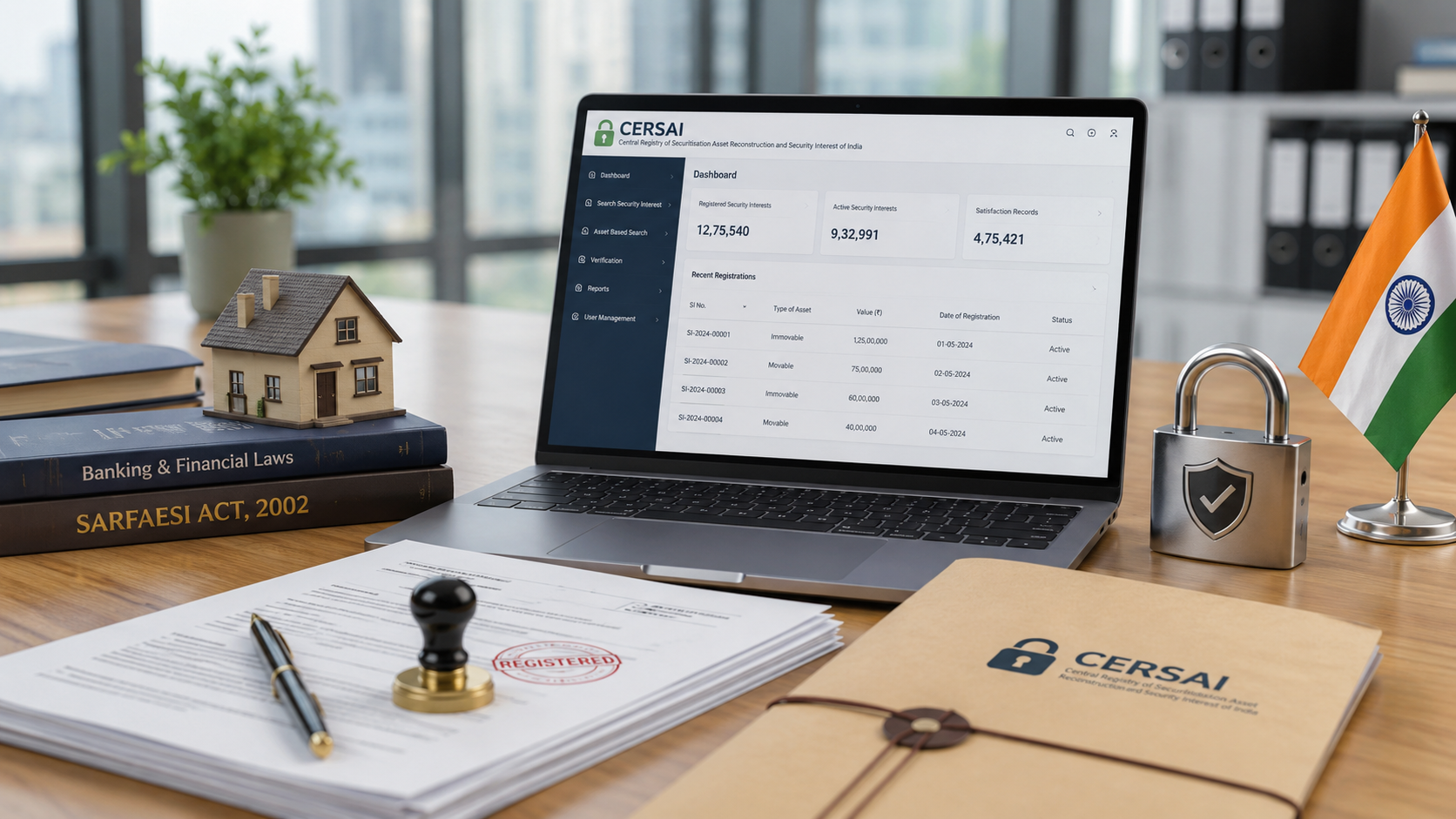
Documents required for registration.
Several documents are often required when establishing and documenting security interests through the centralized system.
Commonly needed documents include:
- Borrower’s identity evidence
- Address Proof
- PAN card details
- Loan Agreement
- Mortgage Deed
- Asset ownership documentation
- Property papers
- Charge Creation Documents
- Bank sanction letter
- Business incorporation paperwork
- Asset value records.
Additional documentation may differ depending on the asset, loan type, and lender requirements.
Role of Banks and Financial Institutions
Banks and lending institutions are primarily responsible for ensuring compliance with secured transaction laws. They are in charge of prompt registration, record management, and updating information when changes occur.
Financial organizations also perform due diligence to confirm existing costs before authorizing new loans. This helps to avoid repeated financing and protects lenders’ interests.
The unified registration system has increased openness in India’s banking sector by eliminating hidden encumbrances and unscrupulous lending practices.
By 2026, digital banking integration has reduced the verification and filing process for lenders.
Get Business Loan Advisory Services.
Benefits of Centralized Registry System
The consolidated secured transaction registry provides various benefits to lenders, borrowers, and financial regulators.
Major advantages include:
- Preventing multiple financial fraud
- Better transparency in lending
- Improved loan recovery processes.
- Enhanced legal protection for lenders
- Faster verification of collateral status.
- Reduced financial disputes.
- Increased trust in secured transactions.
- improved monitoring of financial assets
- Improved financial system efficiency.
These benefits have made the register system an indispensable part of India’s modern financial infrastructure.
Compliance Risks and Common Mistakes
Many institutions experience compliance challenges as a result of faulty filing procedures or registration delays.
Common mistakes include:
- Incorrect Borrower Information
- Delayed fee registration
- Incomplete asset details.
- Mistakes in property descriptions
- Failure to update modified records.
- Non-closure of satisfied charges.
- Documentation mismatches
Such errors may jeopardize legal rights during recovery actions and raise regulatory concerns.
Proper compliance management and professional advice enable organizations to efficiently avoid these dangers.
Penalties and legal consequences.
Failure to comply with the secure transaction registration requirements can result in serious legal and financial penalties.
Possible penalties include:
- Regulatory penalties
- Recovery difficulties.
- Priority disputes between lenders
- Legal enforcement challenges
- Increased legal risks
- Operational compliance issues
- Financial losses from invalid claims
In serious circumstances, lenders may lose enforcement precedence over collateral assets if charges are not properly registered within the required time frame.
As a result, all financial institutions and secured lenders must file their documents accurately and on time.
Why is CERSAI important for businesses?
The unified security registry system is extremely advantageous to firms seeking secure financing from banks and financial institutions.
It establishes a transparent lending ecosystem in which assets may be thoroughly vetted prior to funding approvals. This boosts lender confidence and enhances access to loan facilities.
Businesses with good financial documentation and transparent charge registration typically have smoother loan approvals and greater trust during funding conversations.
The approach also promotes financial discipline and avoids conflicts over asset ownership or loan commitments.
How To Maintain Proper Compliance
Organizations can ensure proper secured transaction compliance by taking a methodical approach.
Important compliance practices are:
- Maintaining correct loan documentation.
- Charges must be filed within the appropriate timelines.
- Updating records immediately after modifications
- Conducting regular compliance reviews.
- Checking asset ownership carefully
- Maintaining digital transaction records.
- Coordinating effectively with lenders and legal teams.
Periodic internal audits also assist organizations in identifying compliance weaknesses before they become big legal difficulties.
The Government’s Role in Secured Loan Regulation
The government plays a significant role in improving India’s lending climate through regulatory reforms and digital monitoring systems.
Authorities are constantly improving transparency, fraud prevention procedures, and financial compliance frameworks to safeguard both lenders and borrowers.
Recent digital transformation initiatives have considerably enhanced financial institutions’ data accuracy, operational efficiency, and monitoring capacities.
The government’s emphasis on open lending standards has boosted confidence in India’s banking and financing system.
Conclusion
CERSAI has become a critical component of India’s financial and secured lending system. It increases transparency, lowers fraud risks, and strengthens legal protections for lenders involved in secured transactions.
With improved compliance measures in place by 2026, the system will be more digital, efficient, and enforcement-oriented. From secured loan registration and charge filing to verification and compliance monitoring, each stage is crucial to preserving financial interests.
Businesses, banks, NBFCs, and financial institutions who adhere to rigorous compliance gain from more efficient financing operations, stronger legal security, and more credibility.
In today’s current financial world, secure transaction compliance is not only a legal obligation, but also a key factor in long-term financial stability and business expansion.
About Us
Sharda Associates is one of India’s leading financial and business consultancy firms, providing professional services in project reports, CMA reports, loan documentation, financial compliance, taxation, MSME registration, startup consultancy, subsidy assistance, and banking advisory solutions.
Our specialist consultants provide entire financial paperwork and regulatory support to startups, enterprises, MSMEs, manufacturers, traders, and service providers, ensuring easy loan processing and compliance management.
We prioritize accuracy, transparency, professional counsel, and prompt service delivery to assist businesses in achieving financial development and operational success while remaining compliant with current government standards.
Call: +91 79870 21896 WhatsApp: +91 89899 77769
Frequently Asked Questions
- What is CERSAI, and why does it matter in India?
CERSAI is a centralized registration system that keeps track of secured financial transactions and loan-related expenses in order to reduce fraud, increase transparency, and protect lenders from various financing risks using the same collateral assets.
- Who is needed to file security interests with CERSAI?
Banks, NBFCs, cooperative banks, housing finance companies, and other secured lenders are required to register charges and security interests generated against movable or immovable assets during secured loan transactions.
- What assets can be registered using the centralized registry system?
Residential properties, commercial assets, machinery, automobiles, inventory, movable assets, agricultural property, receivables, and business-related collateral used for secured financing can all be recorded using the system.
- Why is secure transaction registration required for lenders?
Registration provides legal protection for lenders by establishing priority rights over collateral assets and lowering the risks associated with fraudulent multiple loans against the same property or company assets.
- Which documents are often necessary for charge registration?
Loan agreements, borrower identity verification, mortgage deeds, ownership papers, sanction letters, business incorporation documents, property information, and collateral-related financial data are typically required for registration.
- Can borrowers determine if an asset already has a registered charge?
Yes, borrowers and financial institutions can do approved searches to identify whether an asset has previously been pledged or mortgaged for funding.
- What happens when security interests are not properly registered?
Failure to register charges can result in legal issues, recovery complications, regulatory penalties, and loss of priority rights in enforcement or asset recovery proceedings involving secured loans.
- How does the centralized registry help to decrease financial fraud?
The system stops borrowers from acquiring numerous loans against the same collateral asset by keeping transparent records that are accessible to all financial institutions and authorized bodies in India.