
GSTR-2 is a GST return that reports inward supplies (purchases) made by a registered taxpayer during a tax period. It was designed to record information about goods and services acquired from registered suppliers and assist Input Tax Credit (ITC) matching under the GST system. Although GSTR-2 filing is presently suspended, understanding its function is still necessary for GST compliance and ITC ideas.
Sharda Associates offers professional GST compliance, return filing, GST consultation, and taxation services to businesses throughout India. Our professionals assist taxpayers in successfully managing their GST responsibilities and maintaining accurate compliance records.
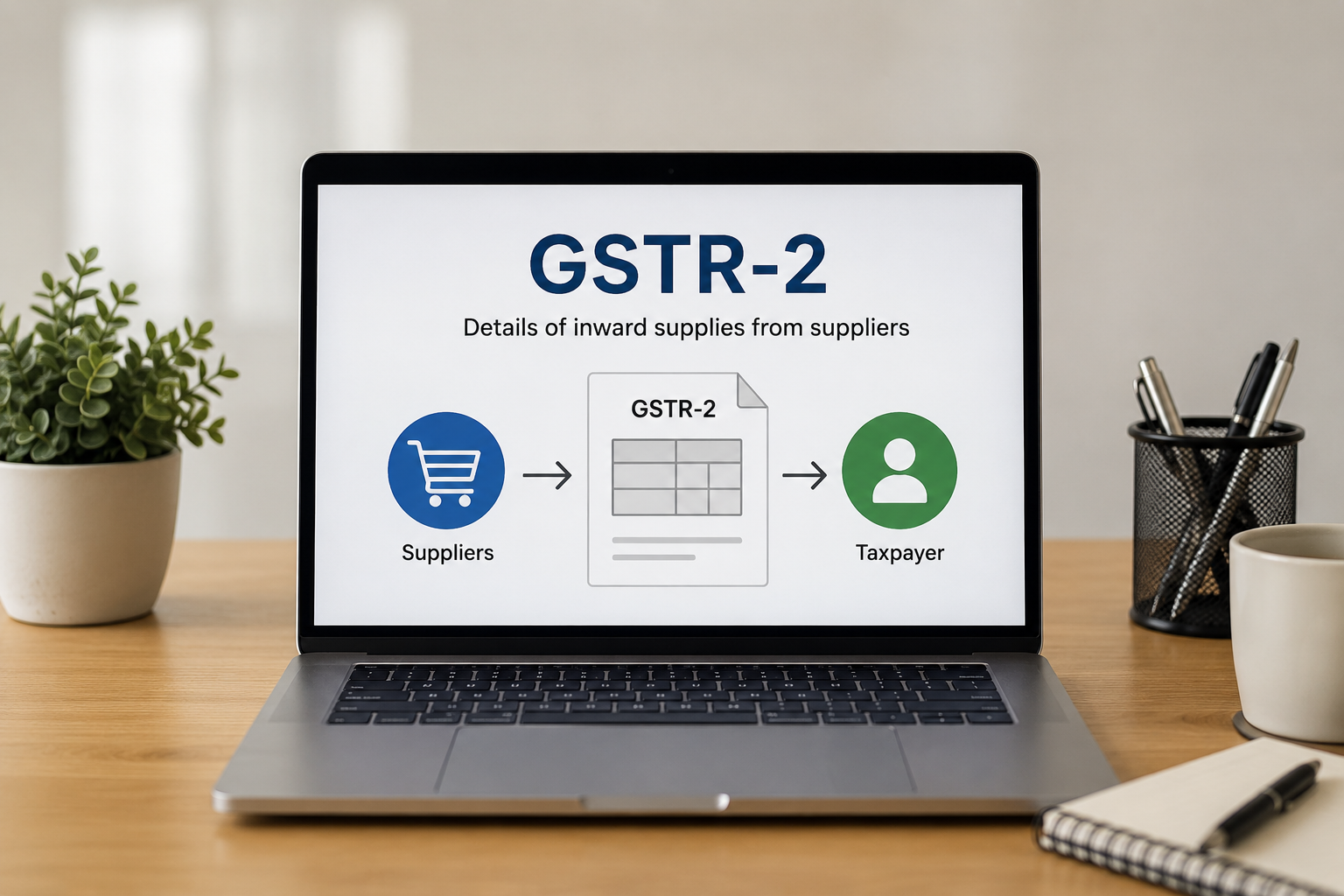
Why Was GSTR-2
To verify purchase transactions: GSTR-2 was introduced to assist taxpayers in verifying the purchase details given by their suppliers on GSTR-1. It enabled receivers to verify bills and ensure that the information matched their records. This checking technique increased the correctness of GST reports. It also helps discover missing or inaccurate invoices early on.
Enable input tax credit matching: GSTR-2’s major goal was to make it easier to connect purchase records with sales data given by suppliers. This mechanism guaranteed that Input Tax Credit (ITC) was only claimed for valid transactions. Accurate matching decreased the likelihood of errors in ITC claims. It also improved compliance with the GST framework.
Reduce Tax Evasion: The invoice matching system in GSTR-2 was significant in decreasing tax evasion and false ITC claims. It helped tax officials uncover anomalies between supplier and receiver records. Such inspections helped to prevent the misuse of tax credits. As a result, the system encouraged fair taxation and increased compliance.
Strengthen GST Compliance: GSTR-2 encouraged firms to keep correct records and balance their purchases on a regular basis. Proper reconciliation ensured that GST returns were filed accurately. This decreased the possibility of disputes, notices, and compliance difficulties. Ultimately, it helped to make the GST environment more efficient and trustworthy.
What Information Was Reported in GSTR-2?
Purchase Invoice Details:
GSTR-2 contained information about the products and services purchased from registered suppliers throughout the tax period. These invoices served as the foundation for claiming Input Tax Credit (ITC).
Debit and Credit Notes.
Taxpayers were expected to disclose debit and credit notes received from suppliers in order to accurately adjust taxable values and GST amounts.
Import of Products and Services
Details about imported goods and services were disclosed in GSTR-2 to make it easier to claim qualifying tax credits for imports.
Information on the Input Tax Credit (ITC)
The return included information about qualifying Input Tax Credit available on inward supply, which helps firms lower their GST burden.
Amendments to Past Transactions
Any adjustments or modifications to previously reported purchase transactions might likewise be made using GSTR-2.
Key Objectives of GSTR-2
Strengthening ITC Validation: One of the primary goals of GSTR-2 was to guarantee that Input Tax Credit (ITC) applications were backed by legitimate supplier transactions. The return allowed taxpayers to verify purchase invoices before claiming tax credits. This minimized the possibility of submitting false or fraudulent ITC claims. It also increased the reliability of the GST credit procedure.
Improving Data Accuracy: GSTR-2 allowed recipients to verify the purchase data supplied by suppliers and make changes as needed. This procedure helped to remove inaccuracies in invoice numbers, GSTINs, taxable values, and tax amounts. Accurate reporting increased the quality of GST records. It also reduced cross-business reconciliation issues.
Creating a Matching System: The return was intended to create an invoice-matching mechanism for suppliers and recipients. Discrepancies between GSTR-1 and GSTR-2 data could be found and addressed. The matching method encouraged consistency in GST reporting. It also helped guarantee that tax benefits were only claimed for verified transactions.
Improving Compliance Monitoring: GSTR-2 provides tax officials with a standardized approach to monitoring GST compliance across enterprises. The matching of supplier and receiver data makes it easier to spot inconsistencies and reporting errors. This improved the effectiveness of GST administration. It also encouraged taxpayers to keep accurate and transparent records.
Who Was Required to File GSTR-2?
Regular GST Registered Taxpayers: Businesses registered under the conventional GST regime were needed to file GSTR-2 to disclose information about their inward supplies. The return included information on purchases made during the tax period. It helped to keep correct transaction records. Filing GSTR-2 was a key step in the GST compliance process.
Businesses claiming Input Tax Credit: Taxpayers who wanted to claim Input Tax Credit (ITC) on their purchases had to utilize GSTR-2 to validate eligible credits. The return allowed them to double-check supplier-reported bills before claiming ITC. This helped to ensure that tax credits were based on legitimate transactions. It also decreased the likelihood of inaccurate credit claims.
Manufacturers and traders: Manufacturers, wholesalers, distributors, and merchants who were registered for GST were needed to file GSTR-2. These companies frequently purchased goods from vendors and had to declare such inward supplies. The result enabled the accurate reconciliation of purchase transactions. It also contributed to accurate tax credit matching.
Service providers: Registered service providers receiving taxable goods or services were also subject to the GSTR-2 filing system. They were obligated to reveal inside supplies and confirm purchase-related information. This allowed them to claim valid ITC on business expenses. Proper reporting increased compliance and transparency in GST filings.
Who Was Exempt from Filing GSTR-2?
Composition Scheme Taxpayers: Taxpayers who registered under the GST Composition Scheme were spared from filing GSTR-2. They used a simplified compliance structure with separate return filing obligations. Because they paid tax at a set rate and could not claim Input Tax Credit, GSTR-2 did not apply to them. This lowered the regulatory burden for small firms under the composition scheme.
Non-resident Taxable Persons: Non-resident taxpayers (NRTPs) were not needed to submit GSTR-2. These taxpayers used a distinct GST registration and return filing system. Their compliance duties were different from those of regular registered taxpayers. As a result, the GSTR-2 filing obligation was not applicable to them.
Input Service Distributors: Input Service Distributors (ISDs) were excused from reporting GSTR-2 since they played a specific role under GST. Their principal role was to issue input tax credits to various corporate divisions. The GST statute required ISDs to file separate returns. As a result, they were not included in the GSTR-2 reporting system.
TDS and TCS registrants: Individuals registered exclusively for Tax Deducted at Source (TDS) or Tax Collected at Source (TCS) purposes were normally exempt from GSTR-2 filing. Their GST obligations were confined to deducting, collecting, and reporting taxes. They were not required to declare entering supplies using the GSTR-2. Separate compliance provisions applied to their GST duties.
Major Components of GSTR-2
Inward Supply Details: This section provided information about purchases made from registered suppliers throughout the tax period. It allowed taxpayers to accurately report all qualifying inward supplies.
Auto-populated Invoice Data: Purchase invoices submitted by suppliers in GSTR-1 were automatically mirrored in GSTR-2, allowing recipients to confirm transaction information.
Details on the Input Tax Credit (ITC): GSTR-2 collected qualified Input Tax Credit for goods and services purchased, allowing firms to decrease their overall GST liability.
Debit and Credit Notes: Taxpayers reported debit and credit notes received from suppliers to accurately adjust taxable values and GST amounts.
Import of Products and Services: GSTR-2 contained information on imported goods and services that might be used to claim applicable tax credits and keep accurate GST records.
Documents Required for GSTR-2 Preparation
- Purchase Invoices
- Debit Notes
- Credit Notes
- Import documentation.
- GSTIN details for suppliers
- Tax payment records.
- Accounting records
- Input Tax Credit Calculations
- Reconciliation Statements
- Business Transaction Reports
How GSTR-2 Was Intended to Work
Step 1: Supplier Uploads Sales Details: The process began with a supplier filing GSTR-1 and reporting information of outward supplies made to customers during the tax period.
Step 2 – Purchase data is auto-populated: Purchase-related information from the supplier’s GSTR-1 filing was automatically included in the recipient’s GSTR-2 for evaluation.
Step 3 – The recipient verifies the information.: If anomalies between actual purchases and supplier-reported data were discovered, the buyer had the option to accept, alter, or reject the invoice.
Step 4: Invoice Matching Process: Prior to processing Input Tax Credit claims, the GST system examined supplier and recipient data to ensure that transaction details matched.
Step 5 – Finalizing the Input Tax Credit: After successful verification and matching, the applicable Input Tax Credit was certified, allowing taxpayers to accurately claim GST credits and remain compliant.
Difference Between GSTR-1 and GSTR-2
Feature | GSTR-1 (Sales) | GSTR-2 / GSTR-2B (Purchases) |
What is it? | A statement of your outward supplies (Sales). | A statement of your inward supplies (Purchases). |
Data Focus | Revenue earned and GST collected from clients. | Business expenses and GST paid to suppliers. |
Filing Action | Mandatory to file by the taxpayer every month or quarter. | No active filing. It is now an auto-generated, read-only view. |
ITC Impact | Passes on credit to your buyers so they can save tax. | Shows available credit (ITC) you can claim to reduce your tax bill. |
Source of Data | Uploaded directly by you from your sales bills. | Pulled automatically by the system from your suppliers’ GSTR-1. |
Key Timeline | Due by the 11th or 13th of the next month. | Generated statically on the 14th of every month. |
Why Was GSTR-2 Suspended?
Complex Matching Requirements: One of the key reasons for GSTR-2’s suspension was the intricacy of its invoice-matching process. The return needed a full reconciliation of supplier and receiver records for each transaction. Implementing this approach on a broad scale proved challenging for both taxpayers and the GST system. As a result, compliance has become more time consuming and resource costly.
Compliance Challenges: Many firms encountered considerable difficulty in reconciling huge volumes of purchase transactions with supplier-reported data. Errors, missing invoices, and inconsistencies frequently resulted in additional compliance obligations. Small and medium-sized firms found the process especially difficult. These challenges pushed up the overall cost and complexity of GST compliance.
System Simplification: To decrease compliance constraints and improve the efficiency of GST return filing, the government simplified the reporting system. The suspension of GSTR-2 simplified the return filing process for taxpayers. This enabled businesses to focus on fewer returns while remaining compliant. The change also simplified the process of doing business under GST.
Alternative Reporting Framework: Following the suspension of GSTR-2, GST compliance switched to a more simpler framework based on GSTR-1, GSTR-3B, and auto-generated statements like GSTR-2A and GSTR-2B. These statements include purchase information without requiring taxpayers to complete a separate inbound supply return. The redesigned approach decreased duplication of effort while increasing reporting efficiency.
Common ITC Mistakes Businesses Should Avoid
Claiming Credit Without Valid Invoices: Businesses should only claim Input Tax Credit (ITC) if they have valid tax invoices and the transaction fits the GST eligibility requirements. Claiming credit without sufficient paperwork can result in the disallowance of ITC during evaluations. It may also lead to penalties and increased tax liabilities. Maintaining accurate invoicing records is critical to compliance.
Ignoring Supplier Reconciliation: Failure to reconcile purchase records with supplier-reported data can result in disparities in ITC claims. Businesses should frequently compare their records against the GSTR-2A and GSTR-2B statements. Timely reconciliation aids in detecting missing or inaccurate invoices. It also lowers the chances of ITC reversals and compliance concerns.
Delayed documentation: Delays in the collection, verification, or maintenance of GST-related documentation might have an impact on ITC eligibility. Missing invoices, purchase records, or supporting documentation might make it harder to justify tax credits. Proper document management promotes seamless compliance and audit readiness. Businesses should keep their records structured and accessible.
Inaccurate GST reporting: Errors in GST returns, such as incorrect invoice values, GSTIN data, or tax amounts, might result in ITC discrepancy. Inaccurate reporting may result in notices from the GST administration and unnecessary conflicts. Businesses should thoroughly review return data prior to submission. Accurate reporting helps to maintain compliance and avoid costly fines.
Conclusion
GSTR-2 was originally intended to report inward supplies and assist input tax credit matching inside the GST system. Although the return has been halted, its objectives continue to impact GST compliance procedures today. Understanding GSTR-2 enables firms to recognize the value of purchase verification, invoice reconciliation, and correct ITC administration.
Frequently Asked Questions
Q1. What is GSTR-2, and what is its purpose under GST regulations?
Answer: GSTR-2 was a GST return designed to record information on inward supply received by taxpayers. Its primary goal was to simplify invoice matching and ensure the correctness of Input Tax Credit (ITC) claims. The return made it easier to compare purchase data to sales data given by suppliers. This strategy sought to increase openness and decrease tax disparities.
Q2. Do GST taxpayers in India currently need to file GSTR-2?
No, GST filers do not yet need to file GSTR-2. The GST officials stopped the return as part of their efforts to simplify the GST compliance system. Businesses currently use GSTR-1, GSTR-3B, GSTR-2A, and GSTR-2B for GST reporting and ITC reconciliation. This has eased the compliance load on taxpayers.
Q3: Why was GSTR-2 introduced when GST was initially implemented nationally?
Answer: GSTR-2 was designed to establish a reliable invoice-matching system under the GST framework. It enabled taxpayers to validate purchase transactions and ensure the correctness of supplier-reported bills. This procedure helped to ensure that Input Tax Credit was claimed only for valid transactions. It also attempted to prevent tax evasion and increase compliance.
Q4: What types of transactions were noted on the GSTR-2 return?
Answer: GSTR-2 includes information on purchase invoices, debit notes, credit notes, imports, and other inward supply activities. Taxpayers were required to disclose qualifying Input Tax Credits for certain transactions. The return also included changes and corrections to the purchase data. This detailed reporting made it easier to keep proper GST records.
Q5. How did GSTR-2 help to prevent fake Input Tax Credit claims?
Answer: GSTR-2 provided an invoice-matching tool that compared supplier and recipient transaction information. Tax credits could only be validated if the relevant supplier information matched. This eliminated the potential of claiming ITC on fraudulent or nonexistent invoices. As a result, the technology improved the integrity of GST compliance.
Q6: Who was initially needed to file GSTR-2 under the GST framework?
Answer: Regular GST-registered taxpayers who received taxable inward supply were often required to file GSTR-2. This rule applied to manufacturers, traders, service providers, and other businesses that claimed input tax credits. The return was meant to report purchase-related transactions. Certain categories were exempt, including composition taxpayers and ISDs.
Q7: Why was GSTR-2 eventually suspended by the GST authorities?
Answer: The GST authorities suspended GSTR-2 because the invoice-matching process was cumbersome and difficult to perform effectively. Businesses faced considerable hurdles when reconciling enormous numbers of transactions. The regulatory burden has increased for taxpayers, particularly small and medium-sized businesses. To simplify the system, other reporting techniques were implemented.
Q8. What return forms are currently replacing the GSTR-2-specific functions?
Answer: GSTR-1, GSTR-3B, GSTR-2A, and GSTR-2B currently perform the majority of the activities that GSTR-2 was designed to perform. These reports and statements include information on GST reporting, tax payment, and Input Tax Credit reconciliation. Taxpayers can use auto-generated statements to verify data reported by suppliers. This framework provides a simplified approach to compliance.