
Short answer: Issue a credit note when the value or tax on an earlier invoice has to come down. The usual cases are goods returned by the customer, an invoice showing more value or tax than correct, services found deficient, and a discount agreed in advance but given after the sale. Report the credit note by 30 November following the financial year, or by the date of the annual return if earlier, or you lose the tax reduction.
Key points
- Law: Section 34 of the CGST Act.
- Issued by the supplier to the customer.
- Reduces the supplier’s tax liability and the buyer’s ITC.
- Time limit: 30 November following the financial year, or the annual return date, whichever is earlier.
Check Whether You Need One
| Situation | Credit note? |
| Customer returns goods | Yes |
| Invoice shows higher value or tax than correct | Yes |
| Service was deficient and you reduce the price | Yes |
| Post-sale discount agreed earlier and linked to invoices | Yes |
| Discount already shown on the invoice | No |
| Price increase after the sale | No, issue a debit note |
| Invoice never delivered or not yet reported | Cancel and reissue instead |
What Must a Credit Note Show?
- The words “Credit Note”, its number and date
- Your name, address and GSTIN
- The buyer’s name, address and GSTIN
- The original invoice number and date
- The taxable value and tax being reduced
- Your signature (digital signature for e-invoice cases)
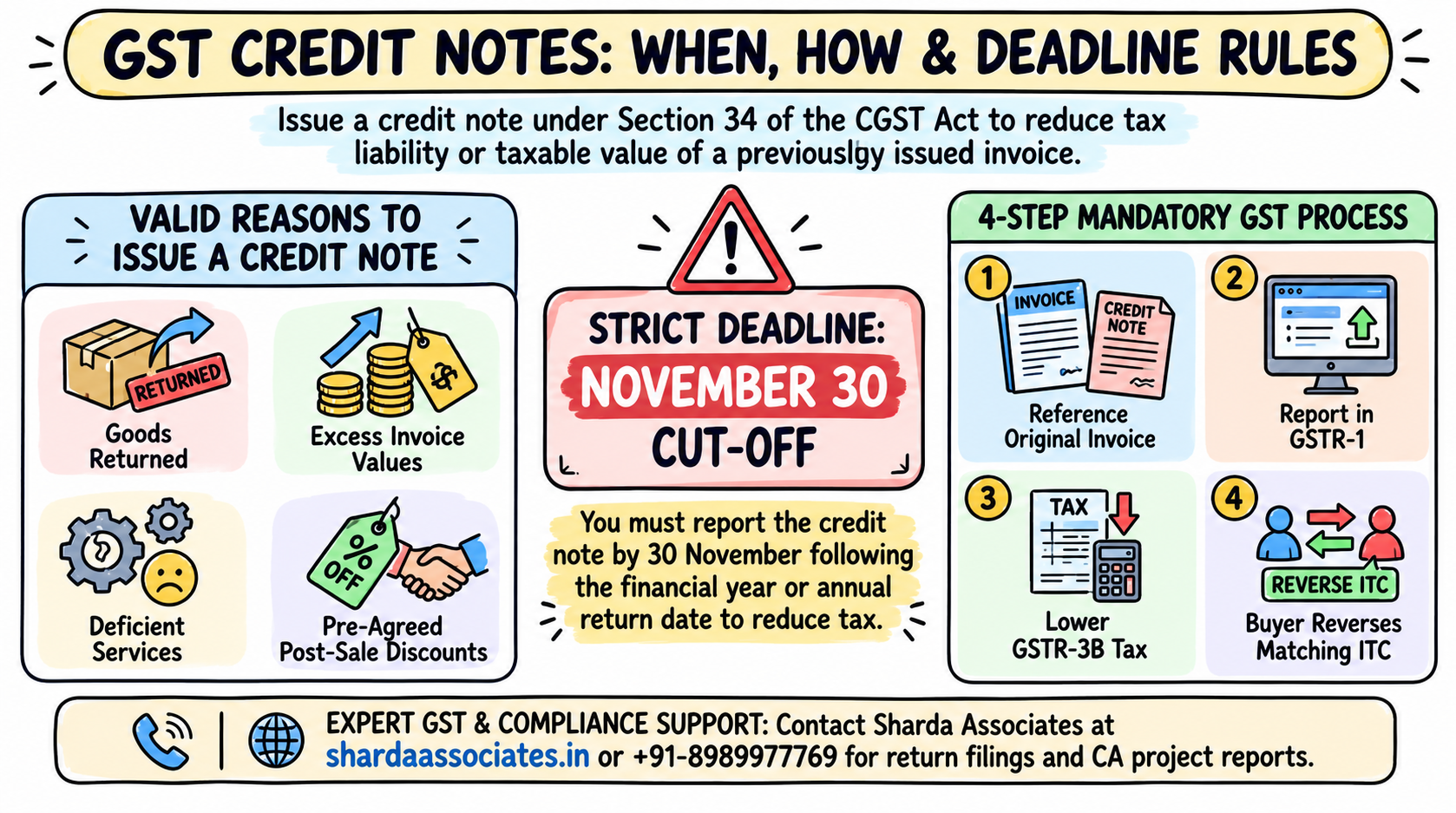
Step by Step
- Identify the original invoice and the reason for the credit.
- Prepare the credit note for the reduced value and tax.
- Send a copy to the customer.
- Report it in the credit and debit note section of GSTR-1.
- Reduce your tax in GSTR-3B, subject to Section 34.
- Ask the customer to reverse the matching ITC.
- Save proof, such as return receipts or the discount agreement.
Discount Credit Notes: What Is Allowed?
- A discount shown on the invoice reduces the taxable value directly, so no credit note is needed.
- A discount given after the supply is allowed only if it was agreed before or at the time of supply and linked to specific invoices.
- The customer must reverse ITC on the discount.
- Keep the scheme or agreement in writing, since an officer may ask for it.
Example 1: Goods Returned
A customer buys goods worth ₹50,000 plus 18% GST of ₹9,000 and returns half.
- Credit note: ₹25,000 taxable value and ₹4,500 tax.
- You: reduce output tax by ₹4,500 within the time limit.
- Customer: reverses ₹4,500 of ITC.
Example 2: Annual Volume Discount
You agree at the time of sale to give 2% on yearly purchases above a limit.
- At year end: issue a credit note linked to the invoices that qualify.
- Customer: reverses ITC on the discount.
- Documents to keep: the agreement and the invoice list.
What If You Miss the Time Limit?
- You cannot reduce your tax liability through that credit note.
- You may still give the customer the money commercially, but you bear the tax.
- Plan year-end returns and discount settlements before 30 November.
Credit Note vs Debit Note
- Credit note: reduces the value or tax of an earlier invoice.
- Debit note: increases the value or tax, for example for a price rise or a rate error.
- Both: are reported in GSTR-1 and need the original invoice reference.
Common Mistakes
- Issuing a credit note without quoting the original invoice.
- Forgetting to report it in GSTR-1.
- Issuing it after the cut-off and still reducing tax.
- Giving a discount outside the agreed terms and expecting tax relief.
- Not informing the customer, which leaves an ITC mismatch.
Conclusion
Issue a credit note whenever the value or tax of a sale must come down after the invoice: returns, excess tax, deficient services or a properly agreed discount. Report it in GSTR-1 before 30 November and tell your customer to reverse the ITC, so that both sides stay in sync.
Keep discount agreements and return proofs ready, because they are your defence in an audit. For GST credit notes, return filing and CA-prepared project reports for loans, call Sharda Associates on +91-8989977769.
Questions People Ask ITC so
Q1. What is a credit note under GST?
A document issued by the supplier to reduce the value or tax of an earlier invoice.
Q2. When should I issue one?
For returns, excess tax or value, deficient services and eligible post-sale discounts.
Q3. What is the time limit?
30 November following the financial year, or the annual return date, whichever is earlier.
Q4. Who reverses ITC?
The customer, for the credit note amount.
Q5. Do I need a credit note for an on-invoice discount?
No, the invoice is already reduced.
Q6. Where do I report it?
In the credit and debit note section of GSTR-1.
Q7. Is a credit note the same as a refund?
No. It is a tax document, while the refund is the actual money given to the customer.
Q8. Do e-invoice taxpayers report credit notes?
Yes, where e-invoicing applies, as per the current rules.