
By Sharda Associates | CA Firm, Bhopal
You spent weeks preparing your business loan application. You gathered every document the bank asked for. You submitted your Project Report with full confidence.
And then the bank returned it. No clear explanation. No specific reason. Just — your Project Report has issues, please resubmit.
This moment is one of the most frustrating experiences an entrepreneur can face. And unfortunately, it happens to thousands of business owners across India every single month. Not because their business idea was weak. Not because they were ineligible for the loan. But because their Project Report had specific, avoidable problems that the bank’s credit team could not overlook.
At Sharda Associates, a qualified CA firm based in Bhopal, we have reviewed and corrected hundreds of rejected Project Reports over the years. And in almost every single case, the rejection came down to one or more of the same ten problems — problems that are completely fixable when you know what they are.
In this guide we explain all ten real reasons why banks reject Project Reports in India — and exactly what you need to do to fix each one before resubmitting your loan application.
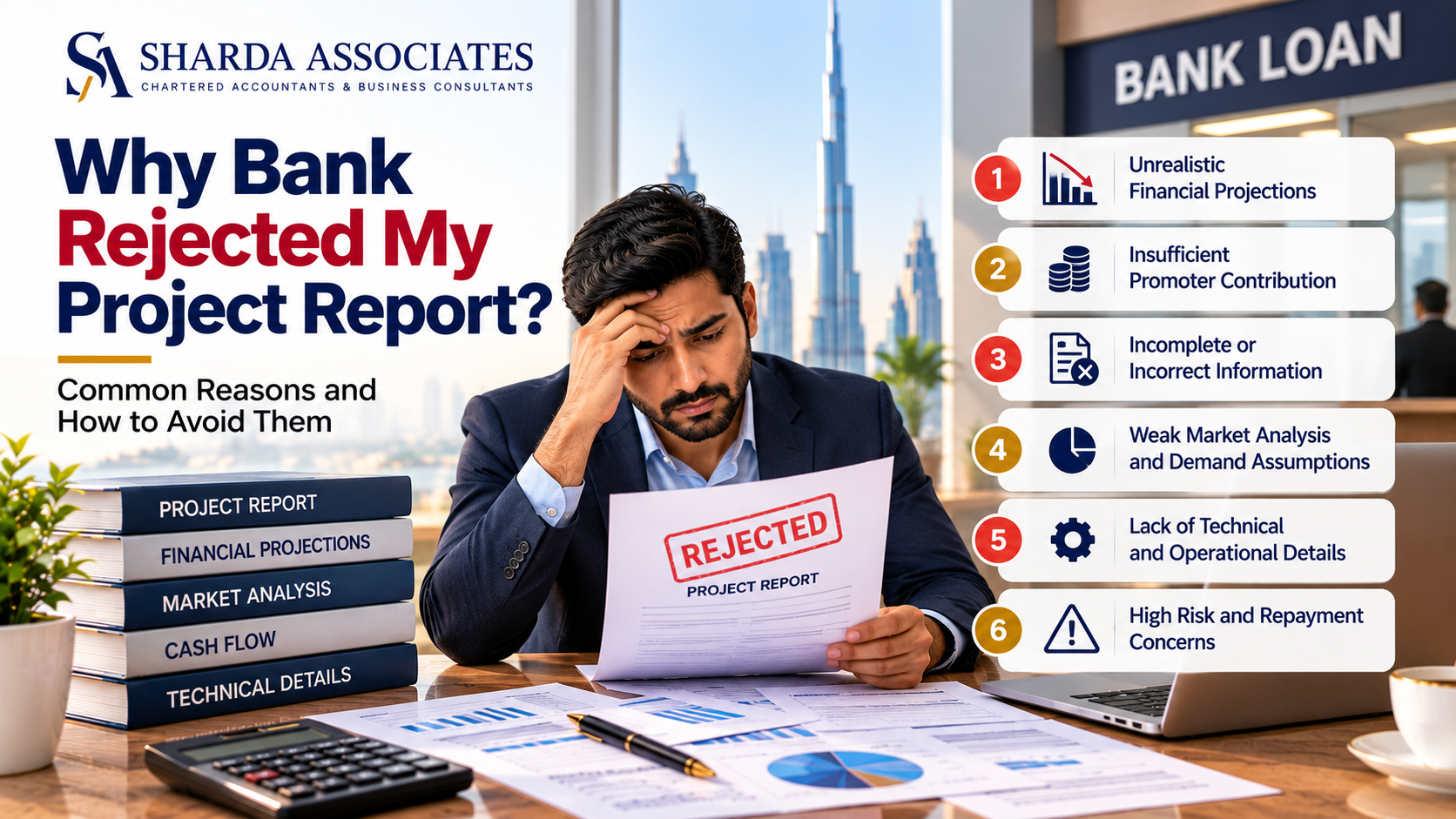
Why Do Banks Reject Project Reports
Before we go into the ten specific reasons, it is important to understand how banks actually evaluate a Project Report.
When your loan file reaches the bank’s credit department, a credit officer goes through your Project Report section by section against a detailed internal checklist. They are not looking for impressive language or a beautiful format. They are looking for three things — credible financial data, realistic projections, and evidence that you can repay the loan on time from your business cash flows.
If your Project Report fails to clearly demonstrate any one of these three things — or if it contains errors, inconsistencies, or missing sections — it gets returned. Sometimes with a query letter. Sometimes with no explanation at all.
The ten reasons below cover every major failure point that causes Project Reports to be rejected by banks across India.
Reason 1 — Unrealistic Financial Projections
This is the single most common reason Project Reports get rejected across India — and it is also the most damaging to your credibility as a borrower.
Many first-time entrepreneurs prepare their financial projections with optimism rather than realism. They project 100 percent production capacity utilisation from Day 1. They show revenue doubling or tripling within the first year. They underestimate operating costs to make the profit numbers look more attractive. They ignore expense inflation in future years.
Bank credit officers have reviewed thousands of Project Reports. They know the realistic revenue and cost benchmarks for almost every industry. When they see projections that are dramatically different from industry norms — without any supporting data or explanation — it does not impress them. It makes them question the credibility of everything else in your file.
The fix is simple in principle but requires real work in practice. Your financial projections must be based on actual market prices, real production capacity data, genuine demand research, and industry-standard cost benchmarks. Every assumption behind your projections must be clearly stated and logically justified.
At Sharda Associates our CA team researches actual industry data for every business we prepare reports for — ensuring your projections are both realistic enough to be credible and strong enough to support your loan approval.
Get Realistic, Bank-Approved Financial Projections →
Reason 2 — DSCR Below Bank Minimum
DSCR — Debt Service Coverage Ratio — is the single most important number in your entire Project Report. It measures how much surplus cash your business generates compared to the loan repayment amount due each year.
The formula is straightforward. DSCR equals Net Cash Accruals for the year divided by the total of Loan Repayment and Interest for the same year.
Most Indian banks require a minimum DSCR of 1.25. Many banks require 1.5 and above. What this means in practice is that for every Rs.1 of loan repayment due, your business must generate at least Rs.1.25 of surplus cash — ideally Rs.1.5 or more.
If your financial projections produce a DSCR below the bank’s minimum threshold — your loan will be rejected. Not returned with queries. Rejected. It does not matter how strong every other aspect of your application is. A DSCR below 1.25 is an automatic disqualifier for term loan approval at almost every bank in India.
The most common causes of low DSCR are unrealistically low revenue projections, underestimating the loan repayment schedule, overestimating operating costs, or simply not understanding how to structure projections to maintain healthy ratios across all five projection years.
Our CA team at Sharda Associates structures every Project Report and CMA Report to ensure DSCR stays comfortably above your specific bank’s minimum requirement — not artificially inflated, but genuinely achievable based on real business data.
Reason 3 — Incorrect MPBF Calculation
MPBF — Maximum Permissible Bank Finance — is the RBI formula that determines the maximum working capital loan your business is eligible to receive. It appears in the CMA Report that accompanies your Project Report, and an error in this calculation has a direct impact on the loan amount the bank will sanction.
Most self-prepared and software-generated reports get the MPBF calculation wrong — either using the incorrect method (Tandon Committee First Method versus Second Method versus Nayak Committee Turnover Method) or making arithmetic errors in the working capital analysis.
The consequence of an incorrect MPBF is that you receive a working capital credit limit that is significantly lower than what your business genuinely needs — even if the bank is perfectly willing to lend more. This single calculation error silently costs businesses enormous amounts in lost credit every year.
Our CAs at Sharda Associates calculate MPBF using the method specifically required by your bank and confirm the figure against your working capital cycle data before every report is delivered.
Get Your CMA Report with Correct MPBF Calculation →
Reason 4 — Mismatch Between Financial Statements
A Project Report contains multiple interconnected financial statements — Profit and Loss Projection, Balance Sheet, Cash Flow Statement, Loan Repayment Schedule, and the CMA data statements. Every single number across all these statements must be perfectly consistent with every other statement.
This is where self-prepared and template-generated reports most commonly fail. When one figure is updated in the Profit and Loss but not carried through correctly to the Balance Sheet — or when the Cash Flow Statement shows a different opening cash balance than the Balance Sheet — the entire report becomes internally inconsistent.
Bank credit officers are specifically trained to cross-check figures across financial statements. When they find even one inconsistency — one number that does not reconcile between two statements — it raises serious doubts about the reliability of all your data. In many cases it results in the entire file being returned for correction.
At Sharda Associates every financial statement in every report is built in an integrated format where all figures automatically flow from one statement to the next — eliminating the possibility of reconciliation errors before the report reaches your bank.
Reason 5 — Missing or Incomplete Sections
Bank credit departments operate from detailed internal checklists. Every section of your Project Report is either present and complete, present but incomplete, or missing entirely. Any section that is incomplete or missing results in your file being returned — regardless of how strong everything else in the report looks.
The sections that most commonly cause rejections due to being missing or incomplete are the Market Analysis section (many reports mention demand is strong without providing any actual data or analysis), the Break-Even Analysis (frequently omitted entirely), the Implementation Schedule showing the timeline from loan disbursement to commercial production, the Promoter’s Profile with complete financial background, and the Means of Finance table clearly showing promoter contribution versus bank loan.
Every Project Report prepared by Sharda Associates includes all required sections in complete detail — structured against the specific checklist used by your bank’s credit appraisal team.
Reason 6 — Zero Promoter Contribution
Banks in India follow a fundamental lending principle — they will not fund 100 percent of any business project. They need to see that the promoter — you — has genuine financial commitment to the project through your own investment alongside the bank loan.
This is called the Debt-to-Equity Ratio or the promoter contribution requirement. For most bank loans in India, the minimum promoter contribution is 10 to 25 percent of the total project cost — meaning you must invest your own money equivalent to at least 10 to 25 percent of the total investment.
A Project Report that shows the total project cost equals the loan amount requested — with no promoter contribution shown — will be rejected. It signals to the bank that you have no personal financial stake in the success of the business.
Your Project Report must clearly show your own contribution in the Means of Finance section — whether it is cash, land, machinery, or any other asset you are bringing to the project.
Reason 7 — Weak or Missing Market Analysis
The Market Analysis section of your Project Report serves one critical purpose — it proves to the bank that genuine, verifiable demand exists for your product or service, and that your revenue projections are grounded in real market conditions rather than assumptions.
Many Project Reports — especially software-generated ones — include a market analysis that consists of one or two generic paragraphs stating that the industry is growing and demand is high. This is not a market analysis. This is a statement of hope. Banks do not lend based on hope.
A proper market analysis in a Project Report must cover the total market size with data, the specific customer segment you are targeting and why, your key competitors and their pricing, your own pricing strategy and competitive advantage, and the realistic market share you can capture in your first two to three years of operations.
When the market analysis is weak or missing, the bank has no basis to evaluate whether your revenue projections are achievable — and the loan will be returned or rejected.
Our CA team at Sharda Associates researches actual market data for every industry and location we prepare reports for — ensuring your market analysis is specific, credible, and genuinely supportive of your financial projections.
Get Your Market-Research Backed Project Report →
Reason 8 — Wrong Format for the Loan Scheme
Every government loan scheme in India has a specific documentation format — and submitting a Project Report in the wrong format to a scheme portal or empanelled bank results in automatic rejection before anyone even reviews your application content.
PMEGP applications require Project Reports in the exact format specified by KVIC, KVIB, or DIC — with specific sections, specific financial statement formats, and scheme-specific data like employment generation numbers and subsidy calculation. A standard Project Report submitted to the PMEGP portal will be rejected automatically.
CMEGP — the Chief Minister’s Employment Generation Programme specific to Madhya Pradesh — has its own format requirements that are different from national schemes. Mudra loans across the four categories of Shishu, Kishore, Tarun, and Tarun Plus each have different documentation requirements. CGTMSE applications have their own set of requirements. NABARD scheme applications have entirely different formats again.
At Sharda Associates our Bhopal-based team has specific, hands-on experience with every major government scheme format — including PMEGP, CMEGP, Mudra, CGTMSE, Stand Up India, and NABARD. Every report we prepare is formatted specifically for the scheme or bank you are applying to.
Reason 9 — Inconsistency Between Project Report and CMA Report
Most bank loan applications above Rs.10 lakh require both a Project Report and a CMA Report to be submitted together as part of the same loan file. These two documents must be completely consistent with each other — every financial figure that appears in both documents must be identical.
The most common inconsistency is a mismatch in projected turnover or net profit between the two documents — where the Project Report shows one set of projections and the CMA Report shows slightly different figures. This happens frequently when the two documents are prepared by different people or at different times.
When a bank credit officer finds a discrepancy between your Project Report and CMA Report — even a small one — it immediately raises a fundamental question. Which set of figures is correct? And if there is an error in one, how many other errors exist across both documents? This loss of credibility is very difficult to recover from once the credit officer has noticed it.
At Sharda Associates we prepare both your Project Report and CMA Report together as an integrated package — ensuring complete consistency between every figure in both documents before either one is delivered to you.
Get Your Project Report and CMA Report Prepared Together →
Reason 10 — Generic Software-Generated Template
This is the reason that surprises most people — because a software-generated report can look perfectly professional on the surface. But bank credit officers have reviewed so many of them that they can identify one within minutes.
Software-generated and template-based Project Reports have specific characteristics that trained credit officers recognise immediately — generic industry descriptions that could apply to any business in that sector, identical financial projection structures that follow the same pattern regardless of the specific business, stock phrases and sentences that appear in hundreds of reports, and financial ratios that look suspiciously identical across multiple applications.
When a credit officer identifies a report as software-generated, they treat it with significantly more scepticism than a personally prepared, business-specific report. Every number gets questioned. Every projection gets challenged. And the overall credibility of the application takes a serious hit before the detailed evaluation has even begun.
A genuinely prepared Project Report — researched and written specifically for your business, your location, your industry, and your specific bank — tells the credit officer that the promoter has thought seriously about the project. It builds confidence before the numbers are even evaluated.
At Sharda Associates every single Project Report is prepared from scratch by a qualified CA — specifically for your business, your loan requirement, and your bank. No templates. No copy-paste. No software output.
How to Fix a Rejected Project Report
If your Project Report has already been rejected by a bank, here is the correct approach to fixing and resubmitting it.
First — find out the exact reason for rejection. Ask your bank branch manager or the loan officer for a specific query letter or written list of the issues they identified. If the bank cannot provide a written list, ask them verbally and note down every point they mention.
Second — do not simply make surface-level changes to the rejected report and resubmit. A report that was rejected for fundamental structural issues — wrong DSCR, incorrect MPBF, missing sections, inconsistent figures — needs to be rebuilt from scratch, not patched up.
Third — get a qualified CA to review the rejected report and identify all issues before preparing a corrected version. At Sharda Associates we offer a free review of rejected Project Reports — call us and share your rejected report, and our CA team will tell you exactly what needs to be fixed.
Fourth — ensure the corrected report is reviewed against your specific bank’s credit appraisal checklist before resubmission. Different banks have slightly different requirements and what works for one branch may need minor adjustments for another.
Get Your Rejected Project Report Fixed →
Documents Required for a Strong Project Report
To prepare a Project Report that avoids all ten of the rejection reasons above, keep these documents ready:
Aadhaar Card and PAN Card of all promoters and directors. GST Registration Certificate or Udyam Registration Certificate. Last 2 to 3 years Income Tax Returns with computation sheet if available. Last 2 to 3 years audited Balance Sheets and Profit and Loss Statements for existing businesses. Last 6 months business bank account statements. Existing loan sanction letters and repayment schedules if any. Machinery quotations from authorised suppliers. Land or building ownership documents or lease agreement. Estimated project cost, expected revenue, and planned expenses — rough estimates are fine, our team will structure them correctly.
For new businesses with no financial history — contact us before gathering documents. Our CA team will guide you on exactly what to prepare.
Conclusion
A rejected Project Report is not the end of your loan journey. It is a signal that specific, fixable problems exist in your documentation — and that getting the right help now will save you months of delay and frustration.
The ten reasons covered in this guide — unrealistic projections, low DSCR, wrong MPBF, mismatched statements, missing sections, no promoter contribution, weak market analysis, wrong scheme format, inconsistency between documents, and generic templates — account for the vast majority of Project Report rejections across India. Every single one of them is avoidable with professional preparation.
At Sharda Associates we have helped 12,500 plus businesses across India get their loan documentation right — and their loans approved. If your Project Report has been rejected, or if you want to make sure your first submission is strong enough to get approved — call us today.
Call or WhatsApp: +91 89899 77769
Frequently Asked Questions
1 — How many times can I resubmit a rejected Project Report to the same bank?
Most banks allow resubmission after corrections. However, multiple rejections to the same bank can affect your loan application negatively. It is strongly advisable to get the report corrected completely and thoroughly before resubmitting — not to make small changes and resubmit quickly.
2 — Can the same Project Report be submitted to multiple banks simultaneously?
Yes — but the report may need minor adjustments for each bank’s specific format requirements. Our team can prepare a bank-specific version of your Project Report for each lender you are approaching.
3 — How long does it take to correct and resubmit a rejected Project Report?
At Sharda Associates we typically correct and deliver a revised Project Report within 3 to 5 working days. For urgent resubmissions we offer 24 to 48 hour delivery.
4 — Does Sharda Associates prepare PMEGP and CMEGP Project Reports?
Yes. Our Bhopal-based team has specific experience with PMEGP, CMEGP, Mudra, CGTMSE, Stand Up India, and NABARD documentation formats.
5— What if the bank asks for further revisions after I resubmit?
All revisions are completely free and unlimited until your bank is fully satisfied and your loan is approved.