
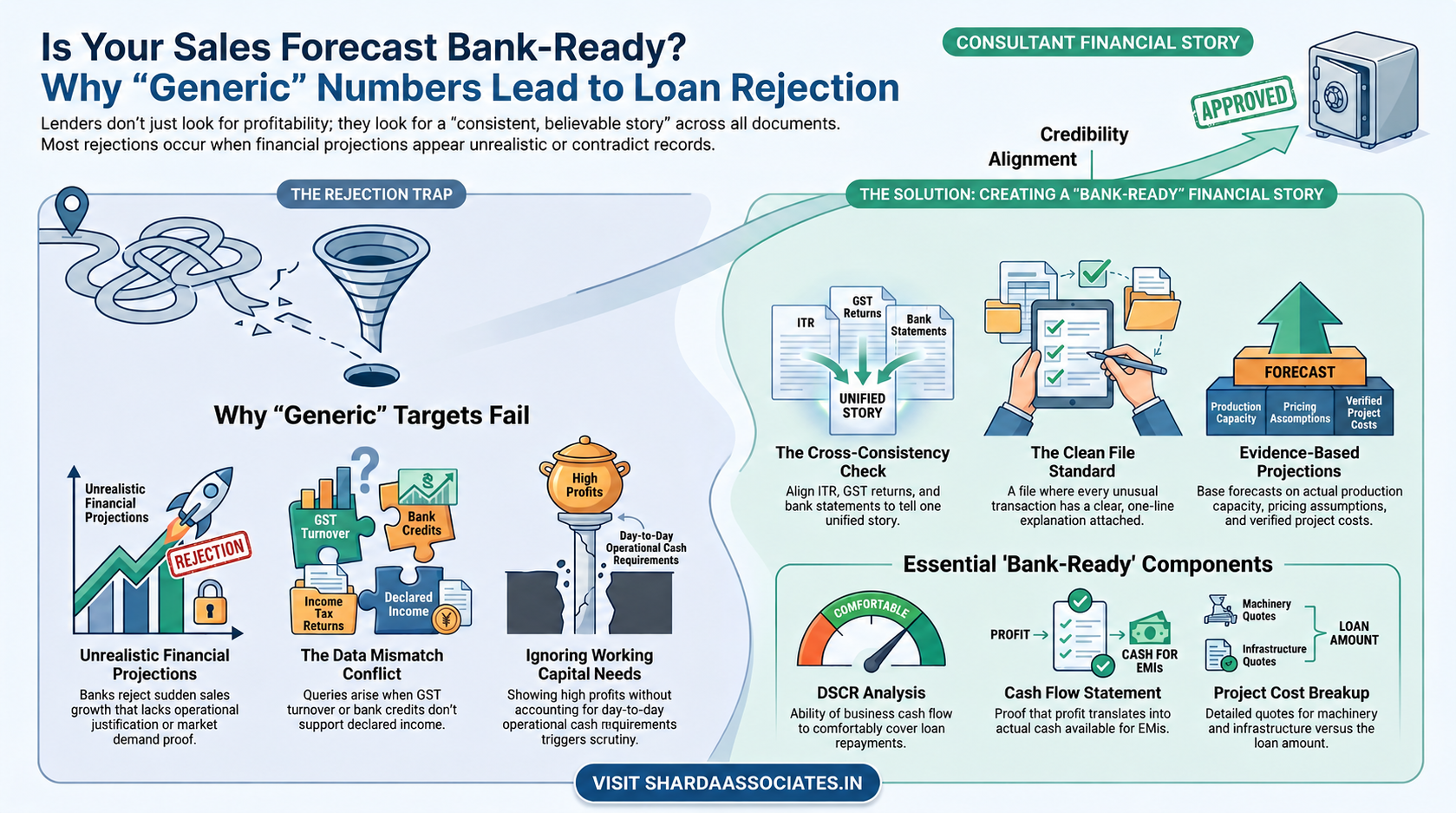
A business loan, a personal loan, and a PMEGP-linked project loan are appraised by different teams against different criteria. Underneath that, though, the same handful of weak points show up again and again. This is why Business Loan Applications Get Rejected even when the business itself may be viable — not because the rules are identical, but because every underwriter is doing the same basic job: deciding whether the file in front of them tells one consistent, believable story. Most rejections happen where it doesn’t.
At Sharda Associates, a CA-led financial consultancy, we help businesses prepare structured financial documentation, project reports and loan-related analysis by focusing on important areas such as project cost, working capital requirement, financial projections, cash flow, repayment capacity and bank documentation requirements. A professionally prepared CA-certified project report can help present a business proposal in a clear and organised manner; however, final approval always depends on the lender’s assessment, policies and applicant eligibility.
What Do Banks Check Before Approving a Loan Application?
A lender generally reviews:
| Area | What Is Evaluated |
| Identity & KYC | Applicant details, ownership, address verification |
| Credit History | Existing loans, repayment behaviour, enquiries |
| Income/Business Performance | Salary income, turnover, profitability |
| Banking Pattern | Cash flow, regular credits, unusual transactions |
| Existing Obligations | EMI burden and repayment capacity |
| Loan Purpose | Whether the requirement matches the actual need |
| Documentation | Consistency among submitted records |
The 8 Common Weak Points That Lead to Business Loan Applications Get Rejected
1. Numbers That Do Not Match Across Documents
This is one of the most common reasons for loan queries and rejection.
Examples:
- GST turnover does not match financial statements
- Bank credits do not support declared income
- Project report sales projections appear unrealistic compared to existing operations
- Address or business details differ across documents
A lender expects all records to support one consistent financial picture.
2. Unrealistic Financial Projections
Many borrowers prepare projections only to show higher profitability.
Common issues include:
- Sudden unrealistic sales growth
- Incorrect expense assumptions
- Ignoring working capital requirements
- Showing high profits without operational justification
Banks analyse whether projections are achievable based on capacity, market demand, investment and repayment ability.
A strong projection should include:
- Profit & Loss Statement
- Balance Sheet
- Cash Flow Statement
- Working Capital Calculation
- Loan Repayment Schedule
- DSCR Analysis
3. Weak Project Report or DPR
For business and project-based loans, the project report plays an important role.
A weak DPR may lack:
- Proper project cost breakup
- Machinery details
- Market understanding
- Revenue assumptions
- Financial feasibility analysis
- Repayment plan
A good project report should explain how the business will operate and generate sufficient cash flow.
4. Unexplained Deposits or Transactions
Banks often review unusual banking patterns.
Examples:
- Large one-time deposits without explanation
- Frequent transfers from unrelated parties
- Sudden increase in account balance before loan application
These transactions are not automatically negative, but unexplained activity may create additional scrutiny.
5. Applying for Multiple Loans at the Same Time
Applying with several lenders within a short period can affect how lenders view the application.
Multiple enquiries may indicate:
- Urgent need for funds
- Financial pressure
- Difficulty obtaining approval
Borrowers should first understand their eligibility and approach suitable lenders rather than applying everywhere.
6. Loan Amount Not Matching Repayment Capacity
The requested loan amount should match the business size and repayment ability.
Examples:
- Small business requesting a very large loan without supporting financial capacity
- High EMI obligations compared to income
- Project cost much higher than expected business scale
Banks evaluate whether future cash flow can comfortably support repayment.
7. Missing Explanations for Financial Irregularities
An irregularity without explanation creates uncertainty.
Examples:
- Temporary business slowdown
- Job change before applying for a personal loan
- Large business investment reflected in bank statements
- Existing liability not properly disclosed
A proper explanation with supporting documents can help lenders understand the situation better.
8. Contradictory or Incomplete Documents
Common documentation issues include:
- Different information in different forms
- Missing supporting documents
- Incorrect details entered in applications
- Expired registrations or incomplete records
A lender evaluates the file based on what is submitted, not what the applicant intended to provide.
How to Fix a Weak Loan Application Before Applying
Before submitting a loan application, borrowers should improve the quality and consistency of their financial file by reviewing all records carefully. GST returns should match accounting books, ITR should reflect actual income, bank statements should support declared transactions, and existing loans or liabilities should be properly disclosed. Borrowers should also prepare realistic financial projections based on practical factors such as production capacity, market demand, pricing assumptions, operating expenses and working capital requirements instead of showing inflated figures only to increase loan eligibility. Banks generally evaluate whether the projected sales, profits and cash flow are achievable according to the actual business model.
Borrowers should also calculate the actual loan requirement by separating fixed asset investment, machinery costs, infrastructure expenses and working capital needs. Applying for a higher loan amount than the business genuinely requires may create repayment concerns. Additionally, applicants should keep proper explanations and supporting documents ready for large deposits, income fluctuations, existing liabilities or major business changes. A transparent explanation helps lenders understand the financial position better and reduces uncertainty during the loan appraisal process.
Difference Between Personal Loan, Business Loan & PMEGP Loan Evaluation
Although the basic principle remains the same — repayment ability and credibility — each loan type focuses on different areas.
| Loan Type | Main Evaluation Factors |
| Personal Loan | Income stability, credit history, existing EMI burden, employment profile |
| Business Loan | Turnover, profitability, cash flow, financial statements, business stability |
| PMEGP Project Loan | Project viability, DPR quality, promoter contribution, business activity, eligibility criteria |
Loan Application Checklist
Before applying, keep the following ready:
Personal Documents
- PAN Card
- Aadhaar/KYC documents
- Address proof
- Income documents
Business Documents
- Business registration documents
- GST registration and returns (where applicable)
- Udyam Registration (if applicable)
- Business licences
Financial Documents
- Income Tax Returns
- Balance Sheet
- Profit & Loss Statement
- Bank Statements
- Existing loan details
Project Loan Documents
- Detailed Project Report
- Machinery quotations
- Project cost estimates
- Working capital calculation
- Financial projections
What a Clean File Actually Looks Like
It isn’t a file with a perfect profile — it’s a file where every number, on every document, tells the same story, and where anything unusual has a one-line explanation sitting next to it instead of the silence the underwriter has to chase. This is the same principle whether the application is a personal loan, an MSME term loan, or a scheme-backed project report — the underwriting logic doesn’t change with the loan product, only the specific ratios and thresholds do.
At Sharda Associates, when we prepare a project report, CMA data, or a set of financial statements for a loan application, this cross-consistency check — ITR against GST against bank statements against the report itself — is one of the first things we do, precisely because it’s the gap most applicants don’t think to check themselves.
Frequently Asked Questions
Q1. Do the same weak points apply to personal loans and business loans equally?
The specific ratios differ (FOIR for personal loans, DSCR for business loans), but the underlying pattern — consistency across documents, explained irregularities, a request sized to capacity — applies to both.
Q2. If my numbers don’t perfectly match across documents, is that always fraud?
No — most mismatches are genuine inconsistencies in how records were kept, not intentional misrepresentation. But the underwriter can’t tell that from the file alone, so it still triggers scrutiny.
Q3. Does explaining an irregularity actually help, or does it just draw attention to it?
It helps. Underwriters are typically less concerned by an explained irregularity than by an unexplained one — silence reads as something being hidden even when nothing is.
Q4. Is applying to multiple lenders after one rejection a reasonable strategy?
It’s a common instinct, but each application adds a fresh hard inquiry, and several in a short window generally work against the applicant rather than for them.
Q5. Can a loan be rejected even with a good credit score?
Yes. Credit score is only one part of evaluation. Banks also assess repayment capacity, income/business stability and documentation quality.
Q6. Does rejection from one bank affect future loan applications?
The rejection itself is not usually the main issue, but multiple applications and credit enquiries within a short period may affect lender perception.
Q7. Can I apply again after loan rejection?
Yes, but it is better to understand the reason for rejection and improve the weak areas before submitting another application.
Q8. Why is cash flow important even when the business is profitable?
Profit shown in financial statements does not always mean immediate availability of cash for EMI payments.