
Once you hand over your application and documents, the process can feel like a black box — you wait, sometimes for weeks, without a clear sense of what’s actually happening on the bank’s side. In reality, every business loan application moves through a fairly consistent internal sequence: document verification, credit appraisal, sanction, documentation, and disbursement. Understanding each stage helps you know what’s normal, what’s a delay worth following up on, and where good documentation — particularly your project report or CMA data — actually speeds things up. At Sharda Associates, we prepare the exact documents that move a file through this pipeline faster, so here’s a realistic walkthrough of what happens after you submit.
Stage 1: Document Verification (Typically 2–4 Working Days)
The bank first checks that your application is complete — KYC, business registration, bank statements, ITR or GST returns (where applicable), and your project report or CMA data. Missing or inconsistent documents at this stage are one of the most common reasons files stall before they even reach the credit team.
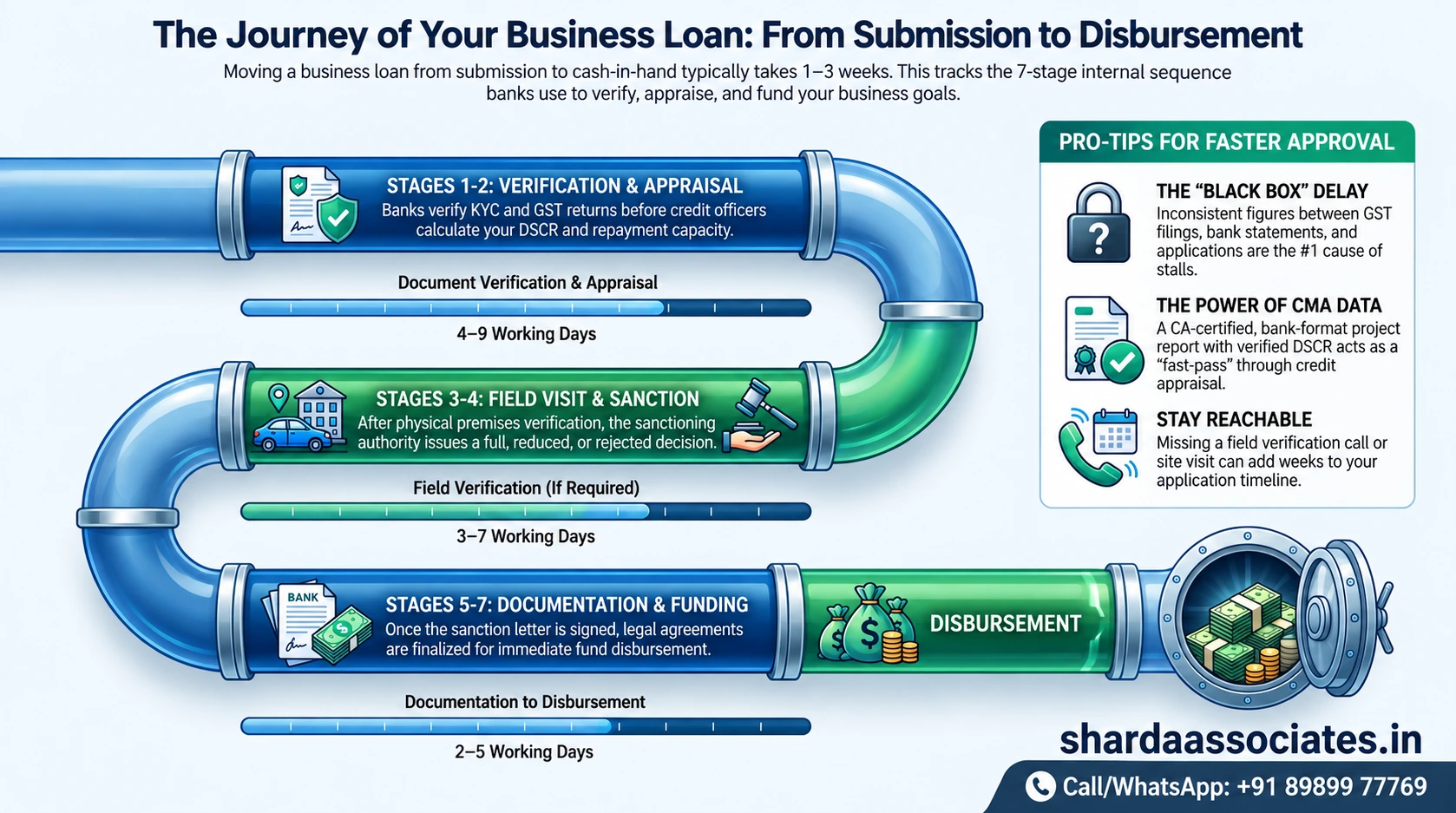
Stage 2: Credit Appraisal and Risk Assessment (Typically 2–5 Working Days)
This is where the credit officer evaluates your repayment capacity in detail:
- DSCR calculation — checking whether your projected income comfortably covers the proposed EMI.
- Turnover and cash flow verification — cross-checking your declared turnover against bank statements and GST filings.
- Credit score and repayment history review — pulling your CIBIL report and checking for defaults, settlements, or irregular repayment patterns.
- Margin money/promoter contribution check — confirming your own contribution meets the bank’s norms for that loan category.
- Collateral valuation, if the loan is secured — a property or asset valuation may be conducted in parallel.
For scheme-linked loans (PMEGP, MUDRA, CGTMSE), this stage also includes checking that your application meets the specific scheme’s eligibility criteria.
Stage 3: Field Verification (Where Applicable)
For many business loans — especially new units, PMEGP applications, or higher-ticket term loans — the bank or a third-party agency conducts a physical verification of your business premises, checks stock or machinery where relevant, and may interview the promoter directly. This step can add several days depending on scheduling and location.
Stage 4: Sanction Decision
Once the credit appraisal is complete, the file moves to a sanctioning authority — this could be the branch manager, a regional credit committee, or a scheme authority (like KVIC/DIC for PMEGP), depending on the loan amount and type. The outcome is one of three:
- Full sanction at the requested amount.
- Reduced sanction, based on DSCR, margin or documentation factors.
- Rejection, with or without a stated reason.
Stage 5: Sanction Letter
If approved, you receive a sanction letter specifying the loan amount, interest rate, tenure, processing fees, and any conditions attached. This is the point to carefully review every term — the amount, rate, repayment schedule, and prepayment charges — before accepting, since these details are also required to be disclosed in the Key Fact Statement (KFS).
Stage 6: Documentation and Agreement Signing (Typically 1–2 Working Days)
After you accept the sanction letter, the bank prepares the formal loan agreement, along with any security creation (for secured loans) and a NACH mandate for EMI collection. This is largely a legal and administrative step rather than a fresh credit review.
Stage 7: Disbursement (Typically 1–3 Working Days After Documentation)
Once all formalities are complete, the sanctioned amount is transferred to your business account — either as a single lump sum (common for term loans) or in tranches (common for construction-linked or working capital facilities). Some lenders disburse directly to a third party, such as an equipment supplier, if that was specified in the loan purpose.
Typical Overall Timeline
| Stage | Approximate Duration |
| Document verification | 2–4 working days |
| Credit appraisal | 2–5 working days |
| Field verification (if applicable) | Varies, often 3–7 days |
| Sanction to agreement signing | 1–2 working days |
| Disbursement after documentation | 1–3 working days |
Overall, most business loan applications move from submission to disbursement in roughly 1–3 weeks, though scheme-linked loans (PMEGP, CGTMSE) and larger term loans can take longer due to additional approval layers.
What Can Delay the Process
- Incomplete or inconsistent documents at submission.
- A project report or CMA data that doesn’t follow the bank’s expected format, triggering queries.
- Mismatches between GST-declared turnover, bank statements and the figures in your application.
- Scheduling delays for field verification.
- Additional queries from the credit committee on DSCR or margin money.
What You Can Do to Keep Your File Moving
- Submit a complete, internally consistent document set the first time — this avoids the most common cause of delay.
- Ensure your project report/DPR and CMA data are CA-certified and follow the bank’s standard format, with a verified DSCR.
- Respond quickly to any verification calls or requests for clarification.
- Keep your bank account active and be reachable for the field verification visit.
Conclusion
The gap between submitting your application and seeing money in your account isn’t a black box — it’s a fairly predictable sequence of verification, appraisal, sanction and disbursement, and most delays trace back to something specific in the documentation rather than the process itself. A well-prepared, bank-format project report or CMA data with a properly calculated DSCR is usually the single biggest lever for moving a file through faster. Our CA team at Sharda Associates prepares exactly this kind of bank-ready documentation daily. Call or WhatsApp us at +9189899 77769 if you’d like your application file reviewed before submission or need help understanding where a pending application currently stands.
Frequently Asked Questions
1. How long does a business loan usually take from submission to disbursement?
Most applications take roughly 1–3 weeks overall, though this varies significantly by lender, loan type, and documentation readiness.
2. What’s the difference between sanction and disbursement?
Sanction is the bank’s approval of the loan and its terms; disbursement is the actual transfer of funds, which happens after agreement signing and any remaining formalities are completed.
3. Is field verification always required?
Not always — it’s more common for new business units, higher-ticket loans, secured loans, and scheme-linked loans like PMEGP, but smaller unsecured loans may skip this step.
4. Can the bank reject my application after field verification?
Yes — field verification is part of the credit assessment, and discrepancies found during the visit (such as a mismatch between the application and the actual business setup) can affect the sanction decision.
5. What should I check before accepting a sanction letter?
Carefully review the loan amount, interest rate, tenure, processing fees, and any prepayment or foreclosure charges before signing the acceptance.
6. Why would my file need multiple rounds of document submission?
This usually happens when the initial documents are incomplete or inconsistent, or when the credit team needs clarification on specific figures like turnover or DSCR.
7. Does a CA-certified project report speed up the process?
It can — a professionally prepared report reduces the back-and-forth queries that arise from inconsistent or unrealistic figures, which is one of the more common sources of delay.
8. Can disbursement happen in parts rather than all at once?
Yes — for working capital facilities and some construction-linked or project loans, disbursement is often structured as tranches rather than a single lump sum.
9. What happens if I don’t respond to a verification call promptly?
This can stall your file at the credit appraisal or field verification stage, so it’s best to stay reachable throughout the process.
10. Can I track my application status?
Many banks and NBFCs provide SMS/email updates or an online portal to check status; for others, following up directly with the branch or relationship manager is the practical option