
Most businesses only discover their billing and payment records are disorganized at the worst possible moment, during a GST audit, a bank loan review, or a client dispute over a payment that supposedly was never received. Up to that point, a mix of paper bills, scattered digital files, and half-remembered payment status seemed to work fine, mainly because nobody had needed to retrieve anything quickly.
Sharda Associates deals with this exact scenario often while preparing CMA data and project reports, spending as much time reconstructing a client’s records into something usable as actually analyzing them. The firm avoids this problem in its own billing by keeping every invoice inside Vinimay’s free software, which means records stay in one searchable place rather than scattered across a folder, a notebook, and someone’s memory.
Start With One Single Source, Not Several
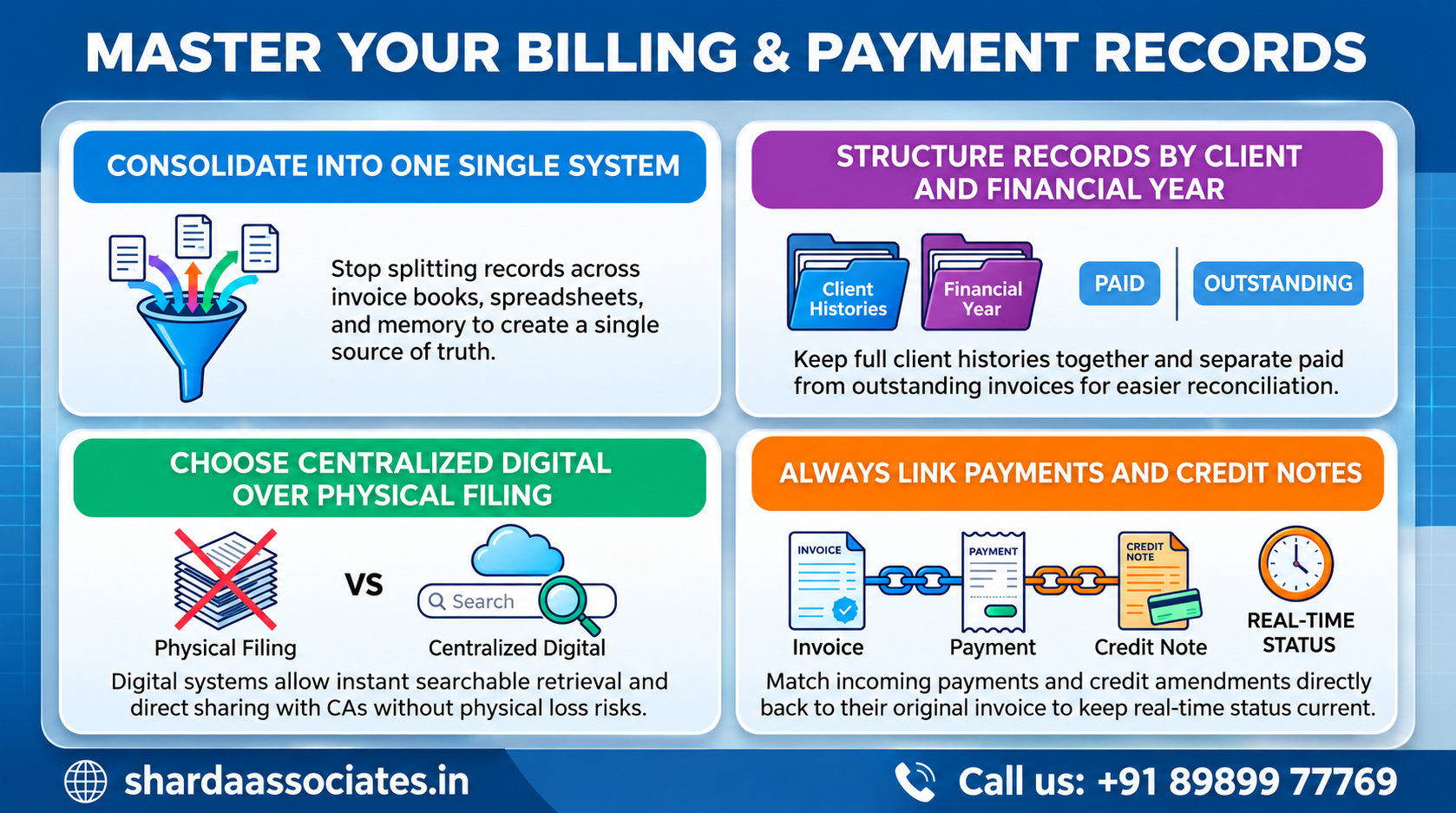
The most common organizational failure is not messiness within one system; it is having several systems at once: an invoice book for some clients, a spreadsheet for others, and memory for the rest. Before anything else, consolidate billing into one place, even if that place is currently just a spreadsheet, so there is a single source of truth to organize from.
A Simple Structure for Filing Records
By client or customer, every invoice and payment tied to a specific client should sit together, so their full history is visible in one place rather than scattered by date across the whole business.
By financial year, records should be grouped by financial year for filing purposes, since GST and income tax both work on this basis, and cross-year mixing makes reconciliation harder than it needs to be.
By status, a quick separator between paid, partially paid, and outstanding invoices, updated regularly, saves considerable time when someone needs to know what is actually owed.
What to Retain and for How Long
- GST-related invoices and records, generally retained for the period prescribed under GST law, which businesses should confirm against current rules
- Bank statements matched against recorded payments, kept alongside the corresponding invoices
- Any credit notes or amendments, linked clearly back to the original invoice they relate to
Digital vs. Physical Filing
| Aspect | Physical Filing | Digital Filing (e.g., via Vinimay) |
| Retrieval speed | Slow, manual search | Fast, searchable by client or date |
| Risk of loss | Higher, single copies | Lower, stored centrally |
| Sharing with a CA or bank | Physical handover | Direct export or access |
| Space required | Physical storage needed | None |
Common Mistakes That Undo Good Organization
- Filing invoices but not linking payments received against them, so status is never actually current
- Starting a good system but reverting to informal habits during busy periods, creating gaps
- Keeping records in a personal folder or device rather than somewhere the whole team or successor can access
Why This Becomes Urgent During Specific Moments
Organization rarely feels urgent day to day, which is exactly why it gets neglected, until a GST notice asks for documentation, a bank wants CMA data prepared quickly, or a new team member needs to pick up client billing without months of handover. Records organized consistently from the start make all three of these moments considerably less stressful.
Conclusion
Sharda Associates sees the value of good organization most clearly in reverse; clients who come in with scattered records take noticeably longer to document for a loan application, and the figures more often need correcting before they can be used at all.
Keeping the firm’s own billing inside Vinimay has meant client records stay searchable by name or date without extra effort, which matters more than it seems until you actually need to pull something up quickly for a filing deadline or a client query.
If your own billing records are currently spread across a notebook, a spreadsheet, and a folder of scanned bills, consolidating them into one searchable system is worth doing before a deadline forces the issue. Call +91 89899 77769 if you would like help organizing your billing records or preparing documentation for a loan application.
Frequently Asked Questions
1. What is the biggest mistake businesses make when organizing billing records?
Using multiple disconnected systems, some invoices in a book, some in a spreadsheet, and some only in memory is more damaging than messiness within a single system.
2. Should invoices be organized by client or by date?
Both matter, but organizing primarily by client, with date as a secondary filter, makes it easier to review a specific customer’s full history when needed.
3. How long should GST-related billing records be retained?
Retention periods are prescribed under GST law and can be updated, so businesses should confirm the current requirement rather than assuming a fixed number of years indefinitely.
4. Does digital filing actually save time compared to physical records?
Yes, searchable digital records are retrieved in moments compared to manually searching physical files, which becomes a bigger time difference as the volume of records grows.
5. What should be linked together when filing a credit note or amendment?
A credit note or amendment should always reference the original invoice it relates to, so the full transaction history stays traceable rather than appearing as a standalone entry.
6. Why does good record organization matter for a bank loan application?
Clean, well-organized records let a CA prepare CMA data and project reports faster and reduce the chance of inconsistencies that slow down bank appraisal.
7. Can Sharda Associates help reorganize an existing mess of billing records?
Yes, Sharda Associates regularly helps clients consolidate and organize existing records as part of preparing financial documentation and loan applications.