
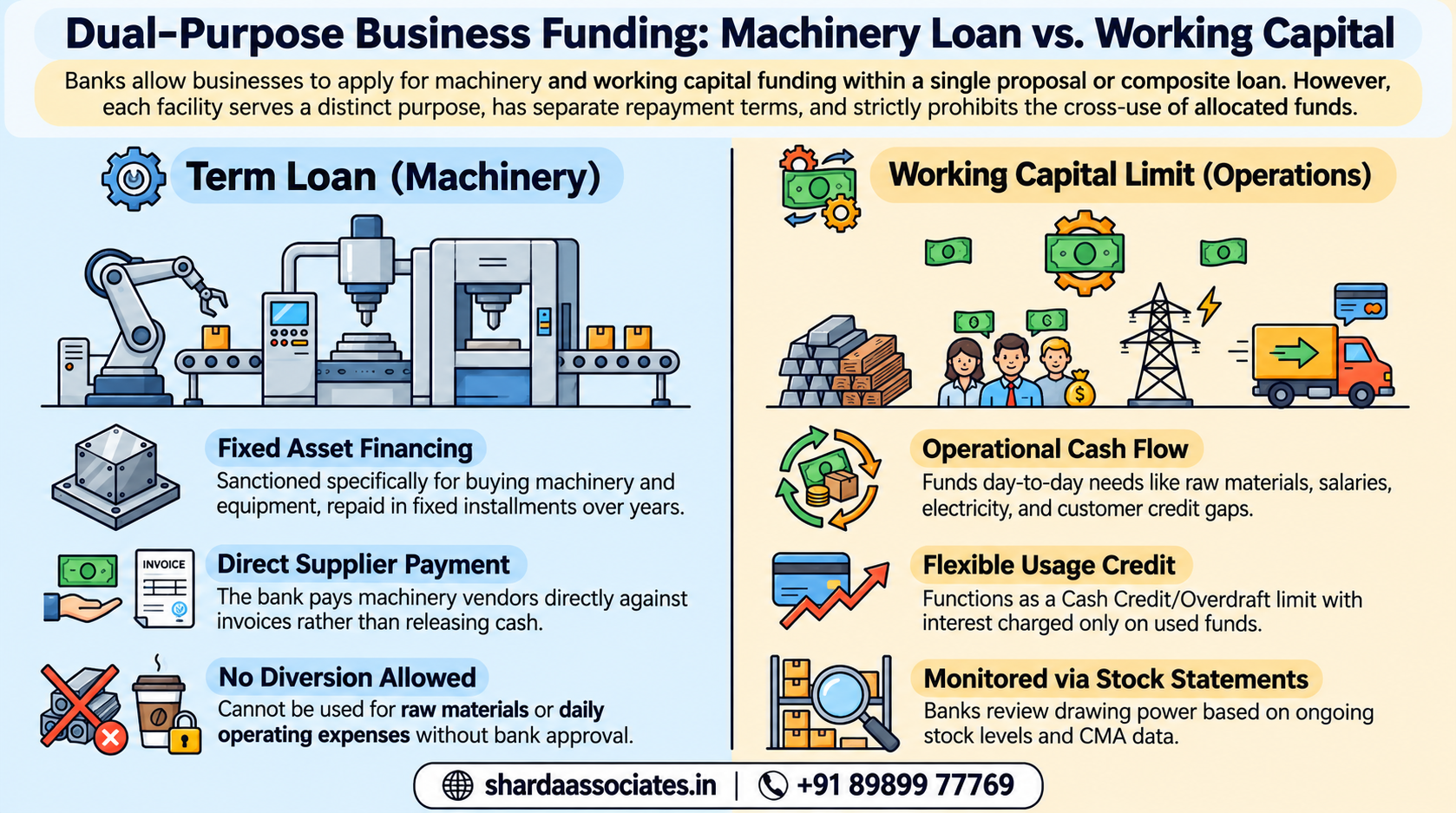
Short answer: Yes, in many cases. A bank can sanction a term loan for machinery and a separate working capital limit, such as cash credit, in the same proposal. Some banks also offer a composite loan that covers both. But the two parts have different purposes, so you cannot freely use one for the other. Your sanction letter decides what each amount can be used for.
Introduction
Many business owners think of a loan as one lump sum. They plan to buy machinery, and whatever money is left they plan to use for raw material, salaries and daily expenses. When the bank sanctions the loan, they find that the amount was approved for a specific purpose and cannot be used any way they like. This is because machinery and working capital are two different needs. Machinery is a long-term asset and is repaid over years. Working capital is the money needed to run the business every day, and it moves up and down with your stock and sales. Banks assess and monitor them differently, even when both come in one proposal.
At Sharda Associates, we prepare CA-certified project reports and CMA data, and we help MSMEs with bank loan documentation. In this guide, we explain how a business can get finance for both machinery and working capital, how the bank treats each part, and what you should avoid after sanction.
Can One Loan Cover Both Machinery and Working Capital?
Yes, it is possible, but it usually comes as two parts under one proposal, not as one amount that you can spend freely. The machinery part is a term loan, and the working capital part is a limit like cash credit or overdraft. Some banks also offer a composite loan, where both are sanctioned together under one process.
- Term loan: for machinery and other fixed assets, repaid in instalments
- Working capital limit: for raw material, stock and day-to-day needs
- Composite loan: both together, as per the bank’s scheme
Ask your branch which of these your bank offers.
Why Does a New or Expanding Unit Need Both?
Buying machinery alone does not start production. You still need raw material, labour, electricity and packaging, and you need to wait for customers to pay. If your whole budget goes into the machine, the business runs short of cash in the first few months.
- Machinery gives you the capacity to produce
- Working capital gives you the money to actually produce and sell
- A project report that shows both gives the bank the full picture
Can I Use the Machinery Loan Money for Working Capital?
No, not on your own. A term loan is sanctioned for a specific purpose, and the bank usually pays the supplier directly against an invoice. Using that money for other needs is called diversion of funds, and it can create serious problems with the bank. If you need more working capital, apply for it properly.
- Use the term loan only for the sanctioned machinery
- Use the working capital limit only for business operations
- If your needs change, inform the bank in writing and ask for approval
How Does the Bank Decide the Working Capital Part?
The bank studies how much money gets blocked in your business between buying raw material and receiving payment from customers. Your project report and CMA data show this estimate. The bank then deducts your margin and any supplier credit, and sanctions a limit within the remaining gap.
- Raw material and finished goods stock
- Credit period given to customers
- Credit period received from suppliers
- Your own margin contribution
Do I Need to Bring Margin Money for Both?
Usually yes. The bank generally expects your contribution toward the machinery and also toward working capital. The percentage can differ for each part, depending on the bank’s policy and the type of project.
- Margin on machinery is part of the project cost
- Margin on working capital is part of the current assets funded by you
- Plan your own funds for both before you apply
What Happens After Sanction?
Both parts follow different rules after sanction. The term loan is repaid as per a fixed schedule, possibly after a moratorium. The working capital limit stays open, with interest charged on the amount you use, and the bank may ask for stock statements to check your drawing power.
- Term loan: fixed instalments
- Working capital: usage-based, reviewed regularly
- Both: keep your account regular and your documents consistent
Example: A Small Spice Processing Unit
A small unit plans to start spice processing. It needs ₹30 lakh for grinding and packing machinery, and it also needs money to buy raw spices and packaging material every month.
The owner prepares one project report that shows both needs. The bank sanctions a term loan for the machinery and a separate cash credit limit for raw material and packaging. The bank pays the machinery supplier directly. The cash credit limit is used only for buying raw material and running the unit.
Later, the owner finds that cash is tight and wants to use part of the term loan for raw material. The bank does not allow it, because the term loan was sanctioned only for machinery. He then requests a review of the working capital limit, supported by his actual sales figures.
Conclusion
A business can get finance for both machinery and working capital, but the two parts work differently. The machinery loan is for buying the asset, and the working capital limit is for running the business. Mixing the two without the bank’s approval can create problems.
The best time to plan for both is before you apply. Calculate how much your machinery will cost, how much raw material and credit you will need in the first year, and how much of your own money you can bring in. Show all of this clearly in your project report so the bank sees one complete plan.
A realistic, CA-certified project report with accurate CMA data helps the bank assess your machinery and working capital needs together. If you need help with your project report or loan documentation, call or message our team directly. Contact us: +91 89899 77769
Frequently Asked Questions
1. Can a business loan be used for both machinery and working capital?
Yes, but usually as two parts: a term loan for machinery and a working capital limit for operations. Some banks offer a composite loan. Each part has its own purpose, so check your sanction letter for permitted use.
2. What is a composite loan?
A composite loan combines a term loan and a working capital facility in one sanction from one bank. It saves you from applying separately. The terms, limits and eligibility depend on the bank and its scheme.
3. Can I use my term loan for raw material?
Not without the bank’s approval. A term loan is sanctioned for specific machinery, and using it elsewhere is treated as diversion of funds. If you need more working capital, request a separate limit or a review.
4. Do I need a separate project report for working capital?
Usually no. One project report with CMA data can show both the machinery cost and the working capital requirement. This helps the bank assess the complete project in one go instead of two separate proposals.
5. Will the bank ask for margin money on both parts?
Generally yes. The bank expects your contribution toward the machinery and toward working capital. The percentage can differ for each, depending on the bank’s policy. Ask your branch for the exact margin before you apply.
6. Is the interest rate the same for both?
Not always. Term loans and working capital limits can carry different rates and charges, depending on the bank and the scheme. Check your sanction letter for the rate, processing fee and any other charges on each part.
7. Can I get working capital later if I take only a machinery loan now?
You can apply later, but it may be harder without a track record, and the bank will assess your actual performance. Including working capital in the first proposal is often easier, because the bank sees the whole project.
8. What documents are needed for both machinery and working capital?
Usually KYC, project report, CMA data, machinery quotations, Udyam registration, GST details and financial documents. For working capital, the bank may also ask for stock details later. Your branch will confirm the exact list.