
Starting a new business almost always means arranging capital before the first rupee of revenue comes in, and this is exactly where most first-time entrepreneurs get stuck, unsure which loan scheme fits their business, what eligibility criteria actually apply, and which documents a bank will ask for. Sharda Associates is a CA-led firm that has delivered over 45,500 CA-certified project reports, accepted by SBI, PNB, Bank of Baroda and all scheduled banks, helping first-time founders put together the exact documentation their chosen financing route requires. This guide walks through eligibility, documents and the main financing options available for a new business in India.
Who Is Eligible for a Startup Business Loan?
Eligibility criteria vary by lender and scheme, but most banks and NBFCs assess a similar core set of factors before sanctioning a loan to a new business.
- Age of the applicant, commonly between 21 and 65 years at loan maturity
- Business registration in a recognised legal form, proprietorship, partnership, LLP or private limited company
- A credible project report or business plan demonstrating technical and financial viability
- Promoter’s personal credit history and, where applicable, existing loan obligations
- Collateral or guarantee availability, depending on the loan scheme chosen
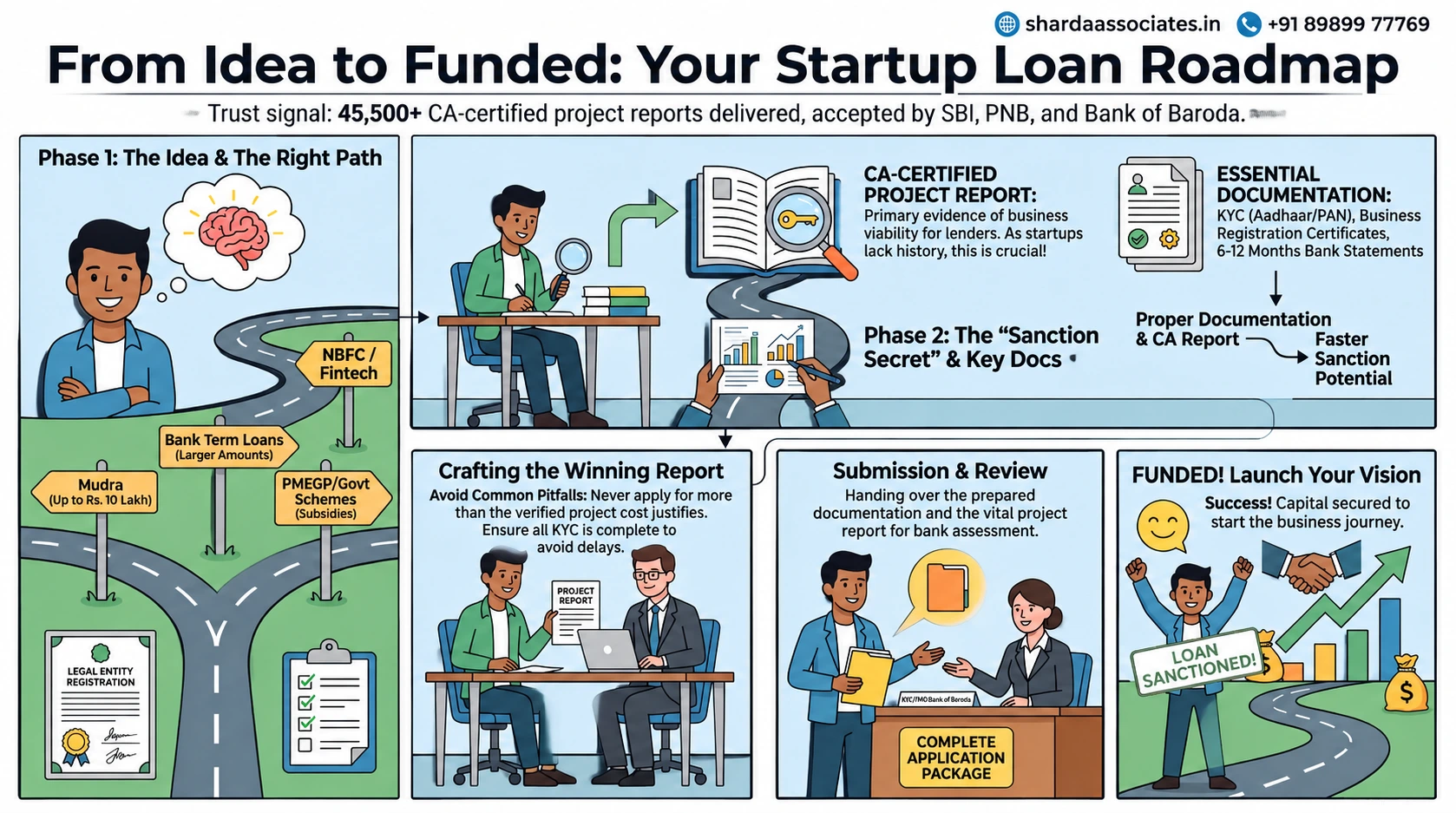
Main Financing Options for a New Business
Bank Term Loans
Traditional bank term loans remain the most common route for funding machinery, working capital or business setup costs, and require a detailed project report covering project cost, means of finance and repayment capacity.
Government-Backed Schemes
Schemes such as PMEGP, Mudra Loan, and Stand-Up India are designed specifically for new and first-time entrepreneurs, often with subsidy components or relaxed collateral requirements compared to standard term loans.
NBFC and Fintech Lending
Non-banking financial companies and digital lenders often offer faster turnaround and more flexible documentation for smaller loan amounts, though typically at a higher interest rate than scheduled banks.
Comparing Startup Financing Options
| Financing Option | Typical Loan Range | Collateral Requirement | Approximate Turnaround |
| Bank Term Loan | Higher amounts, project-cost dependent | Often required above a threshold | 3-6 weeks |
| PMEGP / Government Schemes | Scheme-defined limits with subsidy component | Relaxed under scheme guidelines | 4-8 weeks |
| Mudra Loan | Up to Rs.10 lakh (Shishu/Kishor/Tarun categories) | Generally collateral-free | 1-3 weeks |
| NBFC/Fintech Loan | Smaller ticket sizes | Minimal to none | Few days to 2 weeks |
Note: exact limits, rates and turnaround vary by lender and scheme guidelines in force at the time of application and should be confirmed with the specific institution.
Documents Required for a Startup Loan
- KYC documents of the promoter(s), Aadhaar, PAN, address proof
- Business registration certificate and MOA/partnership deed, as applicable
- CA-certified project report covering project cost, means of finance, and financial projections
- Bank statements for existing accounts, if any, typically for the last 6 to 12 months
- Collateral documents, where the loan scheme requires security
Why the Project Report Matters More Than Founders Expect
A new business has no operating history for the bank to assess, which makes the project report the primary evidence of viability. A generic or templated report, without realistic market assumptions and CA-certified financial workings, is one of the most common reasons first-time applications face delays or reduced sanction amounts.
Common Mistakes First-Time Applicants Make
- Applying for a loan amount higher than the project cost actually justifies, based on rough personal estimates rather than a verified project report
- Submitting incomplete KYC or registration documents, which delays scrutiny even when the business idea itself is sound
- Choosing a financing route without comparing collateral requirements and effective cost across options
Conclusion
The right financing option for a new business depends on loan size, collateral availability and how quickly you need funds, and getting the project report and documentation right the first time avoids weeks of delay. Sharda Associates prepares CA-certified project reports and CMA data accepted by SBI, PNB, Bank of Baroda and all scheduled banks. Call +91 89899 77769 to get your startup loan documentation ready.
Frequently Asked Questions
1. Can a first-time entrepreneur get a business loan without any credit history?
Yes, schemes like PMEGP and Mudra Loan are designed for first-time entrepreneurs, though a strong project report and, where applicable, a co-applicant or guarantor can improve approval chances.
2. Is collateral always required for a startup loan?
Not always. Schemes like Mudra Loan and CGTMSE-backed loans are generally collateral-free up to specified limits, while larger bank term loans often require security.
3. What is the minimum project report requirement for a new business loan?
Most banks require a project report covering project cost, means of finance, profitability projections, break-even and repayment capacity, CA-certified where possible.
4. How long does it take to get a startup loan sanctioned?
Turnaround varies by lender and scheme, ranging from a few days for smaller NBFC loans to several weeks for larger bank term loans or government scheme applications.
5. Can I apply for a government scheme and a bank loan together?
Some schemes are structured as bank loans with a government subsidy component, so it is worth checking whether your chosen scheme is a standalone option or works through a partner bank.
6. What credit score is generally expected for a startup loan?
Requirements vary by lender, but a stronger personal credit score generally improves approval chances and loan terms, especially for larger, unsecured loan amounts.
7. Does Sharda Associates help with PMEGP and Mudra loan documentation as well as bank term loans?
Yes, project reports and documentation are prepared for PMEGP, Mudra, Stand-Up India and standard bank term loan applications.
8. What happens if my project report shows lower profitability than expected?
This is useful information before applying, since it lets you revise the project scope or financing structure rather than facing rejection or a reduced sanction later.
9. Can NBFC loans be a good option for a new business?
NBFC and fintech loans can offer faster turnaround for smaller amounts, though the effective cost is usually higher than a scheduled bank loan, so this should be weighed against urgency and collateral constraints.
10. Does Sharda Associates prepare documentation for both new and existing businesses?
Yes, project reports and financial documentation are prepared for first-time startups as well as expansion and diversification projects of existing businesses.