
Quick Answer
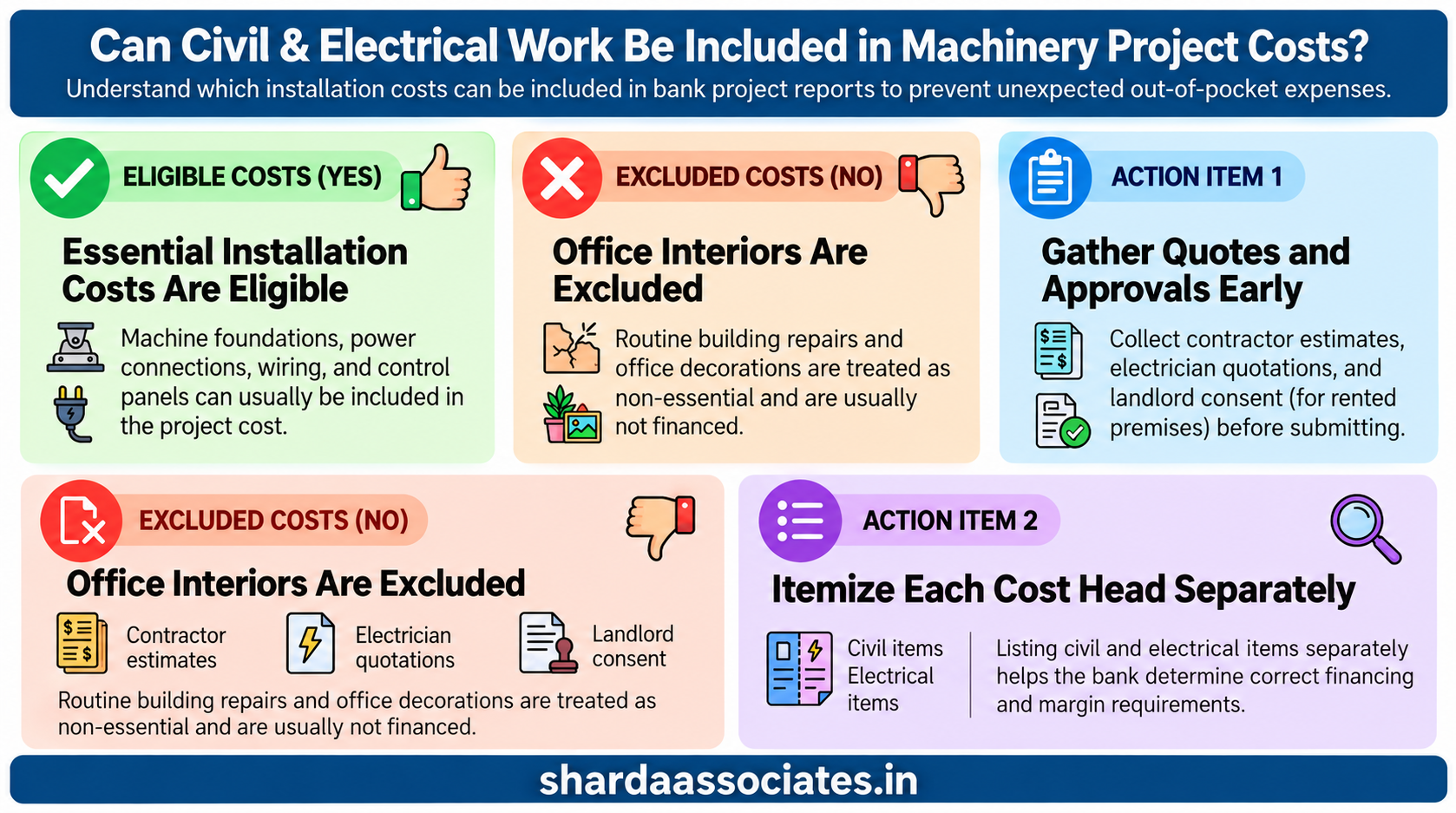
Yes, in many cases. Electrical fittings and civil work that are directly needed to install and run the machinery, such as the machine foundation, platform, wiring, panel and power connection, are commonly shown in the project cost. The bank then decides how much of it to finance and how much you must fund as margin money. General building or office renovation is treated differently. Your bank’s policy and sanction letter are the final reference.
Introduction
Buying the machine is only half the job. Before it can run, it often needs a proper foundation, a shed or platform, a power line, a control panel, earthing and wiring. Many first-time borrowers leave these out of their budget and then pay for them from their own pocket after the loan is sanctioned.
Banks look at the project as a whole. If a cost is necessary to make the machinery operational and is supported by estimates, it can usually be included in the project report. If it is not planned and documented, the bank may not consider it.
At Sharda Associates, we prepare CA-certified project reports, CMA data and DPRs, and handle bank documentation for MSME and government scheme loans. This guide explains which electrical and civil costs are usually accepted, how to present them, and how to avoid a funding gap.
Why These Costs Belong in the Project Plan
A machinery project is not just the machine. The total project cost normally covers everything required to set up a working unit: the equipment, its installation, the civil structure that supports it, and the utilities that power it.
When these items are listed separately in the project report, the bank can see what each rupee is for. When they are missing, the bank sees only the machine price, and the loan is built on that incomplete picture.
Electrical and Civil Work Items Banks Commonly Consider
| Item | Usually considered? | What to keep ready |
| Machine foundation and base | Generally yes | Contractor estimate or engineer’s drawing |
| Platform, pit or mounting structure | Generally yes | Estimate with quantities |
| Factory shed or building for the unit | Depends | Separate civil estimate, ownership or lease papers |
| Power connection and load enhancement | Often yes | Electricity board estimate or receipt |
| Wiring, cabling and control panel for the machine | Often yes | Electrician’s quotation |
| Transformer or generator set | Depends | Quotation and capacity requirement |
| Earthing, safety and fire fittings | Often yes | Quotation |
| Plumbing or water line for the process | Depends | Estimate |
| Office interiors and decoration | Usually no | Treated as non-essential |
| Repair of an old building | Depends | Bank may treat it differently |
This is a general guide only. Each bank and scheme has its own rules, so confirm with your branch before finalising the estimate.
Machinery Cost vs Building Cost
Banks often divide the project cost into groups such as land, building or civil work, plant and machinery, and other fixed assets. Electrical fittings that are part of the machine installation are usually placed under machinery or other fixed assets. Foundations and sheds usually fall under civil work or building.
This matters because the margin money, the security requirement and sometimes the scheme limits can differ between these groups. Your project report should show each item under the right heading rather than lumping everything together.
Will the Bank Finance the Full Amount?
Normally no. The bank finances a share of the eligible project cost, and you bring in the rest as margin. The share can differ for machinery and for civil work. In some cases, the bank may not finance a particular item at all, even though it appears in the project cost.
Also, finance for land or building may depend on ownership or lease conditions, so the bank may ask for property documents and a valuation. Ask the branch which items will be financed and how each will be paid before you start work.
Ownership and Permission Matter
If the civil work is on rented premises, the bank may ask for a valid lease or rent agreement and the owner’s consent for the improvements. If the land or building is yours, expect questions about title and approvals. Electrical connections may also need permission from the electricity provider, and some activities need local licences. Handle these early, because delays here can hold up both installation and disbursement.
Example: A Small Manufacturing Unit
(Illustrative example: figures are not from any real case.)
A small unit plans to install a new production machine in a rented shed. The owner’s first estimate shows only the machine price. During discussions, the branch asks about the foundation, the power load and the wiring.
The owner then collects a contractor’s estimate for the foundation, an electrician’s quotation for the panel and cabling, and a written consent from the shed owner. All three go into a revised project report as separate line items. The bank appraises the full project, confirms what it will finance, and tells the owner which costs fall under margin money.
The owner now knows the real investment needed before placing any order.
Common Mistakes to Avoid
- Including only the machine price in the project report
- Adding civil work or electrical costs without any estimate or quotation
- Mixing office decoration or routine maintenance with project cost
- Starting construction before the bank approves the plan
- Ignoring the landlord’s consent for work on rented premises
- Underestimating the power load the machine needs
- Assuming every item will be financed by the bank
- Adding new costs after sanction without informing the bank
How to Plan These Costs Properly
- Ask the machine supplier for the foundation drawing, power requirement and installation needs.
- Get written estimates from a civil contractor and an electrician.
- Confirm the power load and any electricity provider charges.
- List each item separately in your project report, under the right cost head.
- Check the bank’s margin requirement and which items it will finance.
- Arrange ownership, lease and permission papers in advance.
- Inform the bank in writing before changing the plan or adding costs.
Generally no. Banks usually treat them as non-essential to the machinery.
Conclusion
Electrical fittings and civil work that are essential to installing and running your machinery can often be included in the project cost. The key is to plan them from the start, back each item with an estimate, and place it under the right head in your project report.
Do not assume that every item will be financed. Confirm the margin, the payment method and the bank’s treatment of each cost before you begin work. If your plan changes after sanction, tell the bank in writing first.
A well-prepared, CA-certified project report with accurate CMA data helps the bank see the complete picture and avoids a funding gap later. If you need help with your project cost, DPR or bank documentation, call or message our team directly. Contact us at +918989977769.
Frequently Asked Questions
1. Can electrical fitting be included in the machinery project cost?
Generally, yes, if the electrical work is necessary to install and operate the machinery and is supported by a proper quotation. The bank decides the eligible amount for financing.
2. Is civil work covered in a machinery loan?
Often, yes, for essential works such as machine foundations, platforms, or other structures required for installation. Larger construction or building costs may be considered under a separate civil work component.
3. Will the bank finance the full cost of civil and electrical work?
Usually, the bank does not finance the entire cost. The borrower is generally required to contribute margin money, while the bank finances the eligible portion according to its lending policy.
4. Can I include a new power connection in the project cost?
Often, yes, when the new power connection is required for operating the proposed machinery. Keep the electricity provider’s estimate, demand note, or relevant payment receipt as supporting documentation.
5. Can I include civil work on rented premises?
It may be considered, depending on the bank’s policy and the nature of the work. The bank may require a valid lease agreement and consent from the property owner before considering the expenditure.
6. Can I add these costs after the loan is sanctioned?
Inform the bank before making significant changes. Any increase or modification in the project cost may require approval, revised estimates, or reappraisal by the bank.
7. Can installation and commissioning charges be included in the machinery project cost?
Yes, installation, testing, and commissioning charges may be considered when they are directly related to setting up the machinery. Proper vendor quotations and supporting documents should be maintained.
8. Can transportation charges for machinery be included in the project cost?
Transportation and related handling charges may be included when they are necessary to bring and install the machinery at the project location. Eligibility depends on the bank’s project-finance guidelines.
9. Can wiring and electrical panels be included in the project cost?
Yes, wiring, electrical panels, cabling, and related electrical infrastructure may be considered when they are essential for operating the machinery. The bank may require detailed quotations for these items.
10. What documents are needed for civil and electrical project costs?
Banks may ask for supplier quotations, civil-work estimates, electrical contractor quotations, electricity connection estimates, lease documents, owner consent, and other supporting documents to verify the proposed project expenditure.