
Short answer: Do not guess and do not ignore the gap. Start from the GST returns turnover, adjust for items that GST and income tax treat differently, and compare the result with the revenue in your books and ITR. If timing or classification explains the difference, document it. If it comes from a genuine omission, correct it through a revised ITR, a later GST return or a payment, before the department asks.
Few things worry a business owner more than seeing two departments quote two different turnovers for the same year. The GST return shows one figure, the income tax return shows another, and both were filed honestly from the same books.
Sharda Associates is a CA-led firm that has prepared over 45,500 CA-certified reports. Lenders compare GST turnover, ITR income and bank statements when they appraise a loan, so a turnover gap can show up in a loan file just as easily as in a tax notice.
This guide explains how to find the cause of the gap, how to build a simple reconciliation, and what to do when the difference is real. It is general information, so confirm the treatment of your case with your CA and read any notice you have received carefully.
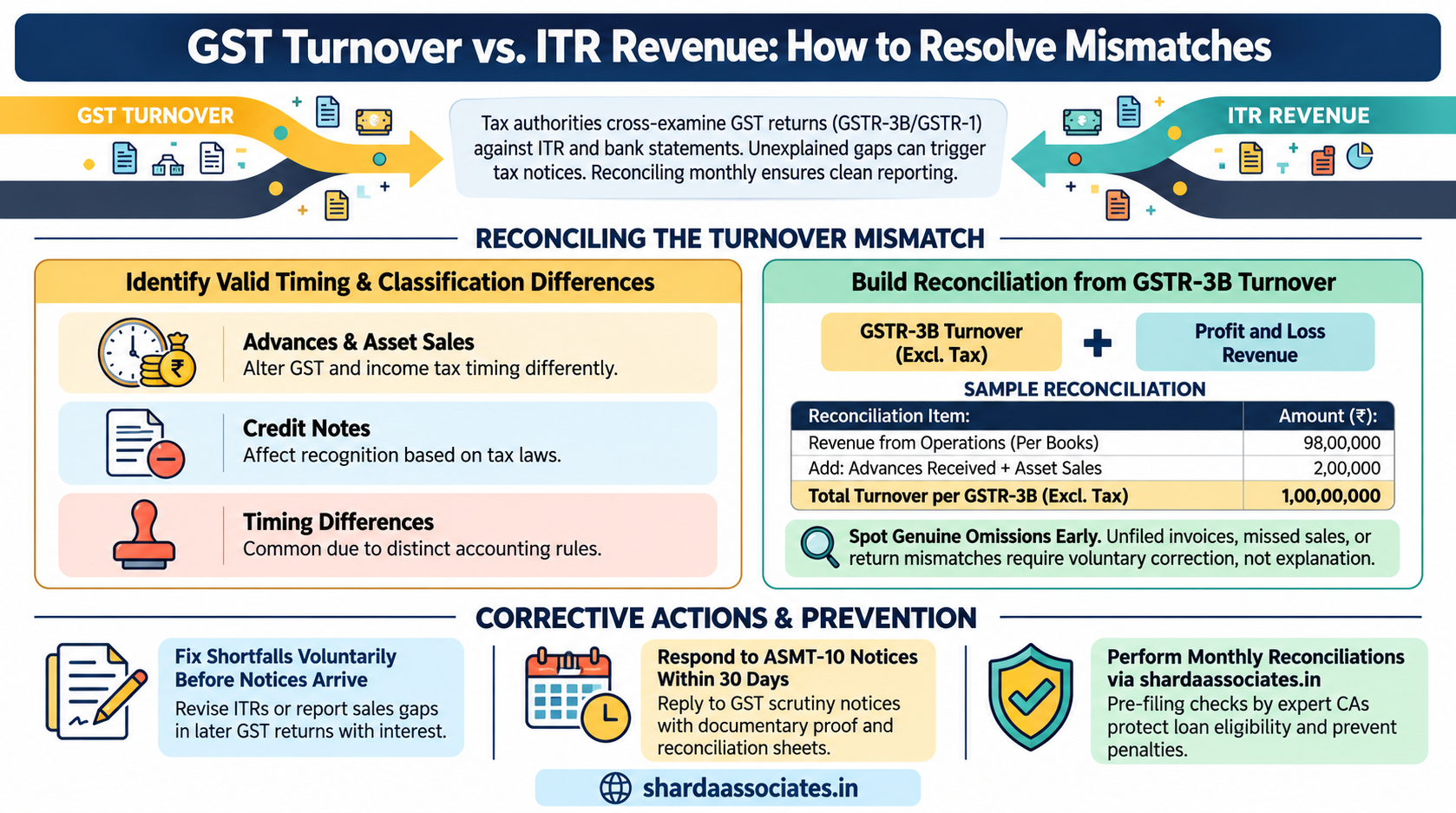
Why Does the Gap Matter in GST Returns Turnover?
GST returns turnover is reported through your returns and is visible in income tax records such as the Annual Information Statement. The two departments can therefore see both numbers. A gap is not proof of under-reporting, since the two systems measure turnover on different bases, but an unexplained gap invites a question, and an unanswered question can become a notice.
How Do You Build the Reconciliation?
- Take the annual gst returns turnover from GSTR-3B for the financial year, excluding tax, and compare it with GSTR-1 and GSTR-9 if filed.
- Take the revenue from operations in your profit and loss account.
- List every item that appears in one but not the other.
- Classify each as timing, classification or error.
- Attach a document for each item, such as an invoice, advance receipt or ledger extract.
- Keep the reconciliation with your ITR working papers.
Here is an illustration with made-up figures:
| Item | Amount (₹) |
| Revenue from operations per books | 98,00,000 |
| Add: advances received, GST paid, revenue recognised next year | 1,50,000 |
| Add: sale of old machinery, a supply under GST, shown outside revenue in books | 50,000 |
| Turnover per GSTR-3B (excluding tax) | 1,00,00,000 |
Which Differences Are Usually Valid?
- Advances. GST may be payable when an advance is received for services, while income tax recognises the income under your accounting method.
- Non-GST income. Interest, rent or discounts may sit in your books but are not GST supplies, depending on how you classify them.
- Sale of assets. Capital items can be supplies for GST but are not part of revenue in the books.
- Credit notes and returns. These may fall in a different month from the original sale.
- Different treatment of exempt, nil-rated and export supplies across the return fields.
When Is the Gap a Real Error?
A real error usually looks like one of these: sales missed in the ITR or the books, invoices raised but never reported in GST, a GSTR-1 that does not agree with GSTR-3B, or cash sales left out of both. These need correction, not explanation.
How Do You Correct a Real Difference?
If the ITR is short, a revised return may be possible within the time allowed, so check the date on the portal. If the GST return is short, the difference can generally be reported through a later return or paid voluntarily with interest, as the facts require. Align your books so that next year’s figures start clean, and confirm the route with a CA before acting.
What If You Have Already Received a Notice?
Read the form and the date first. A GST scrutiny notice in ASMT-10 is generally answered in ASMT-11 within 30 days, extendable on request. An income tax intimation or enquiry will state its own date. In both cases, reply with the reconciliation and documents, not with a general statement.
How Can You Avoid the Gap Next Year?
- Reconcile your sales register with GSTR-1 and GSTR-3B every month
- Record advances and credit notes in the correct period
- Keep non-GST income in separate ledger heads
- Reconcile GSTR-9, the books and the ITR before you file the return
What Documents Should You Keep for the Reconciliation?
A reconciliation is only as good as the paper behind it. Keep these together for each financial year:
- Copies of GSTR-1, GSTR-3B and, if filed, GSTR-9
- The sales register and the sales ledger from your books
- Advance receipt vouchers, credit notes and debit notes
- Records of any sale of fixed assets
- Bank statements that support receipts
- The signed reconciliation sheet prepared with your CA
Keep them for as long as the law requires you to retain records, and confirm that period with your CA, since it can change. If a question comes years later, this one folder answers it.
Conclusion
A gap between GST turnover and ITR turnover is common, and most gaps have a simple, documentable reason. The skill is in finding the reason before the department does and having the paper ready.
The practical rule is to reconcile once a month, not once a year. A twenty-minute check of your sales register against GSTR-3B is far cheaper than rebuilding twelve months of records under a notice deadline.
If you want your turnover reconciled before you file, or a gap looked at, call Sharda Associates on +91 89899 77769. Outcomes depend on the facts, so no result can be promised.
Frequently Asked Questions
1. Should GST turnover and ITR turnover be equal? Not always. They are measured on different bases, so differences can be valid, but they should be explainable.
2. Which GST figure should I compare, GSTR-1 or GSTR-3B? Check both along with GSTR-9. GSTR-3B is the return in which you declare tax, so most reconciliations start there.
3. Does GST turnover include the tax? No. Compare turnover excluding GST with the revenue in your books.
4. Can advances cause a mismatch? Yes. GST can apply when an advance is received, while income may be recognised later under your accounting method.
5. What if I find that I under-reported? Correct it through a revised return, a later GST return or payment, as the facts require, and take advice on interest.
6. How long do I have to reply to an ASMT-10? Generally 30 days, extendable on request. Check the date in your notice.
7. Can this affect my bank loan? Lenders compare GST, ITR and bank statements, so an unexplained gap can raise questions.