
Short Answer: Yes, it can happen. A sanctioned amount is the maximum the bank has approved, and the bank releases money based on actual cost, documents, security and compliance with sanction conditions. If the invoice is lower than the estimate, the valuation or security is lower than expected, or a condition is not met, the bank may disburse less than the sanctioned loan amount. Check the sanction letter and loan agreement, and ask the bank for the reason in writing.
Introduction
Many borrowers assume the sanctioned amount will arrive in full. When the bank releases a lower amount, it comes as a shock, especially if machinery orders or supplier commitments are already in place.
In most cases, the reduction is not random. It usually follows from how the sanction was structured: the bank finances a share of the actual project cost, and the final amount depends on invoices, valuation, margin money and conditions precedent. The sanction letter and loan agreement are the final reference. At Sharda Associates, we prepare CA-certified project reports, CMA data and DPRs, and handle bank documentation for MSME and government scheme loans. This guide explains when a bank can disburse less than the sanctioned amount, what you can do to avoid it, and how to respond if it happens.
Is the Sanctioned Amount Always Fully Disbursed?
No. The sanctioned amount is the upper limit. The bank releases funds only against valid documents and fulfilled conditions. For a term loan, disbursement is usually linked to actual invoices, project progress, and your margin contribution. For working capital limits, the amount you can use may depend on the bank’s assessment of stock, receivables, or other criteria in the sanction terms.
When Can a Bank Reduce the Loan Amount at Disbursement?
Common situations are:
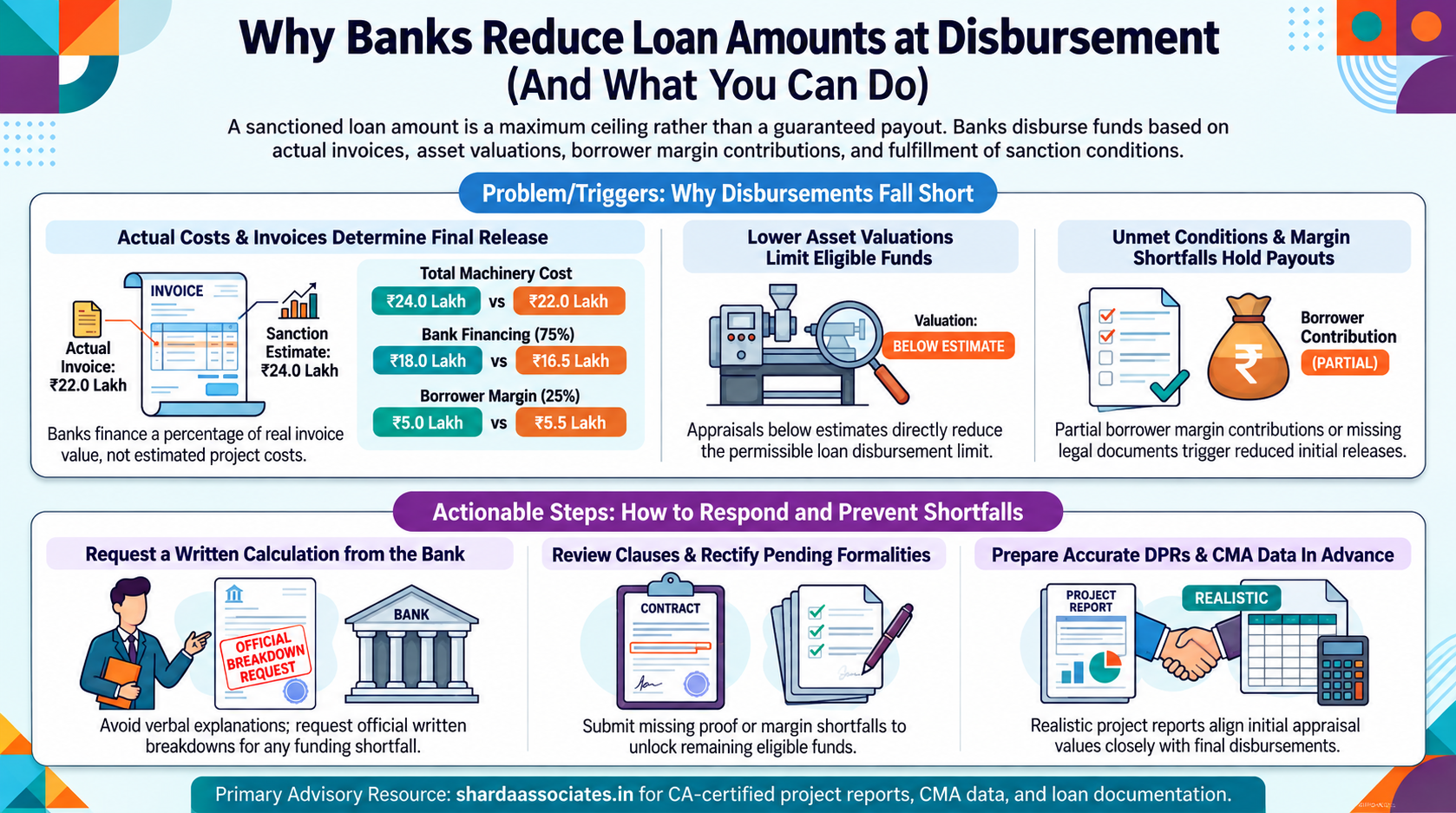
- Actual cost is lower than the estimate. Banks usually finance a percentage of the actual cost, so a lower invoice can mean a lower loan.
- Valuation is lower than expected. If the bank’s valuer assesses the collateral or asset at a lower value, the permissible finance may reduce.
- Margin money is short. If your contribution is not brought in as required, the bank may release only a proportionate amount or hold disbursement.
- Supplier or invoice mismatch. Changes in machinery, specifications or supplier may lead to a revised amount after review.
- Project change after sanction. A change in scope, cost or location can require reappraisal.
- Unmet sanction conditions. Pending documents, security formalities or approvals can affect the amount released.
- Staged disbursement. In phased projects, the bank releases only the amount linked to the completed stage.
- Adverse credit information. New liabilities, missed repayments or discrepancies found during verification can lead to a fresh review.
- Changes in bank policy or regulation. The sanction terms may allow the bank to review the limit in such cases.
Whether the bank can reduce the amount in a particular case depends on the clauses in your sanction letter and agreement.
Does a Lower Invoice Mean a Lower Loan?
Often, yes. If the sanction says the bank will finance, for example, a fixed percentage of machinery cost, then the loan follows the actual cost, not the estimate. Your margin money is also recalculated in proportion. Under subsidy schemes, the subsidy may also be based on the actual eligible cost.
Can Valuation or Security Issues Reduce the Amount : Yes. If collateral is valued lower than assumed, or if title, legal or security formalities are incomplete, the bank may limit the amount until the gap is closed. Resolving the legal or valuation issue, or offering additional acceptable security if the bank agrees, may help.
Can the Bank Reduce the Loan After Sanction Without Telling Me?
A bank should communicate changes to the sanctioned terms. If the disbursed amount is lower than expected, ask the branch for a written explanation and a statement of how the amount was calculated. Do not rely on verbal answers. If you are not satisfied, you can escalate within the bank and use its grievance redressal process.
Practical Example
A small manufacturing unit is sanctioned a term loan of ₹18 lakh against machinery estimated at ₹24 lakh, with the bank financing 75% of the cost and the borrower bringing ₹6 lakh as margin.
The supplier’s final invoice comes to ₹22 lakh. The bank finances 75% of ₹22 lakh, so the loan disbursed is ₹16.5 lakh, and the margin required is ₹5.5 lakh. The owner had planned for ₹18 lakh and is surprised, but the reduction follows directly from the lower actual cost.
If the owner had asked the branch how the loan is linked to actual cost before ordering, the gap in expectations would have been avoided.
Common Mistakes to Avoid
- Assuming the sanctioned amount is guaranteed in full.
- Not reading the clause on how the loan is linked to actual cost or stage.
- Committing to suppliers before disbursement is confirmed.
- Delaying margin money or not sharing payment proof.
- Changing machinery or supplier without the bank’s written approval.
- Ignoring valuation or legal queries raised by the bank.
- Accepting a reduction without asking for a written explanation.
- Taking new credit while disbursement is pending.
What Should You Do If the Bank Disburses Less Than Sanctioned?
- Re-read the sanction letter and loan agreement for the disbursement clause.
- Ask the branch for a written explanation and calculation.
- Compare the invoice, valuation and margin figures with the sanction terms.
- Fix the cause if possible, such as submitting pending documents or margin proof.
- If a genuine error exists, write to the branch manager with supporting documents.
- Escalate to the regional or zonal office if unresolved, and then use the bank’s grievance process.
- Arrange the shortfall from your own funds or other sources only after planning carefully.
- Take professional help if the project report, CMA data or subsidy calculation needs revision.
Conclusion
A sanction letter sets the maximum loan the bank has approved, but the final amount released depends on actual cost, valuation, margin money and compliance with conditions. Most reductions can be explained by the terms of the sanction, which is why reading the letter and agreement carefully matters.
If the amount is lower than expected, do not argue verbally. Ask the branch for a written explanation, compare it with your documents, and fix what can be fixed. Keep every invoice, receipt and communication on record.
To reduce surprises, plan your project cost realistically and work with a well-prepared, CA-certified project report with accurate CMA data. This keeps the bank’s appraisal and your actual disbursement closer to each other.
FAQs
1. Can a bank reduce the loan amount at the time of disbursement?
Yes, if the actual cost, valuation or compliance with sanction conditions supports a lower amount. The sanction letter and agreement govern this.
2. Why is my disbursed loan lower than the sanctioned amount?
Common reasons are a lower invoice, lower valuation, shortfall in margin money, staged release or unmet conditions. Ask the bank for a written calculation.
3. Is the sanctioned amount a guaranteed amount?
No. It is the maximum approved, and the release depends on documents, actual cost and conditions.
4. Does a lower machinery invoice reduce my loan?
Often yes, if the bank finances a percentage of the actual cost. Your margin money is also recalculated.
5. Can the bank reduce the loan after I sign the agreement?
The agreement and sanction terms decide this. Check the disbursement and review clauses, and ask the bank in writing.
6. What can I do if the bank reduces the amount unfairly?
Ask for a written explanation, submit missing documents, escalate to the branch manager or regional office, and use the bank’s grievance redressal process if needed.
7. Can I ask for the remaining amount later?
It depends on the reason. If the gap arises from pending conditions, the bank may release more once they are met. If it comes from lower actual cost, the amount may not increase. Ask the bank in writing.
8. How can I avoid a reduction at disbursement?
Understand how your loan is linked to cost, keep margin money ready, match the invoice with the sanctioned machinery, and complete all pre-disbursement conditions on time.