
Disbursement is the stage where the bank actually transfers your sanctioned loan amount — either in a single payment or in stages, depending on the loan type and purpose — after you’ve accepted the sanction letter and completed any remaining pre-disbursement conditions. Several fees are typically deducted from the disbursed amount before it reaches your account, which is why the amount credited is often slightly less than the full sanctioned figure. Sharda Associates, a CA-certified financial documentation provider, helps applicants understand disbursement terms and prepare the documentation needed to move smoothly from sanction to fund release.
What Are the Main Types of Loan Disbursement?
Full (Lump-Sum) Disbursement
The entire sanctioned amount is transferred to the borrower in a single payment. This is the most common method for straightforward term loans — for example, financing a defined equipment purchase or a fixed working capital requirement — where there’s no need to stagger the release of funds.
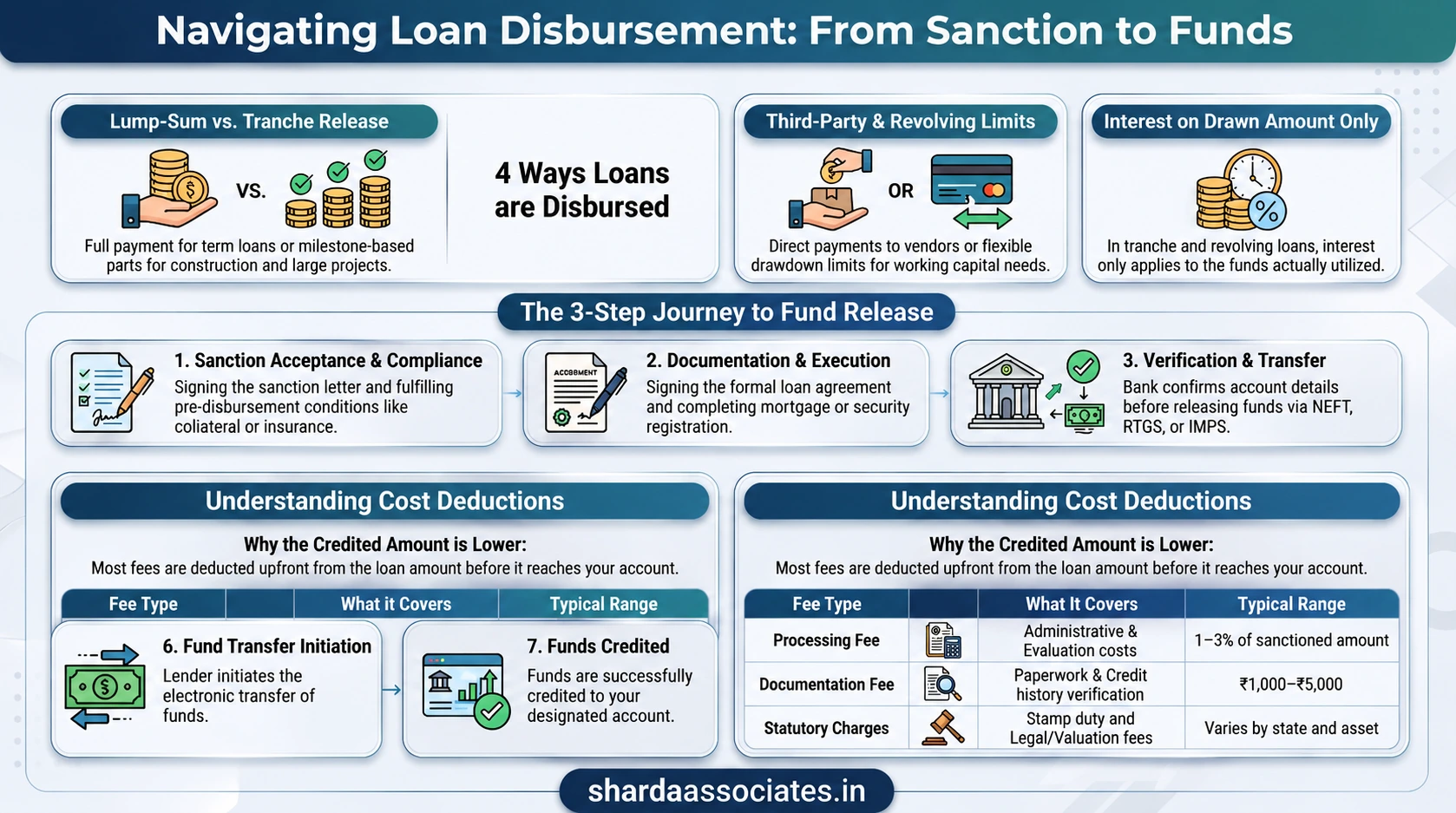
Tranche (Milestone-Based) Disbursement
The sanctioned amount is released in parts over time, with each tranche tied to a specific milestone or condition being met. This is typically used for construction-linked term loans or larger industrial/machinery projects, where funds are needed progressively as the project advances — for instance, one tranche after foundation work, another after structural completion, and a final tranche at finishing stages. Because interest is usually charged only on the amount actually drawn (not the full sanctioned limit), tranche disbursement also reduces unnecessary interest cost during the project’s build-out period.
Third-Party / Vendor Disbursement
For certain loan types, funds are transferred directly to a vendor, supplier, or institution rather than to the borrower’s own account — for example, a machinery loan where the bank pays the equipment supplier directly after verifying the purchase, rather than crediting the borrower first. This is common wherever the loan is tied to a specific, verifiable purchase.
Revolving Disbursement (Working Capital/CC Limits)
For cash credit and working capital facilities, disbursement doesn’t work like a term loan at all — instead of a one-time transfer, a limit is made available that the borrower draws down and repays repeatedly as needed, with interest charged only on the amount actually utilised at any given time.
What Is the Business Loan Disbursement Process, Step by Step?
- Sanction letter accepted — the borrower signs and returns the sanction letter, agreeing to the stated terms
- Pre-disbursement conditions completed — documentation, collateral registration, insurance, or guarantor formalities listed in the sanction letter are fulfilled
- Loan agreement executed — the formal, legally binding loan agreement is signed, incorporating the sanctioned terms
- Security/collateral creation, where applicable — for secured loans, mortgage, hypothecation, or pledge documentation is completed and registered
- Disbursement application submitted — a duly filled and signed request confirming the bank account (or vendor details, for third-party disbursement) where funds should be released
- Bank verifies details — account number, KYC, and any final compliance checks are confirmed before releasing funds
- Funds are transferred — via NEFT, RTGS, IMPS, or direct account credit, depending on the amount and the bank’s process, either in full or as the first tranche
- Repayment schedule begins — EMIs typically start from the disbursement date (or from each tranche, for milestone-based loans)
What Documents Are Typically Needed at the Disbursement Stage?
- Signed loan agreement
- NACH mandate form (for EMI auto-debit), with accurate bank account details
- Original title deed or asset documents, for secured loans
- Insurance documents, where required by the sanction letter
- Board resolution or partnership consent letter, for companies/partnership firms
- Confirmation of the exact bank account (or vendor account, for third-party disbursement) for fund transfer
What Fees Are Typically Deducted from the Disbursed Amount?
| Fee | What It Covers | Typical Range |
| Processing fee | Administrative cost of evaluating and processing the loan | Often 1–3% of the sanctioned amount, or a flat fee |
| Documentation fee | Verifying business documents, credit history, and paperwork | Roughly ₹1,000–₹5,000, sometimes bundled into the processing fee |
| Legal/valuation fee | Property or collateral valuation and legal verification for secured loans | Varies by asset type and lender |
| Stamp duty | Statutory charge on the loan agreement, as applicable by state | Varies by state and loan amount |
| Insurance premium | If loan-linked insurance is bundled in, deducted at disbursement. | Varies by policy and loan amount |
| Guarantee fee (e.g., CGTMSE) | Annual fee for a government credit guarantee, where applicable | Starts from roughly 0.37% per year, varies by loan size |
These figures vary meaningfully by lender and loan type, so it’s worth confirming the exact fee schedule against your specific sanction letter and Key Facts Statement (KFS) rather than assuming a standard figure.
Why Is the Disbursed Amount Sometimes Less Than the Sanctioned Amount?
Most of the fees above (processing fee, documentation fee, and sometimes the first insurance premium) are typically deducted upfront from the loan amount before the remainder is credited to your account — rather than billed separately afterwards. This means the amount that actually reaches your bank account is usually somewhat lower than the full sanctioned figure, which is worth accounting for when planning how much funding you’ll actually have available.
What Other Charges Might Apply Later in the Loan’s Life?
- Prepayment charges — a fee (commonly 1–3% of the amount prepaid) for repaying part of the loan ahead of schedule
- Foreclosure charges — typically higher (roughly 2–6% of the outstanding principal), for closing the entire loan early, often tiered based on how early in the tenure the closure happens
- Penal charges — for missed or delayed EMI payments; under current RBI guidance, these are meant to be levied as a straightforward penal charge rather than compounded penal interest
- Renewal fee — an annual charge for reviewing and extending a working capital or cash credit facility
Note that RBI rules also state that any charge not disclosed in the KFS cannot be levied on the borrower later without explicit consent, so cross-checking the KFS against the sanction letter is worth doing before accepting either.
How Long Does Disbursement Typically Take After Sanction?
Timelines vary by loan type and whether pre-disbursement conditions are already complete — a straightforward, fully documented term loan can sometimes be disbursed within a few days of accepting the sanction letter, while loans needing collateral registration, legal/valuation reports, or milestone-based release naturally take longer, tied to when each condition or project stage is actually met.
Conclusion
Loan disbursement is an important stage in the borrowing process, as it is when the approved loan amount is released to the borrower according to the lender’s terms and conditions. Understanding the different types of disbursement, required documentation, processing stages, and applicable fees can help borrowers plan their finances and avoid unexpected delays or charges.
For businesses applying for a loan, having properly prepared financial documents and a structured project report can make the application process more organised. Sharda Associates helps entrepreneurs and MSMEs prepare CA-certified project reports, Detailed Project Reports (DPRs), CMA reports, and other financial documentation required for bank and government-backed loan applications. The reports are prepared according to the business, proposed loan requirement, and applicable lender or scheme requirements.
If you need assistance with a project report or loan documentation, you can call or WhatsApp Sharda Associates at +91 89899 77769 for guidance on the appropriate documentation and next steps.
Frequently Asked Questions
1. What are the different types of loan disbursement?
The main types are full (lump-sum) disbursement, tranche/milestone-based disbursement, third-party/vendor disbursement, and revolving disbursement for working capital/CC facilities.
2. What fees are typically deducted from a business loan disbursement?
Common deductions include the processing fee, documentation fee, legal/valuation fee (for secured loans), stamp duty, and any bundled insurance premium — most deducted upfront from the disbursed amount.
3. Why is the amount I receive less than my sanctioned loan amount?
Most fees (processing, documentation, sometimes insurance) are deducted upfront from the loan before the remainder is credited, so the amount reaching your account is typically less than the full sanctioned figure.
4. What is tranche disbursement, and why is it used?
It’s when the sanctioned amount is released in parts tied to specific milestones — commonly used for construction or large equipment financing — and it reduces unnecessary interest cost since interest applies only to the amount actually drawn.
5. What documents are needed at the disbursement stage?
Typically the signed loan agreement, NACH mandate form, asset/title documents (for secured loans), insurance documents where applicable, and board resolution or partnership consent for companies/firms.
6. How is disbursement different for a working capital loan compared to a term loan?
A term loan is disbursed as a lump sum or in tranches for a specific purpose, while a working capital/CC facility works as a revolving limit that’s drawn down and repaid repeatedly, with interest only on the amount used.
7. Are there charges for repaying a business loan early?
Yes—prepayment charges (commonly 1–3% of the amount prepaid) and foreclosure charges (typically 2–6% of the outstanding principal for full early closure) may apply, though some floating-rate loans to MSMEs are exempt under RBI rules.
8. Can a lender charge a fee that wasn’t mentioned in my Key Facts Statement (KFS)?
No — RBI rules state that any charge not disclosed in the KFS cannot be levied on the borrower at any stage without explicit consent, so it’s worth cross-checking the KFS against your sanction letter.
9. Does disbursement happen automatically once the loan is sanctioned?
No — disbursement follows sanction only after the loan agreement is signed and any pre-disbursement conditions (documentation, collateral registration, insurance) listed in the sanction letter are completed.
10. Can funds be disbursed directly to a vendor instead of my account?
Yes — for loans tied to a specific purchase, such as machinery financing, the bank may transfer funds directly to the vendor or supplier rather than crediting the borrower’s account first.