
Loan Sanctioned and disbursement are two different stages of a business loan — sanction means the bank has agreed to lend on stated terms, while disbursement is the actual transfer of funds, which usually happens only after a set of pre-disbursement conditions are completed. A delay between the two is common and doesn’t necessarily mean anything has gone wrong; it usually means one or more of those conditions — documentation, collateral registration, verification, or an internal approval step — hasn’t been completed yet. Sharda Associates, a CA-certified financial documentation provider, helps applicants understand sanction letter conditions and prepare the documentation needed to move smoothly from sanction to disbursement.
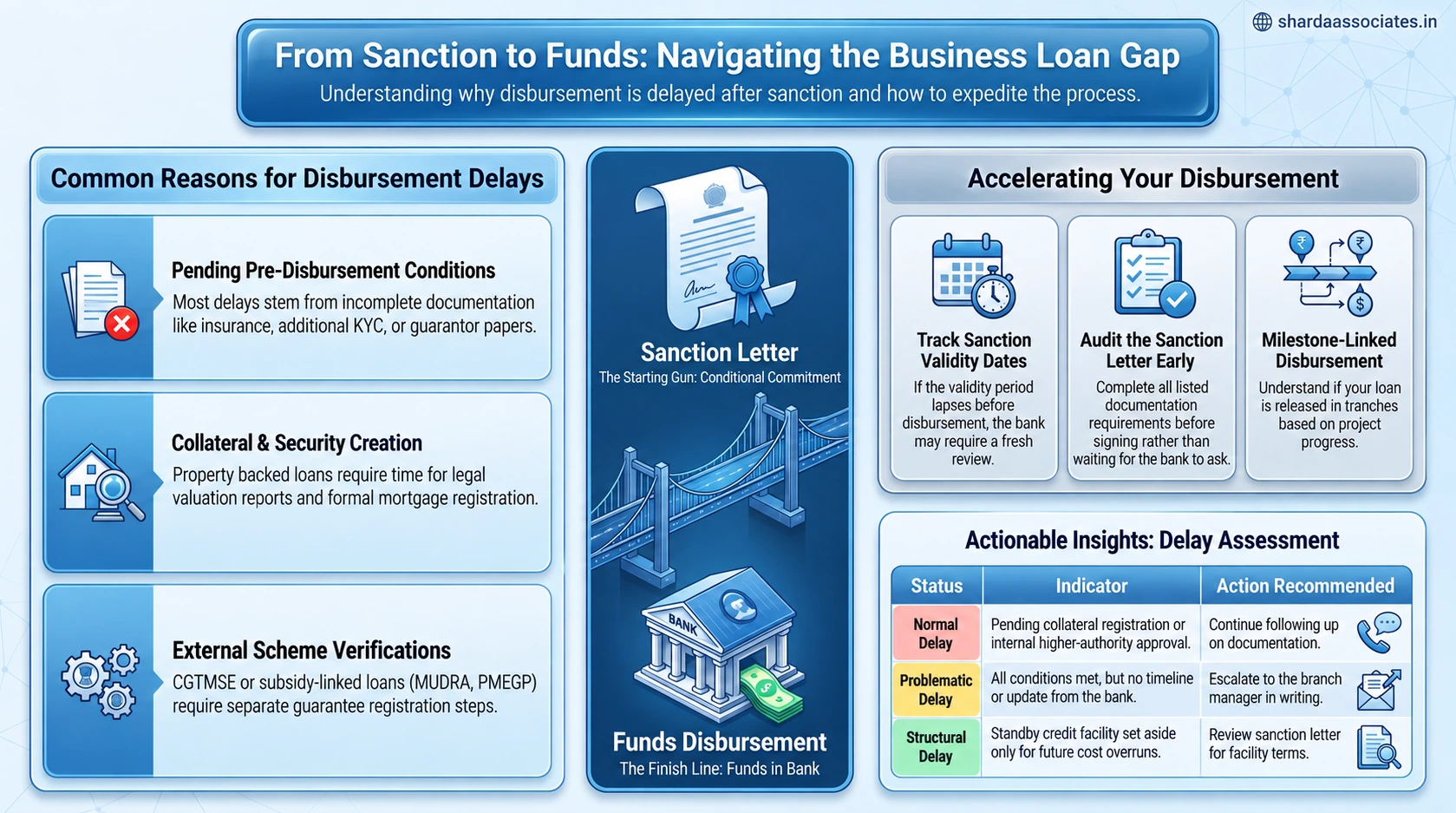
Why Isn’t Sanction the Same as Disbursement?
A sanction letter is the bank’s conditional commitment — it fixes the loan amount, interest rate, and tenure but usually lists a set of conditions that still need to be fulfilled before the bank actually releases funds. Treating the sanction letter as the finish line is a common misunderstanding; in reality, it’s closer to the starting gun for a final set of formalities that have to be completed first.
What Are the Most Common Reasons for a Disbursement Delay?
- Pending pre-disbursement conditions — documents, confirmations, or actions listed in the sanction letter that haven’t been completed yet (insurance, additional KYC, guarantor documents)
- Collateral/security creation and registration — for secured loans, mortgage or hypothecation documentation, property valuation, and registration with the relevant authority can take time
- CGTMSE or guarantee scheme processing — for collateral-free MSME loans backed by a credit guarantee scheme, the guarantee registration process is a separate step that must be completed before disbursement
- Verification and KYC checks — final-stage verification of business registration (Udyam, GST), identity, and address, especially if any earlier submission had inconsistencies
- Internal sanctioning authority approval — larger loan amounts sometimes need sign-off from a higher authority within the bank beyond the branch level, which adds processing time
- Milestone-linked disbursement — for term loans tied to construction or machinery installation, funds are often released in tranches linked to project progress, not as a single lump sum
- Legal and valuation report delays — for property-backed loans, the bank’s empanelled legal and valuation teams need to complete their reports before funds are released
- Scheme-specific eligibility verification — for subsidy-linked loans (PMEGP, MUDRA, NABARD), the scheme’s own verification process runs alongside the bank’s, and delays in either can hold up disbursement
- Branch-level processing backlog — during high-volume periods, a completed file can sit in a processing queue simply due to volume
- Technical or system issues — occasional glitches in the bank’s internal disbursement systems can delay fund transfer even after everything else is in order
Is a Standby Credit Facility the Same as a Disbursement Delay?
No — this is a different concept worth knowing about. For some project loans, banks sanction a “standby credit facility” alongside the main loan specifically to fund unforeseen cost overruns, but this standby amount is disbursed only if and when an actual cost overrun occurs, not automatically. If part of your sanctioned facility falls into this category, it isn’t a delay — it’s a feature of how the facility was structured from the start, and it’s worth checking your sanction letter to see if this applies.
How Can You Tell If a Delay Is Normal or a Genuine Problem?
Generally normal:
- Funds not yet disbursed while pre-disbursement conditions (collateral registration, insurance, additional documents) are still being completed
- A short wait for internal higher-authority approval on larger loan amounts
- Milestone-based disbursement for a term loan tied to construction or installation progress
Worth following up on:
- All listed pre-disbursement conditions have been completed, but there’s still no update or timeline from the bank
- No clear explanation of what’s pending despite repeated follow-up
- A delay well beyond what the bank itself indicated when the sanction letter was issued
What Should You Do If Disbursement Is Taking Longer Than Expected?
- Re-check the sanction letter for the exact list of pre-disbursement conditions, and confirm each one has genuinely been completed on your end
- Ask the bank directly which specific condition, if any, is still pending — rather than assuming the delay
- Follow up in writing, so there’s a documented trail of your queries and the bank’s responses
- Check whether the loan is scheme-linked (PMEGP, MUDRA, CGTMSE) — in these cases, ask specifically whether the delay is on the bank’s side or the scheme’s verification side
- Escalate if genuinely stuck — first to the branch manager, and if unresolved, through the bank’s grievance redressal mechanism
Does a Disbursement Delay Affect the Loan Terms Already Sanctioned?
Generally, the terms fixed in the sanction letter (amount, rate, tenure) don’t change simply because disbursement is delayed, as long as the sanction is still within its validity period. However, if the sanction letter’s validity period lapses before disbursement, the bank may require a fresh review or re-sanction, which is why it’s worth tracking the validity date alongside any pending conditions.
Can You Do Anything Upfront to Avoid Disbursement Delays?
- Complete all pre-disbursement documentation as early as possible, rather than after signing the sanction letter
- Ensure collateral/security documents are ready and consistent with what’s stated in the sanction letter
- For scheme-linked loans, track both the bank’s and the scheme’s verification steps separately
- Respond immediately to any bank query — even a short delay in responding can add days to the overall timeline
- Confirm the disbursement structure (single tranche vs. milestone-based) at the sanction stage, so there are no surprises later
Frequently Asked Questions
1. Why is my business loan sanctioned but not disbursed yet?
Usually because one or more pre-disbursement conditions listed in the sanction letter — collateral registration, insurance, verification, or internal approval — haven’t been completed yet.
2. How long can a bank take to disburse a loan after sanction?
There’s no single fixed timeline; it depends on the loan type, whether conditions are pending, and whether disbursement is structured as a single payment or in milestone-based tranches.
3. Is it normal for disbursement to take weeks after sanction?
It can be, especially for secured loans needing collateral registration and legal/valuation reports, or for milestone-based term loans — but an unexplained delay well beyond the bank’s own indicated timeline is worth following up on.
4. Does disbursement always happen in one lump sum?
No — for term loans tied to construction or machinery installation, disbursement is often released in stages linked to project progress rather than as a single payment.
5. Can a bank delay disbursement due to internal approval requirements?
Yes — larger loan amounts sometimes require sign-off from a higher sanctioning authority within the bank beyond the branch level, which can add processing time.
6. What is a standby credit facility, and is it the same as delayed disbursement?
No — a standby credit facility is a portion of a sanctioned amount set aside specifically to fund unforeseen cost overruns, and it’s disbursed only if that overrun actually occurs; it’s a feature of the facility’s structure, not a delay.
7. Does a CGTMSE-backed collateral-free loan take longer to disburse than a secured loan?
It can, in some cases — the credit guarantee registration process for CGTMSE-backed loans is a separate step that runs alongside the bank’s own disbursement process.
8. What should I do if my sanction letter’s validity period is about to expire without disbursement?
Contact the bank immediately — a lapsed sanction may require a fresh review or re-sanction, so it’s important to track this date alongside any pending pre-disbursement conditions.
9. Can I escalate if my loan disbursement seems unreasonably delayed?
Yes — first raise it with the branch manager, and if unresolved, escalate through the bank’s formal grievance redressal mechanism.
10. Does a delay in disbursement affect the interest rate or terms already sanctioned?
Generally not, as long as the sanction is still within its validity period; if the validity lapses before disbursement, the bank may need to review or re-sanction the loan, potentially on updated terms.