
Quick answer: A proprietorship needs a tax audit under Section 44AB when business turnover exceeds ₹1 crore (or ₹10 crore if cash receipts and payments are each within 5%), or professional receipts exceed ₹50 lakh. An audit is also required when you opt for the presumptive scheme but declare lower profit than prescribed and your income exceeds the basic exemption limit.
At Sharda Associates, our Chartered Accountants (CA) conduct tax audits, prepare Form 3CB-3CD, file income tax returns and handle notices for proprietors, and also prepare CA-certified project reports for bank loans and business funding. Knowing the audit limits in advance helps you avoid penalty and plan your books properly.
What Is a Tax Audit?
A tax audit is an examination of your books of account by a practising Chartered Accountant under Section 44AB of the Income Tax Act. The CA checks whether books are properly maintained, income and expenses are correctly reported and tax provisions are followed. The report is given in Form 3CB-3CD and filed online before the income tax return.
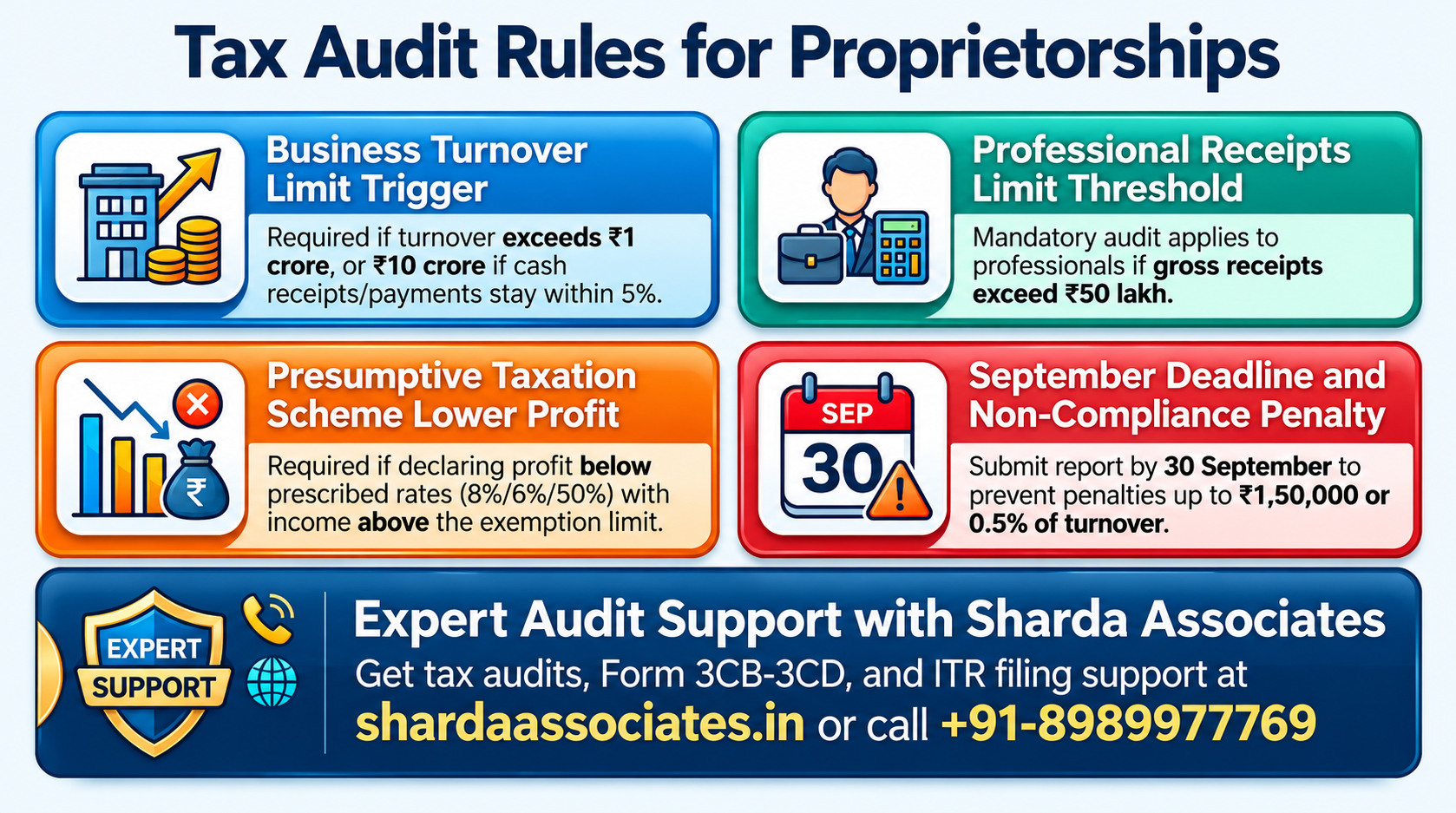
Turnover Limits for Tax Audit of a Proprietorship
- Business: audit applies if total sales, turnover or gross receipts exceed ₹1 crore in the financial year.
- Business with limited cash dealings: the limit rises to ₹10 crore if cash receipts do not exceed 5% of total receipts and cash payments do not exceed 5% of total payments.
- Profession: audit applies if gross receipts exceed ₹50 lakh. Doctors, lawyers, architects, consultants and similar professionals fall here.
Turnover includes all business sales and receipts, not just profit. Include every business of the proprietor together when checking the limit.
Tax Audit Applicability at a Glance
| Situation | Tax audit required? |
| Business turnover above ₹1 crore with normal cash dealings | Yes |
| Business turnover up to ₹10 crore, cash receipts and payments each within 5% | No, until turnover crosses ₹10 crore |
| Professional receipts above ₹50 lakh | Yes |
| Presumptive scheme (Section 44AD), profit below 8% (6% for digital receipts), income above basic exemption limit | Yes |
| Presumptive scheme for professionals (Section 44ADA), profit below 50%, income above basic exemption limit | Yes |
| Opted out of presumptive scheme within five years and income above basic exemption limit | Yes |
Audit Under the Presumptive Taxation Scheme
Small proprietors often choose the presumptive scheme to avoid detailed books. Under Section 44AD, profit is declared at 8% of turnover (6% for digital receipts), and under Section 44ADA professionals declare 50% of receipts. If you declare a lower profit and your total income exceeds the basic exemption limit, a tax audit becomes mandatory. The same applies if you leave the scheme and later return within five years.
Due Dates and Penalty
- Audit report: the tax audit report must generally be filed by 30 September following the financial year.
- Income tax return: proprietors liable to audit file the return by 31 October of the assessment year, unless the date is extended.
- Penalty: under Section 271B, failure to get the audit done or to file the report can attract a penalty of 0.5% of turnover or ₹1,50,000, whichever is lower, unless there is reasonable cause.
A late audit can also delay your return and loan applications, since banks usually ask for audited accounts.
Documents to Keep Ready for the Audit
- sales and purchase registers, bank statements and cash book
- GST returns reconciled with books
- expense bills, TDS records and loan statements
- fixed asset register and stock statement
- details of payments above prescribed cash limits
Conclusion
A proprietorship needs a tax audit when turnover or receipts cross the prescribed limits, or when presumptive scheme conditions are not met. Check your turnover and cash ratio before the year ends, so that you know whether an audit will apply.
Plan early, keep books updated and reconcile your GST and bank records every month. Starting the audit well before 30 September avoids penalty, delay in return filing and problems with loan applications.
For tax audit, ITR filing, GST compliance and CA-certified project reports, contact Sharda Associates at +91-8989977769.
Frequently Asked Questions (FAQs)
1. What is the tax audit limit for a proprietorship?
It is ₹1 crore of turnover for business, or ₹10 crore if cash transactions stay within 5%.
2. What is the limit for professionals?
Professionals need an audit when gross receipts exceed ₹50 lakh.
3. Is a tax audit required if I have a loss?
It is required only if turnover crosses the limit or the presumptive scheme conditions are triggered.
4. Who can conduct a tax audit?
Only a practising Chartered Accountant can conduct the audit and sign Form 3CB-3CD.
5. What is the last date for tax audit?
Generally 30 September after the end of the financial year, subject to government extensions.
6. What is the penalty for not getting the audit done?
The penalty is 0.5% of turnover or ₹1,50,000, whichever is less, unless reasonable cause is shown.
7. Does GST turnover count for audit limits?
Yes. Turnover for the audit is based on your business receipts, and your books should match GST returns.
8. Can I avoid audit by using the presumptive scheme?
Yes, if you declare the prescribed profit rate. A lower profit with income above the exemption limit triggers an audit.