
Short answer: Getting a GSTIN is only the start. A Indian Startup founder must also invoice correctly, file returns on time, reconcile input tax credit (ITC) every month, handle exports and imported services properly, and keep GST data consistent with the books that investors and banks review. Most GST trouble for startups comes from these routine steps, not from registration itself.
Key points
- File GSTR-1 and GSTR-3B on time, every period, even with no sales.
- Reconcile ITC with GSTR-2B before claiming it.
- Export of services can be zero-rated under a Letter of Undertaking (LUT).
- Equity funding is not a taxable supply, but many other startup payments are.
- Investors and banks compare GST returns with your financial statements.
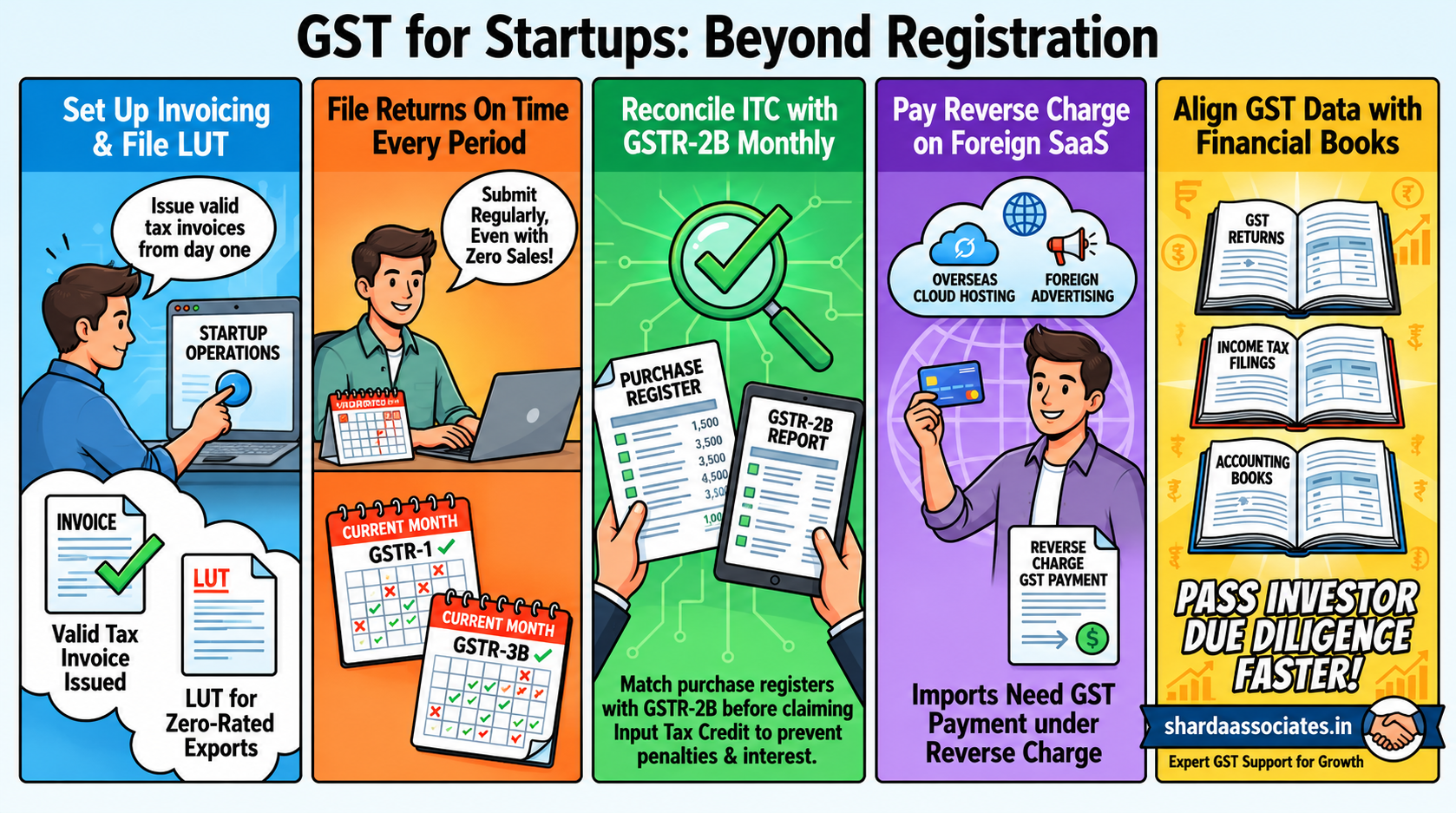
What Changes After You Get Your GSTIN
Registration makes you part of a monthly compliance cycle. From the first invoice, you must charge the right rate, issue a valid tax invoice and report every sale. You also start building a record that lenders, investors and the tax department can see. At Sharda Associates, our Chartered Accountants (CA) set up this routine for startups and prepare CA-certified project reports for loans and funding. When your GST returns, books and project report agree, due diligence goes faster.
How GST Applies to Common Indian Startup Situations
| Situation | GST treatment | What you should do |
| Selling software or services to Indian customers | Taxable, usually at 18% for most IT services | Charge GST and issue a tax invoice |
| Selling services to a client outside India | Export of services, zero-rated if conditions are met | File an LUT and claim a refund of ITC if needed |
| Raising equity from investors | Issue of shares is not a supply of goods or services | No GST, but record the transaction properly |
| Paying for foreign software, cloud or ads | Import of services, taxed under reverse charge | Pay GST on reverse charge and claim ITC if eligible |
| Fees to a non-employee director | Reverse charge may apply | Check with your CA and pay if applicable |
| Advance received from a customer for services | Taxable when received | Issue a receipt voucher and pay GST |
| Salary to employees including founders on payroll | Not a supply | No GST |
| Free trials with no payment | Generally no consideration, so not a taxable supply | Keep terms clear, and watch related-party gifts |
Your Compliance Rhythm
Every invoice
- Use the correct HSN or SAC code and rate.
- Show your GSTIN and the buyer’s GSTIN for B2B sales.
- Raise service invoices within the time allowed.
Every month or quarter
- File GSTR-1 for outward supplies and GSTR-3B for tax payment.
- Startups with smaller turnover may choose the quarterly (QRMP) scheme, which allows quarterly returns with monthly tax payment.
- Match your purchase register with GSTR-2B and claim only eligible ITC.
- Pay tax on reverse charge purchases.
Every year
- File the annual return GSTR-9 if it applies to you, and the reconciliation statement GSTR-9C where required.
- Renew your LUT at the start of each financial year if you export.
- Tie GST turnover with the books and the income tax return.
Check current due dates, thresholds and the e-invoicing limit before you plan, since these change.
Five Areas Where Startups Slip
- Input tax credit. Claiming ITC that does not appear in GSTR-2B, or on blocked items, leads to reversal with interest.
- Export of services. Missing the LUT, or not receiving payment in foreign exchange, can turn a zero-rated sale into a taxable one.
- Imported services. Foreign SaaS, cloud and advertising bills attract reverse charge, and many founders forget it.
- Advances. Taking money before delivering a service creates GST liability on receipt.
- Late filing. Late returns attract a late fee and interest at 18% a year on unpaid tax, and repeated delay can lead to a notice.
Cash Flow and Refunds
Startups often have more ITC than output tax, especially in the early months. Unused credit is carried forward, and refund is possible in specific cases, such as export of services without payment of tax. A refund claim needs clean data, so keep invoices, bank realisation proofs and returns in order from day one.
GST and Fundraising
Investors and lenders usually ask for GST returns, financial statements and tax filings during due diligence. They compare turnover across all three. A gap you cannot explain slows funding or lowers valuation. Prepare a reconciliation of turnover across books, GST returns and the income tax return before you start a funding round.
A Simple Quarterly Review for Founders
- Check that every return was filed on time.
- Compare GST sales with the sales shown in your accounts.
- Review ITC claimed against GSTR-2B.
- List imported services and confirm reverse charge was paid.
- Confirm that the LUT is valid and export proofs are saved.
- Note any notices and replies pending.
Conclusion
GST for a startup does not end with registration. It is a monthly habit of correct invoicing, timely returns, ITC reconciliation and careful handling of exports, imported services and advances. When this routine is clean, refunds come faster and funding conversations are smoother.
Set a quarterly review, keep one reconciliation file and involve your CA before big contracts or funding rounds. For startup GST, tax audit and CA-certified project reports for loans and investors, call Sharda Associates on +91-8989977769.
Questions Founders Ask
Q1. Do I need to file GST returns if I had no sales?
Yes, nil returns are generally required for each period.
Q2. Is GST charged on equity funding?
No. Issue of shares is not a supply of goods or services.
Q3. Can I claim ITC on software subscriptions?
Yes, if the software is used for business and the conditions of Section 16 are met.
Q4. What is an LUT?
A Letter of Undertaking that lets exporters supply without paying IGST, filed in Form GST RFD-11 each year.
Q5. Do I pay GST on foreign software and cloud bills?
Yes, under reverse charge, and you can usually claim it as ITC.
Q5. What is the QRMP scheme?
An option for smaller taxpayers to file returns quarterly while paying tax monthly.
Q6. What happens if I file late?
A daily late fee applies, and interest at 18% a year on tax paid late.
Q7. When should a startup hire a CA?
Before the first invoice, so that registration, invoicing and books are right from the start.