
Almost every business owner asks this before visiting a bank, and most hear a rough “20 to 25 percent” from friends. That figure is real, but it belongs to a specific method for working capital, not a rule for every loan. If you want the broader eligibility basics, start with our guide on working capital loan eligibility for small businesses.
Sharda Associates is a Bhopal-based CA firm with 45,500+ CA-certified reports delivered, and we prepare the numbers banks use to decide your limit. Our CMA report for bank loan service shows your projected turnover, working capital need and repayment capacity in the format bank officers expect.
This guide shows how a bank turns turnover into a loan amount, with worked examples, the method for larger limits, and the other factors that raise or cut your figure. If you are short of collateral, read how the collateral-free MSME loan works as well.
Quick Answer: For an MSME with projected turnover up to ₹5 crore, banks commonly use the turnover method: the working capital need is 25% of projected turnover, the bank finances about 20% of turnover and you bring 5% as your own margin. So a business with ₹1 crore turnover can look at about ₹20 lakh of working capital finance. There is no official minimum turnover for every loan, and no rule that every loan must equal 20 to 25% of turnover. For larger limits, banks use the MPBF method, based on your current assets and liabilities, and the final amount also depends on profit, credit record and existing loans.
Loan amount at a glance
| Projected turnover | Working capital need (25%) | Your margin (5%) | Bank finance (20%) |
| ₹40 lakh | ₹10 lakh | ₹2 lakh | ₹8 lakh |
| ₹60 lakh | ₹15 lakh | ₹3 lakh | ₹12 lakh |
| ₹1 crore | ₹25 lakh | ₹5 lakh | ₹20 lakh |
| ₹2 crore | ₹50 lakh | ₹10 lakh | ₹40 lakh |
| ₹5 crore | ₹1.25 crore | ₹25 lakh | ₹1 crore |
The ₹60 lakh and ₹2 crore rows come from published examples of the method. The other rows are the same formula applied to different turnovers, so treat them as estimates, not offers.
How does the turnover method work?
The Nayak Committee method applies to micro and small borrowers whose projected annual turnover is up to ₹5 crore. The bank takes 25% of your projected turnover as the working capital you need, asks you to fund 5% of turnover yourself, and lends the other 20%. RBI’s own FAQ for small units describes it as a minimum of 20% of estimated turnover, up to a ₹5 crore limit.
Banks check your projection against actual sales. Your bank usually asks for a CMA data file for this, and the layout is explained in our guide to the CMA report format for bank loans.
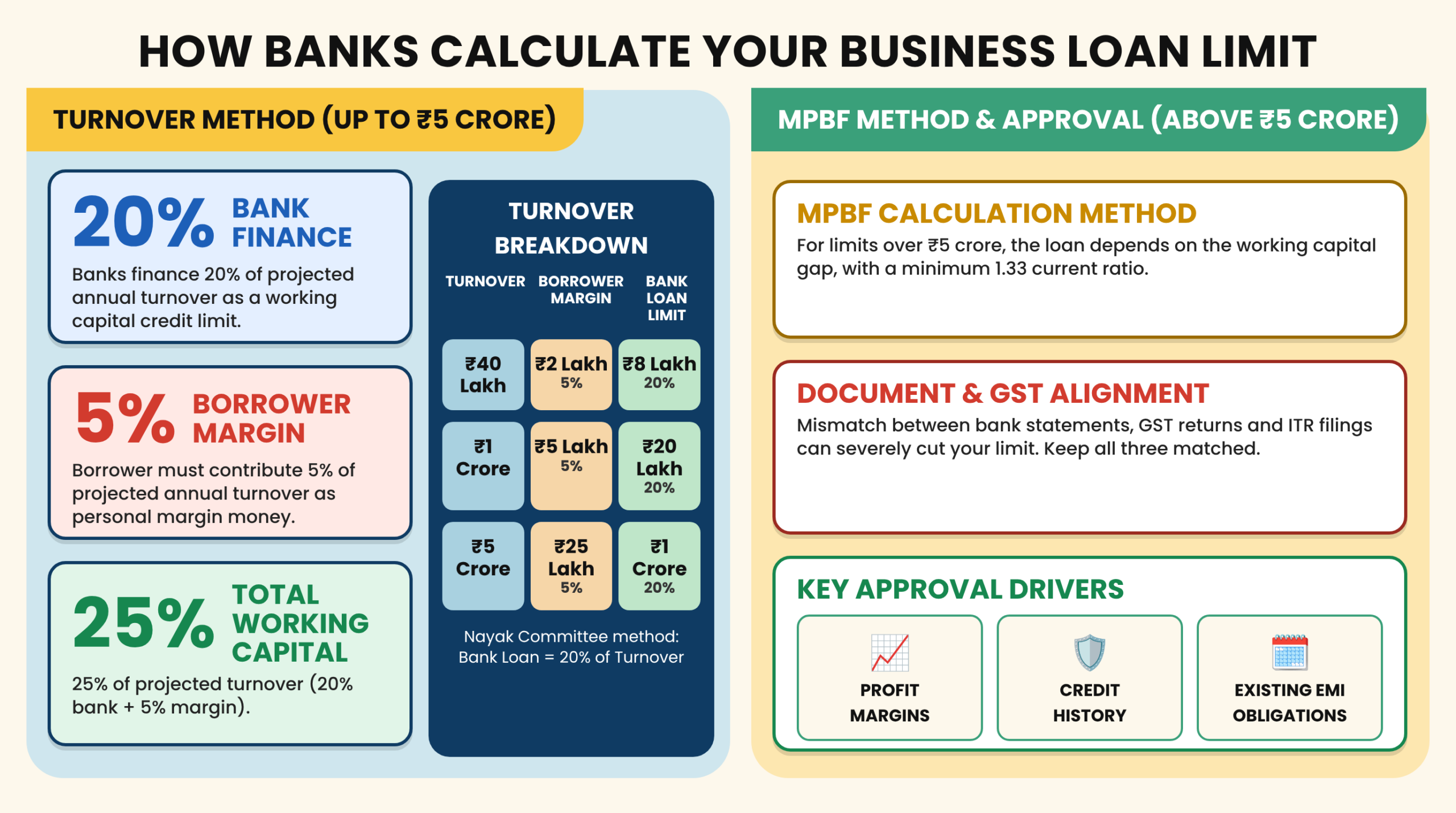
Worked example : Take a trader with ₹60 lakh projected turnover. The working capital need is ₹15 lakh. You bring ₹3 lakh as margin, and the bank finances ₹12 lakh. That ₹12 lakh is a working capital limit, such as cash credit, and not an unsecured cash loan.
What if your turnover is above ₹5 crore?
For larger limits, banks lean on the Maximum Permissible Bank Finance (MPBF) method. They first calculate your working capital gap, which is current assets minus current liabilities other than bank borrowing. Under Method II, the most used one, you must fund at least 25% of current assets from your own money, and the minimum current ratio expected is 1.33.
Example: current assets of ₹100 lakh and current liabilities (excluding bank borrowing) of ₹30 lakh give a gap of ₹70 lakh. You fund ₹25 lakh, so the MPBF is ₹45 lakh. The Tandon system was relaxed by RBI in 1997, but banks still use it as a benchmark. See how working capital products differ in our guide to working capital loans in India.
Does a business loan always equal 20 to 25% of turnover?
No. The 20 to 25% figure comes from the working capital method above. It is not a universal rule for term loans, unsecured loans or NBFC loans. Each lender sets its own criteria by product, and there is no regulator-prescribed minimum turnover for every business loan. Some products ask for as little as six months of operations. Term loans depend on the project cost, your margin money and your ability to repay.
What else decides your loan amount?
- Profit and margins. High sales with thin margins can support less borrowing.
- Credit record. Repayment history and credit report data affect the bank’s risk view.
- Business age. A longer record gives the bank more comfort.
- Existing EMIs. Current debt reduces your free cash flow.
- GST and bank statements. Returns and account credits are used to confirm your turnover.
Why your GST turnover must match your bank statement
Banks compare the turnover in your projection with GST returns, ITR and bank credits. A gap between them is one of the quickest ways to lose limit. We explain this in how GST returns impact your business loan. Reconcile sales and bank credits every month, and be ready to explain cash sales and transfers between your own accounts.
How to increase the loan you can get
- Show a realistic projected turnover, backed by last year’s actual sales.
- File GST and income tax returns on time and keep them consistent.
- Route business receipts through the same bank account.
- Reduce small unsecured loans and keep EMIs low.
- Present a clear plan with a project finance consultant before you apply.
Conclusion
Your turnover gives a starting point, not a fixed answer. For micro and small businesses up to ₹5 crore, a rough guide is 20% of projected turnover as bank finance and 5% as your own margin.
The final limit depends on profit, credit record, existing loans and how well your documents match. Keep GST returns, bank statements and projections consistent before you meet the bank.
Need your limit calculated and a bank-ready file prepared? Call Sharda Associates on +91 79870 21896 or +91 89899 77769, or contact us online.
Frequently asked questions
1. How much loan can I get on ₹1 crore turnover?
Under the turnover method, the working capital need is ₹25 lakh, and the bank may finance about ₹20 lakh, with ₹5 lakh as your margin.
2. Is 20% of turnover the maximum loan?
It is the commonly used bank finance level under the turnover method for turnover up to ₹5 crore. RBI’s FAQ calls it a minimum, so banks may go higher after appraisal.
3. Does the turnover method apply above ₹5 crore?
No. Larger limits are assessed with MPBF, based on working capital gap and current ratio.
4. Is there a minimum turnover for a business loan?
There is no regulator-set minimum for every product. Each lender decides by product, and some ask for at least six months of operations.
5. Is the loan based on projected or actual turnover?
The bank starts with your projected turnover and checks it against actual sales, GST returns and bank credits.
6. Can I get this loan without collateral?
RBI’s FAQ says banks should not take collateral for MSE loans up to ₹10 lakh, and CGTMSE covers collateral-free loans for larger amounts. Confirm the current limits with your bank.
7. What is MPBF?
Maximum Permissible Bank Finance is the working capital limit calculated from your current assets and liabilities, with your own margin deducted.
8. Does low profit reduce my loan?
Yes. High turnover with low margins may support less borrowing, because repayment depends on profit.