
Most founders think ROC filing can wait until the books are “ready,” and then find that the late fee runs every single day with no upper limit. A startup that held its AGM on time but filed AOC-4 late still pays ₹100 per day, per form. The MCA has now moved the dates for FY 2025-26, and the relief is easy to lose if you miss it by even one day.
Sharda Associates is a CA firm with 45,500+ CA-certified reports delivered, and we handle company registration and annual ROC filing for startups through our business registration services. We prepare the financial statements, check your AGM dates, and file AOC-4 and MGT-7 on time.
This guide gives the verified dates, explains who files which form, what the relief does not cover, and what happens if you miss it. Keeping your books current through accounting and bookkeeping makes the filing much faster.
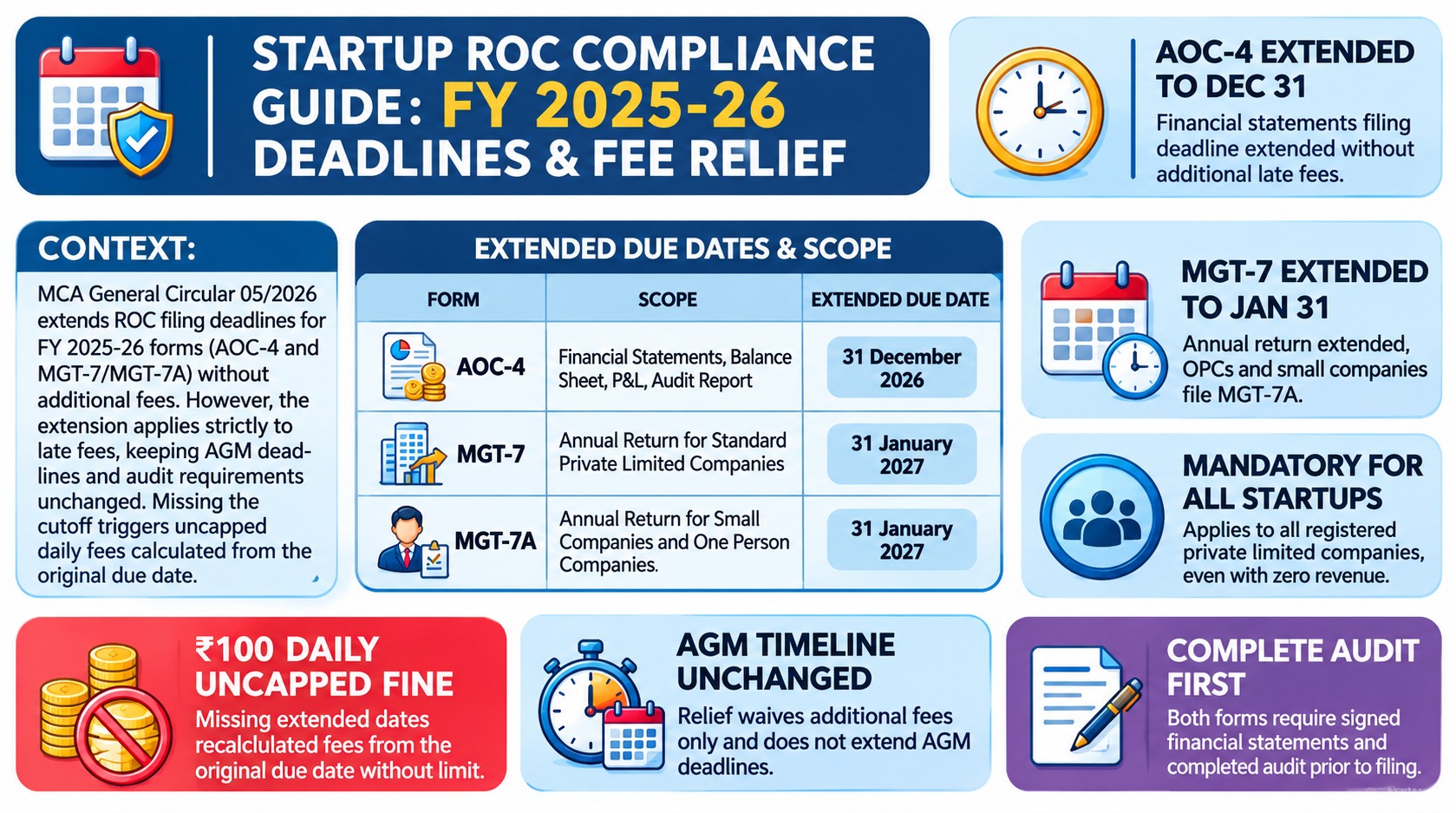
Quick Answer: For FY 2025-26, MCA General Circular 05/2026 (dated 24 October 2026) extends the due date of AOC-4 (financial statements) to 31 December 2026 and MGT-7 or MGT-7A (annual return) to 31 January 2027, without additional fees. The relief covers additional fees only. It does not extend the AGM deadline, and if you miss the extended date, the additional fee of ₹100 per day per form is charged from the original due date, with no upper cap. Small companies and one-person companies file MGT-7A instead of MGT-7.
Due dates at a glance
| Form | What it is | Extended due date (FY 2025-26) |
| AOC-4 (and variants such as XBRL) | Financial statements filing | 31 December 2026 |
| MGT-7 | Annual return | 31 January 2027 |
| MGT-7A | Annual return for small companies and OPCs | 31 January 2027 |
These are fixed calendar dates and are not tied to your AGM date. Confirm them against the circular on the MCA website before you file.
Who must file AOC-4 and MGT-7?
Every company registered under the Companies Act must file its financial statements and annual return with the ROC each year. A private limited startup files them even when it has no revenue or has made a loss. A startup registered as an LLP does not file these forms, because it files a different return.
Small companies and One Person Companies file the shorter MGT-7A. The size limits for a small company were revised in recent years, so check the current limits for your company before choosing the form.
Being recognised under DPIIT or registered on the Startup India portal does not exempt you from ROC filing. Our Startup India registration guide explains what recognition does and does not give you.
What are AOC-4 and MGT-7?
AOC-4 is the form in which you file your balance sheet, profit and loss account and the auditor’s report. It is normally due within 30 days of the AGM. The figures must match the books that your tax return will use later.
MGT-7 is the annual return. It lists shareholders, directors, shareholding changes and key facts about the company. It is normally due within 60 days of the AGM.
Both forms need a signed set of accounts, so the audit must be finished first. Our taxation team can coordinate the audit, the tax return and the ROC forms together.
What does the relief cover and what does it not?
The circular waives only the additional fee, and only for FY 2025-26 forms, if you file by the extended date. Normal filing fees are still payable. You cannot file one form late and expect partial relief.
The circular does not extend the time for holding the AGM. A company that missed the AGM timeline stays liable under the Act, and penalties under Section 99 can apply, according to the CAclub India article. The usual route in that case is compounding.
If your AGM was held on or before 30 September 2026, the relief applies as described. If you held it later, check with a professional before relying on the extended dates.
What happens if you miss the extended date?
The relief is all-or-nothing. If you file after 31 December 2026 for AOC-4, or after 31 January 2027 for MGT-7, the additional fee is calculated from the original due date, not from the extended one. The additional fee is ₹100 per day per form, with no upper limit, as per the Companies (Registration Offices and Fees) Rules, 2014.
A delay of 200 days on both forms can therefore mean ₹40,000 in additional fees alone. Late filing also makes your company look careless in front of banks and investors.
Lenders and investors check ROC compliance during due diligence. If you plan to raise a loan, a project report for bank loan backed by filed accounts reads far better.
A simple checklist for founders
- Confirm the date of your AGM for FY 2025-26.
- Finish the books and the audit.
- File AOC-4 well before 31 December 2026.
- File MGT-7 or MGT-7A before 31 January 2027.
- Keep signed copies and SRNs on record for investors.
Startups in Madhya Pradesh can also look at the state’s startup policy for benefits that depend on up-to-date compliance. If you need DPIIT recognition, see how to get it for a Madhya Pradesh startup.
Conclusion
The new dates give startups extra time, but only on additional fees. The AGM rule, the audit and the signed accounts are still on you.
Do not wait for 31 December. Fix your AGM date, close the books and file AOC-4 first, then MGT-7. A filing done in November costs you nothing extra, while one day of delay can cost you ₹100 per form per day.
Want Sharda Associates to handle your ROC filing? Call us directly on +91 79870 21896 or +91 89899 77769, or contact us online and we will confirm your dates in the same call.
Frequently asked questions
1. What is the AOC-4 due date for FY 2025-26?
31 December 2026, without additional fees, under MCA General Circular 05/2026.
2. What is the MGT-7 due date for FY 2025-26?
31 January 2027, without additional fees. The same date applies to MGT-7A.
3. Who files MGT-7A?
Small companies and One Person Companies file MGT-7A instead of MGT-7. Check the current definition of a small company.
4. Does the circular extend the AGM deadline?
No. It extends only the filing dates for AOC-4 and MGT-7, and waives only additional fees.
5. What is the late fee if I miss the extended date?
₹100 per day per form, with no upper cap, counted from the original due date.
6. Does a startup with no revenue need to file?
Yes. A private limited company must file AOC-4 and MGT-7 every year, even with nil turnover.
7. Is a DPIIT-recognised startup exempt from ROC filing?
No. DPIIT recognition gives startup benefits but does not remove annual ROC filing.
8. Do LLPs file AOC-4 and MGT-7?
No. LLPs file different annual forms.