
Of every document in a business loan application, your bank statement is arguably the one that’s hardest to dress up. GST returns can be filed selectively; a project report can present projections in the best possible light, but your bank statement is a running, timestamped record of what actually moved through your account — and lenders know it.
For businesses without audited financials or a long credit history, bank statement analysis is often the single most reliable signal a credit officer has, which is exactly why it gets scrutinised as closely as it does. Here are the five real reasons this document carries so much weight in a loan assessment and what specifically gets checked.
Get MSME Registration and CA-certified Project Reports prepared by experts to improve loan and subsidy approval chances. Sharda Associates has delivered 45,500+ reports across India, helping businesses prepare accurate and lender-ready documentation. Get reliable business documentation starting at ₹2,999, with fast 24–48 hour delivery.
1. It Verifies Income and Turnover That Other Documents Can’t
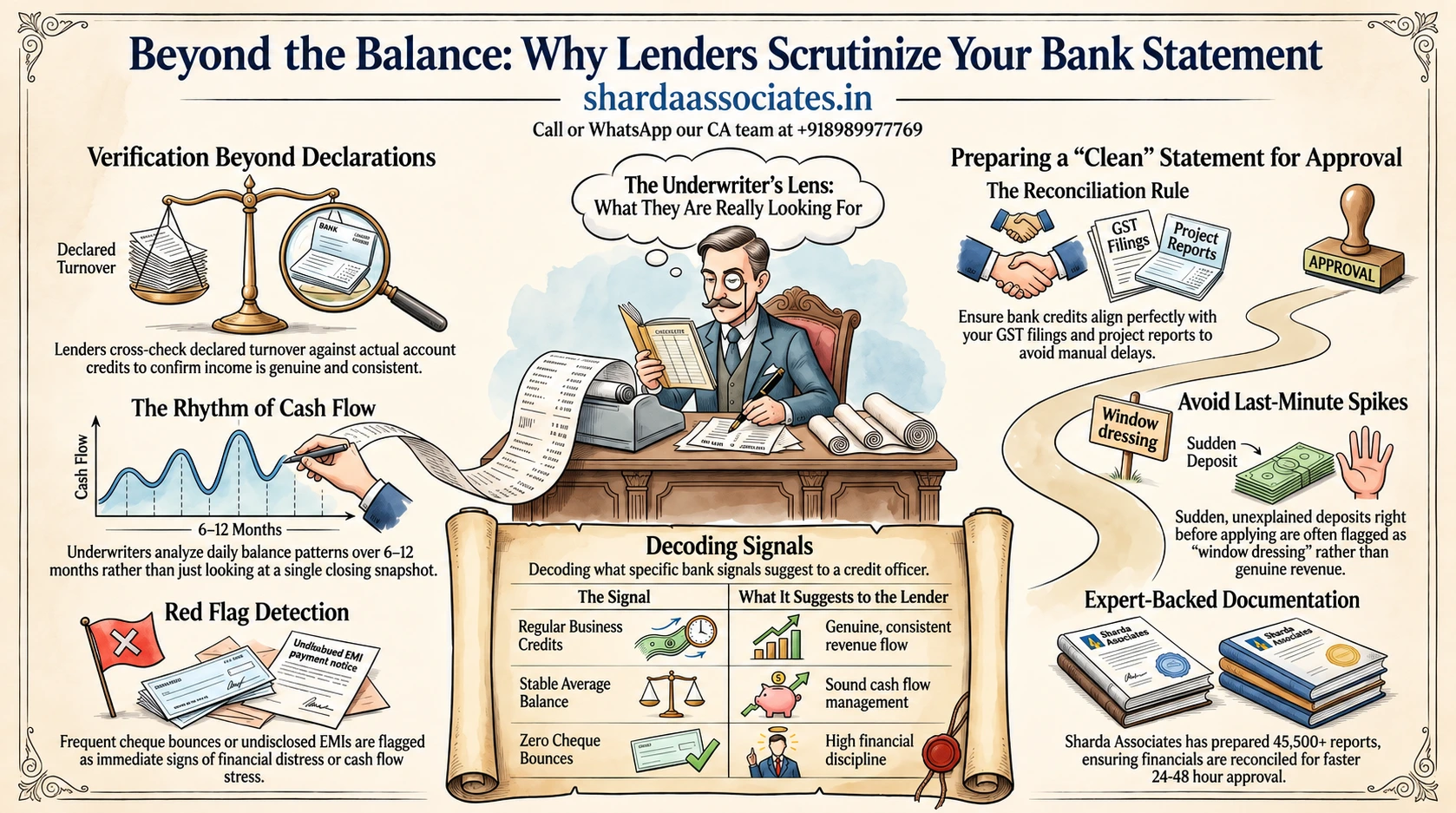
GST returns and financial statements tell a lender what you’ve declared; your bank statement shows what actually happened. Underwriters cross-check declared turnover and income against the actual credits flowing through your account, looking specifically for consistency — regular, traceable deposits that match your claimed business activity, rather than one large, unexplained credit right before you applied. For businesses without a long ITR history, this becomes one of the primary ways a lender can independently confirm income at all.
2. It Reveals True Cash Flow and Financial Stability, Not Just a Snapshot Balance
A single closing balance tells a lender almost nothing on its own. What matters is the pattern over several months — average daily balance, how consistently money comes in and goes out, and whether the account swings wildly between very high and very low balances or holds a steady, predictable rhythm. An account maintaining a consistent balance signals a fundamentally different financial situation than one swinging from a few hundred rupees to a large sum every month, even if the average looks similar on paper.
3. It Detects Red Flags: Fraud and Financial Distress Checks Are Built to Catch
Bank statement analysis exists as much to protect the lender from risk as it does to assess your eligibility. Underwriters specifically look for:
- Frequent cheque bounces or failed auto-debits, which point to cash flow stress.
- Unusual or unexplained large deposits, especially ones that don’t match your declared business activity — lenders want to know these funds are genuinely “sourced”, not borrowed from elsewhere to make the account look healthier.
- A sudden spike in account activity right before the application date, which is a well-known pattern underwriters are trained to flag rather than take at face value.
- Multiple loans or EMIs already running through the account that weren’t disclosed elsewhere in the application.
4. It’s Often the Only Reliable Data Source for Small Businesses Without Strong Financial Records
Traditional underwriting leans heavily on audited financials, collateral, or a long credit history — markers that are frequently unavailable or incomplete for small businesses, first-generation entrepreneurs, or those operating substantially in cash. In these situations, bank statement analysis becomes the most objective, verifiable window into how the business actually manages money, which is why it’s increasingly central to underwriting decisions for MSME and unsecured business lending specifically.
5. It Directly Shapes the Loan Amount, Terms, and Approval Speed
None of this analysis is just a formality — the findings feed directly into the credit decision:
- Repayment capacity assessment — consistent, sufficient cash flow supports a higher approved amount and better terms.
- Risk-based pricing — a stable, well-managed account can support a better interest rate than a volatile one, even at similar turnover levels.
- Faster processing for a clean file — a statement with clear, unambiguous activity generally needs fewer follow-up queries, which speeds up the entire assessment.
- Additional scrutiny for anything inconsistent — if declared turnover, GST figures or the project report don’t reconcile with actual bank statement activity, this typically triggers a slower, more detailed review rather than an outright rejection.
What a Clean Bank Statement Actually Looks Like to an Underwriter
| Signal | What It Suggests |
| Regular, traceable business credits | Genuine, consistent revenue |
| Stable average balance over months | Sound cash flow management |
| Minimal or no cheque bounces | Financial discipline |
| Deposits matching declared turnover/GST figures | Consistency across your documentation |
| No unexplained large one-off credits | No red flags around fund sourcing |
| Reasonable, explainable EMI/debit patterns | Manageable existing obligations |
How to Prepare Your Bank Statements Before Applying For Loan Assessment
- Provide complete statements for the full requested period — every page, since missing pages can trigger a hold or rejection.
- Avoid last-minute large, unexplained deposits right before applying; if a large credit is genuine (a sale, an investment, a refund), be ready to explain and document its source.
- Reconcile the turnover shown in your bank statements with your GST returns and project report figures before submission, since mismatches are exactly what triggers extended scrutiny — this is the kind of cross-check our CA-certified project report and CMA preparation is built to catch before a bank ever sees the file.
- Maintain a steady, explainable pattern of activity in the months leading up to your application rather than irregular, spiky transactions.
Conclusion
Your bank statement is the one document a lender trusts almost more than anything else you submit, simply because it’s the hardest to embellish. Keeping it clean, consistent, and reconciled with the rest of your application — GST returns, ITR, and your project report — is one of the most practical things you can do to move a loan application through faster and with fewer questions.
If you’d like your bank statements, GST data and financials checked for exactly the kind of mismatches underwriters look for before you submit rather than after a delay or query, call or WhatsApp our CA team at Sharda Associates +918989977769.
Frequently Asked Questions
1. How many months of bank statements do lenders typically ask for?
This varies by lender and loan type, but 6–12 months is common for business loans, since it gives underwriters enough history to assess genuine patterns rather than a short snapshot.
2. Can a single large deposit hurt my loan application?
It can raise a flag if it’s unexplained or doesn’t match your declared business activity — being ready to document the source (sale, investment, refund) usually resolves this.
3. Does bank statement analysis matter even if I have strong ITR and GST filings?
Yes — it’s used to cross-verify those declared figures against actual account activity, so consistency across all three documents matters.
4. What happens if my declared turnover doesn’t match my bank statement credits?
This typically triggers additional scrutiny or a reduced sanction rather than automatic rejection, but it’s one of the more common causes of delay.
5. Are cheque bounces always disqualifying?
Not always, but frequent bounces are read as a sign of cash flow stress and can meaningfully affect both approval and the terms offered.
6. Is bank statement analysis done manually or by software?
Increasingly by AI-powered automated tools that flag patterns and anomalies quickly, though manual underwriter review often follows for anything flagged as unusual.
7. Can bank statement analysis help me get a loan even without collateral or a long credit history?
Yes — for many small businesses and unsecured lending products, it’s precisely the tool lenders use in place of these traditional markers.
8. Does having multiple bank accounts complicate this analysis?
It can, if your business activity is spread thin across accounts — consolidating your primary business transactions into one main account generally presents a clearer picture.
9. Will a volatile balance history automatically get me rejected?
Not automatically, but it can lead to a more cautious approach from the lender, including a smaller sanctioned amount or a request for additional documentation.
10. How far back should I start preparing my bank statement history before applying?
Ideally 60–90 days of clean, consistent activity at minimum, though a longer, stable track record generally works in your favour for larger loan amounts.