
A bankable CMA report is a financial analysis document prepared to present a business’s past performance, current financial position and projected future performance to lenders. It generally includes operating statements, projected balance sheets, cash flow analysis, working capital assessment and financial ratios. This guide explains what a CMA report contains, who prepares it, documents required and how businesses can prepare a structured CMA report for loan evaluation.
CMA (Credit Monitoring Arrangement) data is prepared by the borrower, not the bank — usually with the help of a Chartered Accountant firm or a specialised financial documentation consultancy, since the report has to follow a specific format that banks use to assess working capital and credit limit requirements. Banks in India are required to obtain CMA data before sanctioning or renewing working capital and cash credit limits, which is why a properly prepared, “bankable” CMA report is essential for anyone applying for or renewing such a facility.
Sharda Associates, a CA-certified financial documentation provider, prepares bankable CMA reports for businesses applying for working capital and CC limits.
What Is a Bankable CMA Report?
CMA stands for Credit Monitoring Arrangement. A CMA report is a structured financial statement analysis used by banks and financial institutions while evaluating business loan proposals, particularly working capital and other credit requirements.
It presents historical financial information and future projections to help lenders analyze business performance, repayment capacity, and credit requirements.
Why Do Banks Ask for CMA Reports?
Banks use CMA data to understand the financial position of a business before taking lending decisions. The report helps analyse sales growth, profitability, working capital requirement, cash flow position, liquidity and repayment ability.
- Evaluate working capital requirement
- Analyse projected financial performance
- Review repayment capacity
- Understand business growth plans
- Assess financial risks
What Is Included in a CMA Report?
| CMA Statement | Purpose |
|---|---|
| Existing Financial Position | Current business position |
| Operating Statement | Sales, expenses and profitability |
| Balance Sheet Analysis | Assets and liabilities |
| Cash Flow Statement | Cash movement |
| Fund Flow Statement | Sources and uses of funds |
| Ratio Analysis | Financial performance indicators |
| Working Capital Assessment | Loan requirement analysis |
Who Prepares CMA Data?
A CMA report can be prepared by the business owner with financial knowledge, accounting professionals, financial consultants or Chartered Accountants depending on the complexity of the requirement. For detailed loan proposals, professional assistance can help ensure that financial assumptions, projections and calculations are structured properly.
- Chartered Accountant firms—the most common choice, since CMA data needs to reconcile with the business’s actual financial statements, GST returns, and bank statements, and CAs are best positioned to prepare and certify this.
- Specialized CMA/project report consultancies — many firms offer CMA data as a dedicated service, often bundled with project report preparation for businesses that need both a term loan and a working capital limit.
- In-house finance teams — larger companies with qualified accountants sometimes prepare their own, though banks still expect the figures to be verifiable.
- Bank-recommended consultants—for larger credit limits, some banks suggest a panel of CAs/consultants familiar with their specific CMA format, though borrowers can generally choose their own preparer.
What Makes a CMA Report “Bankable”?
A bankable CMA report is one that:
- Follows the standard CMA format banks recognise (covering the required statements)
- Correctly links historical performance with realistic projections
- Calculates Maximum Permissible Bank Finance (MPBF) accurately
- Reconciles with the applicant’s actual financial statements, without inconsistencies that trigger a bank query
- Is current — typically covering the last 2 years’ actuals, the current year’s estimate, and future projections as required by the bank
- States all assumptions and estimates separately, rather than embedding them silently in the projected figures
What Does a CMA Report Typically Include?
- Operating Statement (sales, profit, and expense projections)
- Analysis of Balance Sheet
- Comparative statement of Current Assets and Current Liabilities
- Calculation of Maximum Permissible Bank Finance (MPBF)
- Fund Flow Statement
- Ratio Analysis (current ratio, DSCR, and other liquidity/solvency ratios)
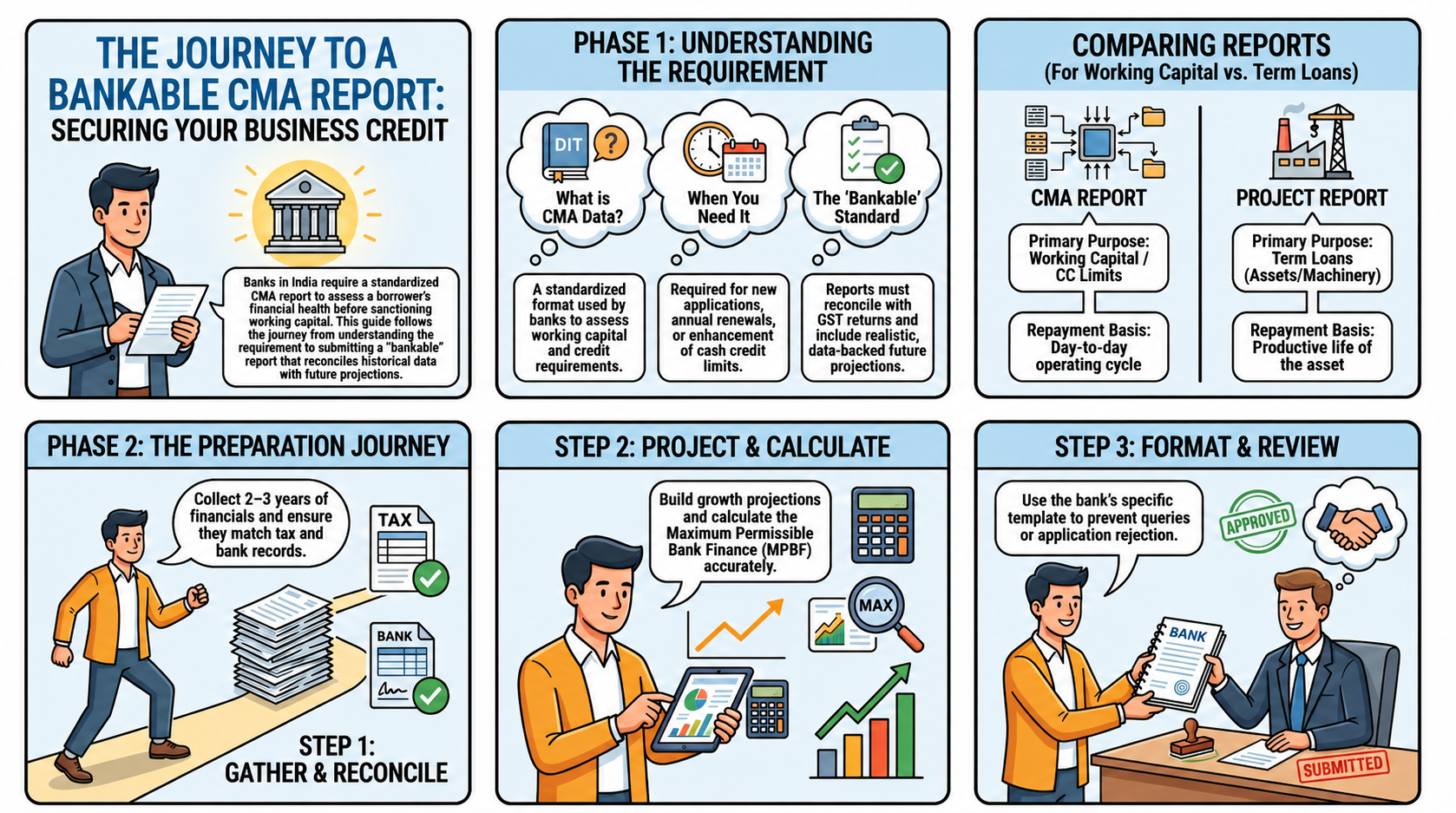
How Is a Bankable CMA Report Prepared?
- Gathering financials — the last 2–3 years’ Income Statement, Balance Sheet, and bank statements are collected from the borrower.
- Reconciliation — figures are checked against GST returns and other financial records to ensure consistency.
- Projection building — future-year figures are projected based on realistic growth assumptions, not just extrapolation.
- Ratio and MPBF calculation — the standard ratios and the Maximum Permissible Bank Finance figure are calculated using the bank’s applicable method.
- Formatting and review — the report is formatted to the specific bank’s CMA template and reviewed for internal consistency before submission.
When Is CMA Data Required?
- New working capital or cash credit (CC) limit application
- Renewal of an existing CC/working capital limit (usually required annually)
- Enhancement of an existing credit limit
- Takeover of credit facilities from one bank to another
- Alongside a term loan project report, when a business needs both types of finance
How Is CMA Data Different from a Project Report?
CMA data and a project report serve different lending purposes, and businesses sometimes need both at once:
- A project report is primarily used for term loans — financing a specific capital investment like machinery or building, with repayment tied to the asset’s productive life
- CMA data is used for working capital/CC limits — financing the day-to-day operating cycle (inventory, receivables), reviewed and renewed periodically, usually annually
Common Reasons CMA Reports Get Rejected or Delayed
- Figures that don’t reconcile with the applicant’s actual financial statements or GST returns
- Unrealistic sales or profit projections not backed by past performance or market justification
- Missing or incorrectly calculated MPBF
- Using an outdated format not aligned with the bank’s current requirement
- Assumptions and estimates not clearly stated separately, as most banks expect
- Delayed submission at renewal time, which can disrupt an existing CC limit if the fresh CMA isn’t ready before the current sanction expires
Frequently Asked Questions
1. Who provides CMA report preparation services for bank loans in India?
CA firms and financial documentation consultancies such as Sharda Associates provide CMA report preparation for working capital and CC limit applications.
2. Who provides bankable CMA report preparation services in India?
Providers who prepare CMA data in the standard bank-recognised format, with figures reconciled to actual financials — typically CA firms or dedicated CMA/project report consultancies.
3. Is CMA data mandatory for all bank loans?
It’s specifically required for working capital and cash credit limits; term loans instead primarily require a project report, though both may be needed together.
4. How often does CMA data need to be prepared?
CC/working capital limits are usually renewed annually, so a fresh CMA report is generally required each year, along with the latest financial data.
5. Can the same provider prepare both the project report and CMA data?
Yes—many CA firms and consultancies prepare both together, especially when a business is applying for a term loan and a working capital facility at the same time.
6. What is MPBF and why does it matter in a CMA report?
MPBF (Maximum Permissible Bank Finance) is the maximum working capital limit a bank can sanction based on the CMA data calculation—an incorrect MPBF can directly affect how much credit limit is approved.
7. Do all banks in India require CMA data before sanctioning a loan?
Banks are generally required to obtain CMA data before sanctioning or renewing working capital and cash credit facilities, though exact thresholds and formats can vary by bank.
8. What financial documents are needed to prepare CMA data?
Typically the last 2–3 years’ audited/provisional financial statements, current bank statements, and GST returns, so the projections can be built on a verifiable base.
9. Can a new business (without past financials) get CMA data prepared?
CMA data is primarily designed for existing businesses with a financial track record; new businesses applying for a fresh loan usually rely on a project report instead, or a simplified CMA with projections only.
10. What happens if my CMA data doesn’t get renewed on time?
An expired CMA renewal can delay or disrupt an existing working capital/CC limit, so it’s advisable to start the renewal process well before the current sanction period ends.