
The honest answer is: that Business Loan Amount in India depends entirely on your business stage, turnover, and the specific scheme or lender you approach — a first-time entrepreneur and an established manufacturer aren’t competing for the same loan product or the same ceiling. India’s business lending landscape is layered, ranging from ₹50,000 collateral-free MUDRA loans for very early-stage units all the way to ₹10 crore CGTMSE-backed collateral-free credit for established MSMEs, with several schemes and lender types in between.
At Sharda Associates, one of the most common questions we get from clients is simply “which loan fits my business right now?”—so here’s a clear breakdown of how much you can realistically borrow, and from where, at each stage.
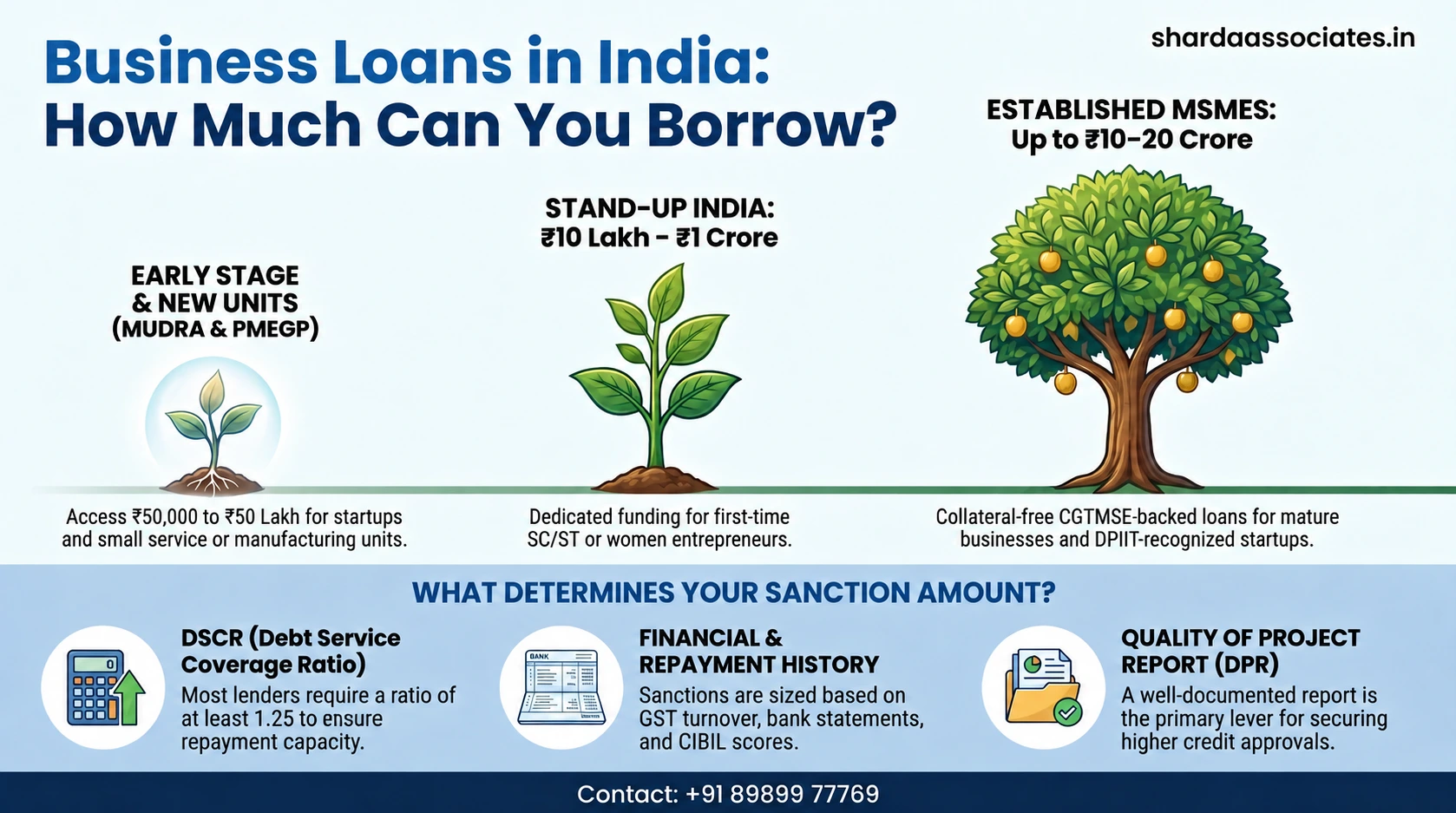
Business Loan Amount by Stage and Source
| Business Stage | Loan Route | Typical Amount Range | Collateral |
| Very early-stage/first-time (Shishu) | MUDRA (PMMY) | Up to ₹50,000 | None |
| Small, some operating history (Kishor) | MUDRA (PMMY) | ₹50,000 – ₹5 lakh | None |
| Growing micro-business (Tarun/Tarun Plus) | MUDRA (PMMY) | ₹5 lakh – ₹20 lakh | None |
| New manufacturing/service unit | PMEGP (KVIC/DIC) | Project cost up to ₹50 lakh (manufacturing) / ₹20 lakh (services), with 15–35% subsidy | None (as per RBI norms for eligible loan sizes) |
| First-time SC/ST or women entrepreneurs | Stand-Up India | ₹10 lakh – ₹1 crore | Per scheme norms |
| Established micro/small enterprise | CGTMSE-backed bank/NBFC loans | Up to ₹10 crore (guarantee ceiling as of April 2025), DPIIT-recognised startups up to ₹20 crore | Collateral-free, subject to lender appraisal |
| Established business, standard term loan | Scheduled banks (SBI, PNB, HDFC, ICICI, etc.) | Typically ₹10 lakh – several crore, based on turnover and DSCR | Often secured for larger amounts |
| GST-registered business needing working capital | GST-based loans (banks/NBFCs) | Sized as a multiple of GST-declared turnover | Usually unsecured |
Figures above reflect scheme ceilings and commonly seen lender ranges; the actual amount you’re offered still depends on your specific turnover, DSCR, credit profile and the lender’s own risk assessment — a scheme ceiling is a maximum, not a guaranteed sanction.
Where to Apply, by Route
- MUDRA (PMMY): Available through virtually all scheduled commercial banks, regional rural banks, small finance banks, NBFCs and MFIs. You can also start an application via the Jan Samarth portal, which routes it to a participating lender.
- PMEGP/CMEGP: Applied for online through the KVIC PMEGP e-portal (or state-level CMEGP portals), with the District Industries Centre (DIC) or KVIC/KVIB verifying and forwarding the application to a financing bank.
- Stand-Up India: Facilitated through the Stand-Up India portal (standupmitra.in), which connects eligible applicants to participating bank branches.
- CGTMSE-backed loans: Applied for directly through any CGTMSE Member Lending Institution — scheduled banks, RRBs, small finance banks, and CGTMSE-registered NBFC-MFIs. You cannot apply to CGTMSE directly; the request goes through your bank, which then seeks the guarantee cover.
- Standard term loans/working capital: Directly through PSU banks (SBI, PNB, Bank of Baroda, Canara Bank), private banks (HDFC, ICICI, Axis, Kotak), or SIDBI for larger MSME/industrial credit.
- GST-based/unsecured business loans: Increasingly offered by NBFCs and fintech lenders, often with faster, lighter-documentation processing than traditional bank term loans.
What Actually Determines How Much You Get
Regardless of the scheme ceiling, the amount you’re actually offered comes down to:
- DSCR (Debt Service Coverage Ratio) — most banks require at least 1.25, and the loan amount is sized so this ratio holds after including the new EMI.
- Turnover and cash flow — verified through GST returns, bank statements, and (where available) ITR.
- Margin money/promoter contribution — banks typically expect you to fund a portion of the project cost yourself; a stronger contribution supports a larger sanction.
- Existing debt obligations — high existing EMIs reduce your assessed additional borrowing capacity.
- Credit score and repayment history — a stronger CIBIL score and clean repayment record generally support higher sanctions and better terms.
- Collateral offered, where applicable — secured loans can typically go higher than unsecured products, even under a guarantee scheme.
- Quality of your project report/DPR — a realistic, well-documented report with a verified DSCR is one of the most direct levers over how much a credit officer is willing to approve.
A Practical Way to Think About It
- Need under ₹10 lakh and have little or no operating history? Start with MUDRA (Kishor/Tarun) or, for a brand-new unit, PMEGP.
- Need ₹10 lakh to ₹1 crore and are a first-time SC/ST or women entrepreneur? Stand-Up India is built specifically for this.
- Need a larger, collateral-free amount for an established MSME? Ask your bank to route the application through CGTMSE.
- Have strong, verifiable turnover and want working capital quickly? A GST-based loan from an NBFC or bank can be faster than a traditional term loan.
- Need a large, secured term loan for expansion? Approach a scheduled bank or SIDBI directly with a detailed project report.
Conclusion
The right loan amount and source depend far more on your business stage and documentation quality than on simply picking the scheme with the highest ceiling. A realistic, well-prepared project report or CMA data — matched to the right scheme or lender for your stage — is usually what actually determines how much you walk away with. Our CA team at Sharda Associates helps businesses figure out which route fits and prepares the CA-certified documentation lenders expect. Call or WhatsApp us at +91 89899 77769.
Frequently Asked Questions
1. What is the maximum loan amount available without any collateral?
As of April 2025, CGTMSE-backed loans can go up to ₹10 crore collateral-free for eligible MSEs (up to ₹20 crore for DPIIT-recognised startups), though the actual sanction still depends on the lender’s credit appraisal.
2. Can a completely new business get a large loan?
Not typically at the very top of these ranges — new businesses usually start with MUDRA or PMEGP, and access to larger amounts builds as the business develops turnover and repayment history.
3. Is the CGTMSE ceiling a guaranteed loan amount?
No — it’s a maximum guarantee cover; the bank still assesses your actual repayment capacity, DSCR and business viability before deciding the sanctioned amount.
4. Which lender offers the fastest processing for smaller amounts?
NBFCs and fintech lenders, particularly for GST-based or MUDRA-linked products, are often faster than large PSU banks due to lighter documentation requirements.
5. Do all banks participate in MUDRA and CGTMSE?
Most scheduled commercial banks, RRBs and small finance banks participate in both; specific product availability can still vary by branch and lender policy.
6. Can I combine schemes, like MUDRA and PMEGP, for the same project?
Generally no — most government schemes require you to apply through one specific route per project; check current scheme guidelines before assuming otherwise.
7. How does DSCR affect how much I can borrow?
Your loan amount is sized so that your projected income comfortably covers the resulting EMI at the bank’s minimum required DSCR (commonly 1.25 or higher) — a weaker DSCR results in a smaller approved amount.
8. Is a project report needed for every loan amount?
It’s expected for most term loans and scheme-based loans above smaller MUDRA tiers; very small, GST- or bank-statement-based loans may rely more on financial data than a formal project report.
9. Can turnover-based (GST) loans exceed CGTMSE-covered amounts?
Typically no — GST-based loans are usually sized more conservatively as a multiple of turnover and are generally used for smaller working capital needs rather than large project financing.
10. Where can I check the latest scheme ceilings and interest rates?
Always verify current limits directly on the scheme’s official portal (CGTMSE, MUDRA, PMEGP/KVIC, Stand-Up India) since ceilings and terms are revised periodically.