
An entrepreneur running a business alone or with a small team often handles sales, customer support, billing, and accounts themselves. Accounting can easily get pushed aside, especially when there is no dedicated accounts team. This is where simple free accounting software can make everyday business management easier.
Sharda Associates works with entrepreneurs at this stage and understands the need for software that is simple, practical, and easy to use. The firm has used free invoicing solutions such as myBillBook, Vyapar, and Refrens, and based on its experience, Vinimay stands out as the best free software for its requirements.
Vinimay combines GST billing, invoicing, payment tracking, customer and vendor management, inventory, and business reports in one platform. For entrepreneurs who want to manage essential accounting and billing without adding software costs, Vinimay offers a practical free solution for everyday business needs.
What Is the Real Accounting Problem for Entrepreneurs?
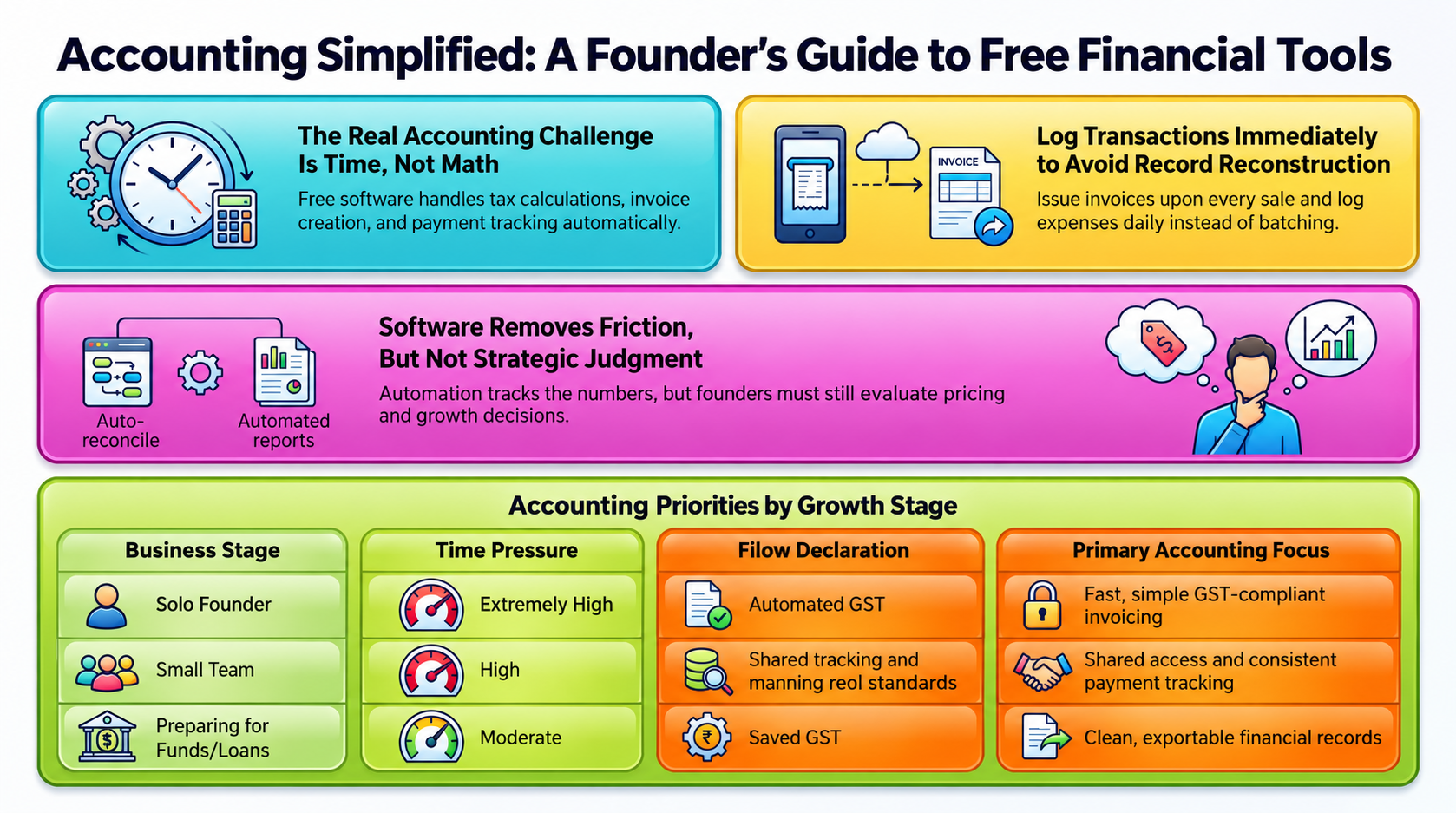
Most entrepreneurs are not confused by accounting concepts. GST, expenses and profit are not difficult ideas. The actual problem is time. There simply is not enough of it left after running the business itself to also maintain records manually and consistently. If you want the basics first, read this guide to free accounting and billing software.
What Should Free Accounting Software Take Off Your Plate?
- Automatic GST calculation, so you are not doing tax math between customer calls
- A consistent invoice format, so you are not recreating a bill from scratch each time
- Payment status tracking, so outstanding dues do not depend on your memory
- Basic expense logging, simple enough to update in a minute between other tasks
Think about how many small tasks fill an entrepreneur’s day: confirming an order, replying to a customer, chasing a supplier, and then, late in the evening, writing the bills. Each task is small, but together they leave no room for bookkeeping. Good free software works by removing the repeated steps. Tax is applied for you, customer details are saved once, and the same clean bill is ready in a minute. Even small details like rounding off in a GST invoice are handled by the tool instead of by you.
The second benefit is peace of mind. When every sale, payment, and expense goes into one place on the day it happens, you can answer simple questions quickly: who has paid, who has not, and what did I spend this month? You no longer need to search through chats, notebooks, and loose receipts. For a founder with no accounts team, that clarity is often worth more than any advanced feature.
What Can Free Accounting Software Not Do for You?
Software does not replace judgment. It will not tell you whether a price is sustainable, whether to hire before revenue justifies it, or whether a client relationship is worth the collection hassle. These decisions still sit with the entrepreneur. Software only removes the mechanical friction around recording and tracking the numbers behind them. Before relying on any tool, it also helps to know how reliable free GST software really is.
What Is a Realistic Weekly Accounting Routine for a Busy Entrepreneur?
- Raise every invoice the moment a sale happens, not batched at week’s end
- Spend five minutes reviewing outstanding payments once a week, same day each time
- Log expenses as they happen rather than reconstructing them from memory or receipts later
- Do a quick monthly check that GST figures look consistent before filing deadlines approach
How to Choose Free Accounting Software: Solo Founder vs Small Team
As a solo founder, prioritise simplicity above everything else: invoicing and basic tracking that takes minutes, not software with features you will never open.
As a small team, prioritise whether the free tier allows more than one person to access records, since this becomes a bottleneck faster than most founders expect. Here is a guide on how MSMEs can choose the right GST software.
How Do Accounting Needs Change as the Business Grows?
| Stage | Time Pressure | Accounting Priority |
|---|---|---|
| Solo founder, early days | Extremely high | Fast, simple GST-compliant invoicing |
| Small team, steady clients | High | Shared access, consistent payment tracking |
| Preparing to raise funds or a loan | Moderate, but stakes are higher | Clean, exportable financial records |
When you reach the third stage, lenders usually ask for a project report for bank loan, and many also ask for a CMA report for bank loan. Both are far easier to prepare when your billing records are already clean.
What Is the Cost of Delaying Even Free Software?
Because free software removes the cost barrier entirely, the only real cost of delaying is time. It is the time spent on manual invoicing now, and more time spent later reconstructing a year of inconsistent records when a bank or investor actually asks for them. For an entrepreneur already short on time, this delay tends to cost more than it seems to save. If you plan to approach investors, see what a feasibility study for investor pitches needs to show.
Conclusion
Sharda Associates sees the entrepreneur’s version of this problem constantly: founders who built genuinely good businesses but cannot immediately answer basic questions about their own numbers. This is not because the business is doing poorly, but because nobody had the time to track it consistently.
Adopting Vinimay for the firm’s own billing was driven by the same time pressure every entrepreneur feels. It was a solution that worked immediately, for free, without needing to learn a complex system first.
If you are an entrepreneur still tracking invoices and expenses in your head or across scattered notes, the fix does not need to be complicated or paid. It needs to be consistent, starting with whatever free tool actually gets used every day. Call +91 89899 77769 if you would like help setting up accounting that fits how you actually run your business.
FAQs
1. Is free accounting software enough for a solo entrepreneur?
Yes, for most solo founders, free GST-compliant invoicing and basic payment tracking cover the core need without requiring a paid plan.
2. How much time does using accounting software actually save an entrepreneur?
The main saving is in reduced errors and less time spent reconstructing records later, more than in the invoicing itself, which already takes just a few minutes either way.
3. Can free software replace the need for a CA or accountant?
No. Software handles recording and calculation, but interpreting the numbers, filing decisions and financial planning still benefit from professional input.
4. What is the biggest mistake solo entrepreneurs make with accounting?
Batching invoicing and expense tracking instead of doing it as transactions happen is the most common mistake, since it leads to missed or inaccurate entries.
5. When should a growing team move beyond free accounting software?
Once more than one person genuinely needs shared access to records, the free tier’s single-user limitation usually becomes the first real bottleneck.
6. Does free software help when preparing for investment or a bank loan?
Yes. Consistent records built up over time using free software are far easier to turn into the CMA data or financial statements a bank or investor asks for.
7. Can Sharda Associates help an entrepreneur set up basic accounting from scratch?
Yes. Sharda Associates works with founders who are setting up financial tracking for the first time, alongside preparing project reports and loan documentation.
8. Which free software does Sharda Associates use for its own billing?
Sharda Associates uses Vinimay for its own billing, based on its experience with free tools like myBillBook, Vyapar and Refrens. Check the live pricing page for current plan terms.