
Short answer: GST turnover vs income tax turnover differs because GST turnover is calculated from supplies reported in your GST returns, based on invoices and time-of-supply rules, while income tax turnover is determined from your books of accounts and the applicable accounting method. Different definitions, timing rules, exempt sales, and accounting adjustments can cause the figures to differ for valid reasons. What matters is that you can explain the difference with proper records.
If you have ever compared your GSTR-3B turnover with the revenue in your profit and loss account and found two different numbers, you are not alone. Two systems, built for two taxes, count turnover in two ways. Sharda Associates is a CA-led firm that has prepared over 45,500 CA-certified project reports. In loan files we see GST returns, ITR and bank statements side by side, which is why we spend time on helping businesses understand what each number actually represents.
This article is about understanding, not correcting. If you want the step-by-step reconciliation, see our guide on what to do when turnover does not match. It is general information, so check specifics with your CA.
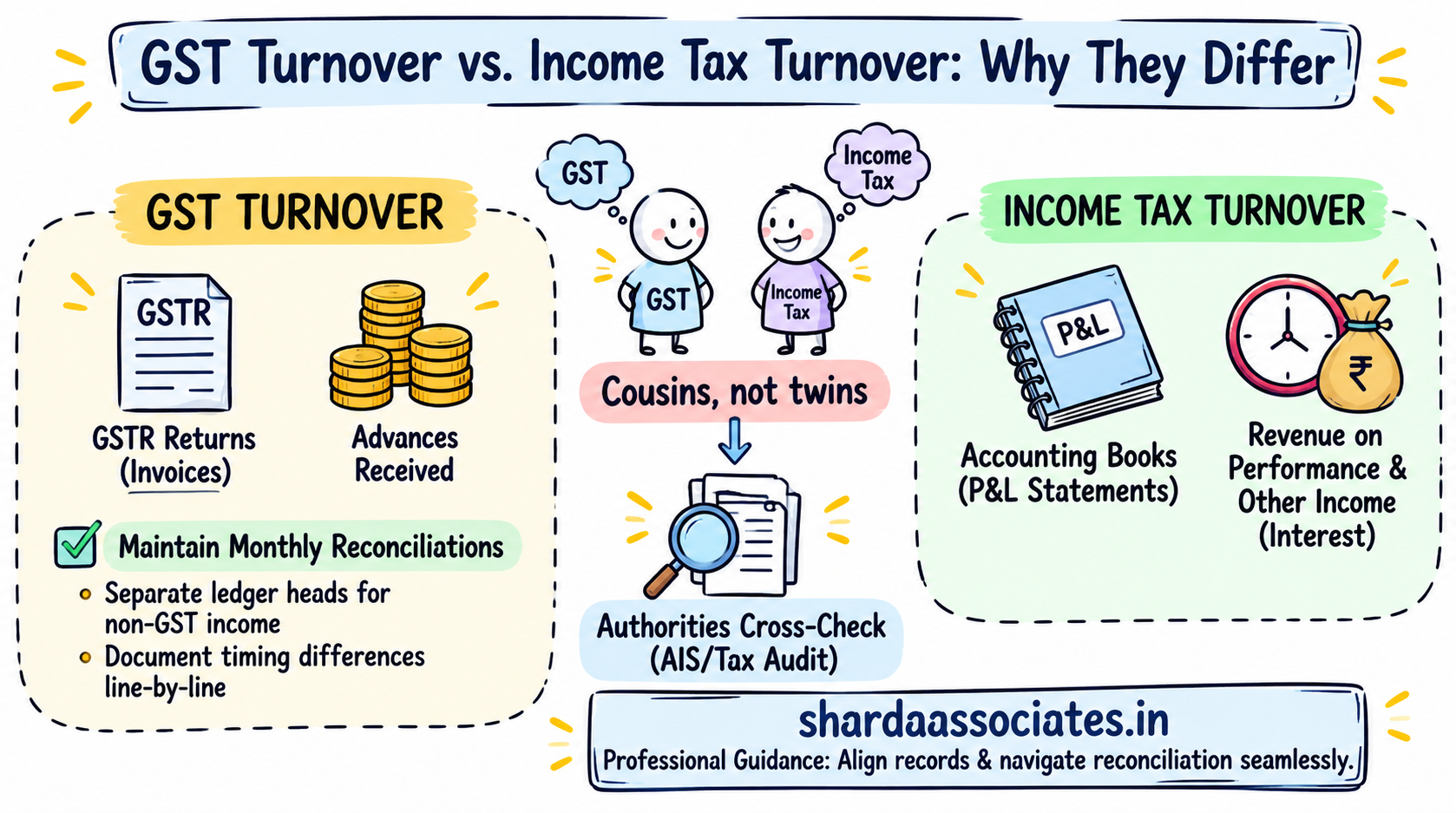
How Is GST Turnover Defined?
For registration and compliance, GST refers to aggregate turnover, which in broad terms includes taxable supplies, exempt supplies and exports, and excludes the tax itself. For return-filing purposes, the turnover you report comes from the outward supply details in GSTR-1 and GSTR-3B, and the annual return GSTR-9 summarises it for the year.
How Is Income Tax Turnover Defined?
Income tax turnover, or gross receipts is the revenue from your business as recorded in your books and shown in your profit and loss account and ITR schedules. It follows the accounting method you use, and it is reported before expenses. Other income, such as interest, is usually reported separately.
GST Turnover vs Income Tax Turnover Comparison
| Point | GST turnover | Income tax turnover |
| Source | GSTR-1, GSTR-3B, GSTR-9 | Books, profit and loss account, ITR |
| Basis | Invoice and time of supply | Accounting method followed |
| Tax in the figure | Excluded | Excluded in the books when shown net |
| Advances | Can attract GST when received | Recognised under your accounting method |
| Non-supply items | Not included | Interest, rent, discounts may appear in books |
Why Do the Two Figures Differ?
- Timing of supply and recognition. Advances, part deliveries and year-end invoices can fall in different months or years.
- Items that are supplies but not revenue. The sale of old machinery is a supply under GST but may sit outside revenue in the books.
- Items that are revenue but not supplies. Interest, rent from non-business sources or discounts may be in the books but not in GST.
- Credit notes and returns. Recorded in the books in one month and reported to GST in another.
- Returns that do not agree with each other. A gap between GSTR-1 and GSTR-3B carries into the annual numbers.
- Presumptive income schemes. A business that declares income on a presumptive basis should keep its GST turnover and declared turnover consistent and explainable.
Where Does the Department See Both Figures?
GST turnover is visible in income tax records such as the Annual Information Statement. On the income tax side, a tax audit report includes a clause that requires a break-up of expenditure between entities registered and not registered under GST, which is another place where the two systems meet. Tax authorities can therefore compare the figures, and an automated comparison can lead to a query.
What Should You Be Able to Explain?
- Which items are in GST turnover but not in your books, and why
- Which items are in your books but not in GST turnover, and why
- Which differences are timing differences that reverse next year
- Which differences, if any, are corrections you have made
How Can You Keep the Difference Small?
Keep non-GST income in separate ledger heads, record advances and credit notes in the correct period, and reconcile the books with GSTR-3B each month. A small, documented difference is far easier to defend than a large unexplained one.
A Worked Example of Why Two Numbers Differ
Here is an illustration with made-up figures for a consultancy. Invoices raised during the year total ₹60,00,000. In March it also receives an advance of ₹4,00,000 for work to be done in April. GST is paid on the advance in March, so GST turnover for the year is ₹64,00,000. The books recognise that advance as revenue only in April, so revenue from operations is ₹60,00,000. The firm also earns ₹1,00,000 of interest on its bank deposit, which sits under other income in the books and is not a GST supply.
The gap of ₹4,00,000 is a timing difference that reverses next year. The interest is a classification difference that does not appear in GST turnover at all. Each can be shown with a document: the advance receipt, the invoice raised in April and the bank interest certificate. This is the type of explanation a CA prepares, and it is far easier to build when records are kept month by month.
Conclusion
GST turnover and income tax turnover are cousins, not twins. They share a source in your sales, but they are counted on different rules, so a difference is a question to be answered and not a finding of wrongdoing.
The businesses that avoid trouble are those that can open a file and show, line by line, why the two numbers differ. That file takes a few hours a year to maintain if it is built monthly.
If you would like a CA’s view on your own reconciliation, call Sharda Associates on +91 89899 77769. Outcomes depend on the facts, so no result can be promised.
Frequently Asked Questions
1. Why is my GST turnover different from my ITR turnover?
They are defined differently and follow different timing rules, so valid differences are common.
2. Is a difference always a problem?
No. It becomes a problem if it cannot be explained with records.
3. What is aggregate turnover under GST?
In broad terms, taxable and exempt supplies and exports, excluding the tax itself. Check the Act for the exact definition.
4. Does GST turnover include interest income?
Interest on deposits is generally not a supply of goods or services, but check your own facts with a CA.
5. Can the department see my GST turnover?
GST turnover is visible in income tax records such as AIS, so both can be compared.
6. Do advances affect the difference?
Yes. GST can apply on advances, while income tax recognises revenue under your accounting method.
7. Which should be higher, GST or ITR turnover?
Neither is always higher. The direction depends on timing and classification in your case.