
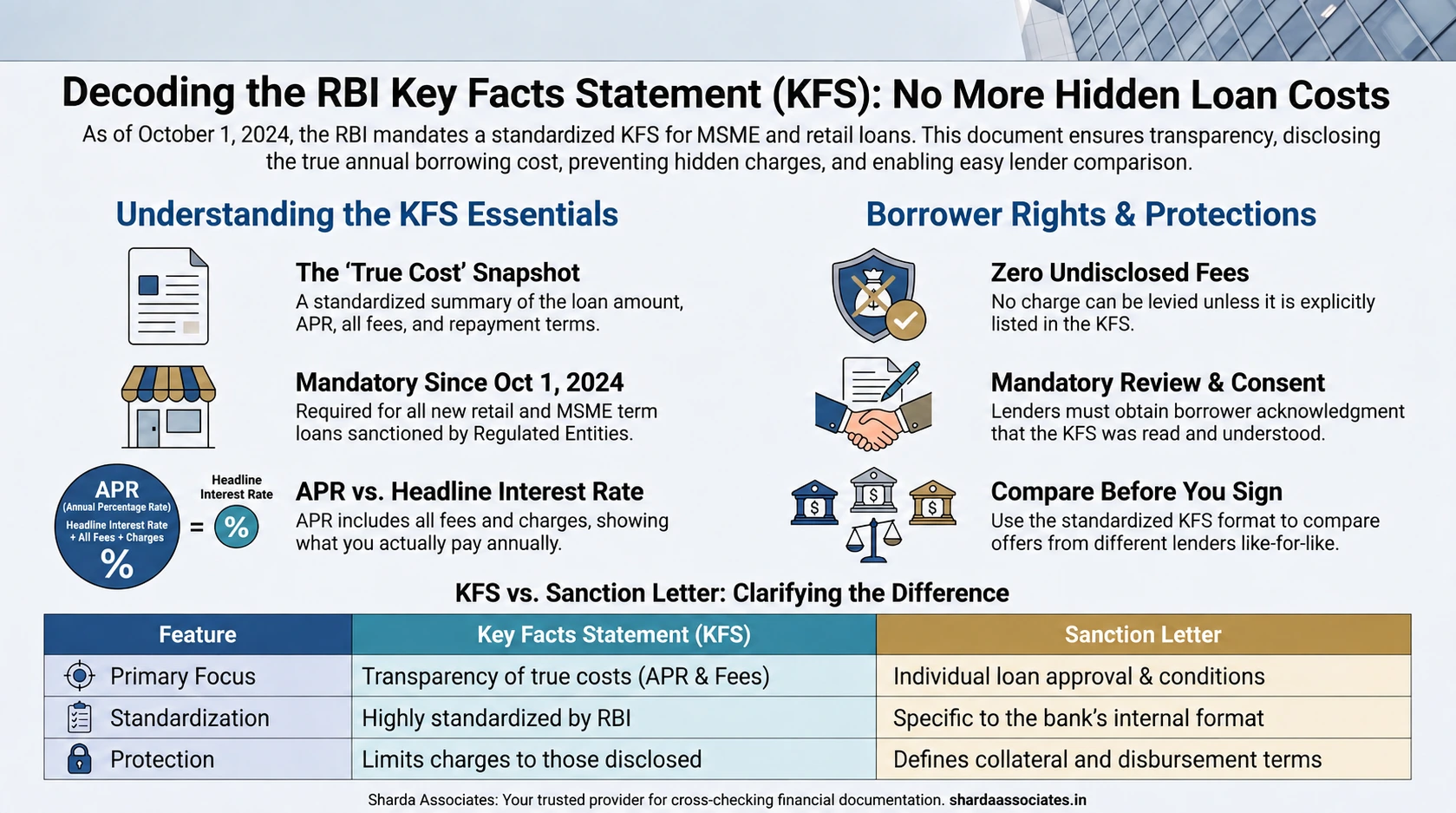
A Key Facts Statement (KFS) is a standardised, RBI-mandated document that every bank and NBFC must give MSME and retail term loan borrowers before the loan agreement is finalised, summarising the true cost of borrowing — including the Annual Percentage Rate (APR), all fees, and repayment terms — in simple, comparable language. The RBI made this mandatory for all new retail and MSME term loans sanctioned on or after October 1, 2024, specifically to stop borrowers from being surprised by hidden charges after signing. Sharda Associates, a CA-certified financial documentation provider, helps applicants understand and cross-check KFS terms as part of the broader loan documentation process.
Why Did RBI Introduce the KFS?
Before the KFS mandate, loan cost disclosure varied significantly across lenders — some buried fees in legal language, others quoted only the headline interest rate without the full cost of borrowing. RBI introduced KFS specifically to standardise this: a single, easy-to-read document, in a language the borrower understands, that lets a borrower compare loan offers on a like-for-like basis rather than relying on scattered terms across multiple documents.
Who Is Required to Provide a KFS?
All Regulated Entities — commercial banks, co-operative banks, and NBFCs (including housing finance companies) — are required to provide a KFS for all new retail and MSME term loans, including fresh loans extended to existing customers, sanctioned on or after October 1, 2024. Credit card receivables and corporate loans are exempted from this specific requirement.
What Must a KFS Include?
- Loan amount and type
- Annual Percentage Rate (APR) — the true annual cost of the loan, including interest and all associated charges
- All fees and charges — processing fees, legal/documentation charges, insurance premiums (if bundled), and any third-party charges recovered through the lender
- Recovery mechanism and grievance redressal contact details
- A statement that no charge not mentioned in the KFS can later be levied on the borrower, without explicit consent
- Repayment schedule and tenure
- Borrower acknowledgement — the lender must obtain confirmation that the borrower has read and understood the KFS
What Is APR, and Why Does It Matter More Than the Headline Interest Rate?
The interest rate a lender advertises often doesn’t reflect the full cost of the loan — processing fees, documentation charges, and other add-ons can meaningfully increase what you actually pay. APR (Annual Percentage Rate) folds all of this into a single annualised figure, which is why comparing APR across two loan offers gives a more accurate picture than comparing headline interest rates alone.
What Should You Specifically Check in a KFS Before Signing?
- APR, not just the interest rate — confirm the APR reflects everything, and compare it against other lenders’ APR rather than just the quoted rate
- All fees listed — processing fee, documentation charges, legal/valuation fees, and any insurance bundled with the loan
- Whether any fee is missing that you were verbally told about — since RBI rules state that a charge not mentioned in the KFS cannot be levied later without your explicit consent, an omission here actually protects you, but it’s worth flagging any mismatch before signing
- Repayment schedule and EMI amount — confirm this matches what was discussed and is realistic against your cash flow
- Recovery and grievance redressal details — note the escalation contact in case of a dispute later
- Language and clarity — the KFS is required to be in a language you understand; if anything is unclear, ask before signing rather than after
- Consistency with the sanction letter — the KFS and the sanction letter relate to the same loan and should not contradict each other; flag any discrepancy to the lender
Can a Lender Charge Something Not Mentioned in the KFS?
No — RBI has explicitly directed that any fees or charges not mentioned in the KFS cannot be levied on the borrower at any stage during the loan term, without the borrower’s explicit consent. This is one of the KFS’s strongest borrower protections: if a charge appears later that wasn’t disclosed upfront, it generally shouldn’t be enforceable without your separate agreement.
How Is the KFS Different from the Sanction Letter?
The KFS is a standardised cost-disclosure document focused on making the true cost of borrowing (APR, fees) transparent and comparable across lenders. The sanction letter is the bank’s individual approval document for your specific application, covering the sanctioned amount, collateral, pre-disbursement conditions, and case-specific terms in more detail. Both documents relate to the same loan and should be checked together — if the numbers or terms in one don’t match the other, that’s worth raising with the lender before proceeding.
When Do You Receive the KFS?
The KFS is meant to be provided before the loan agreement is executed, giving the borrower a chance to review and understand the loan’s true cost before committing — not handed over after the fact as a formality alongside other paperwork.
Frequently Asked Questions
- What is a Key Facts Statement (KFS) for a business loan?
It’s a standardised, RBI-mandated document that summarises a loan’s true cost — including APR, all fees, and repayment terms — in simple language, provided before the loan agreement is finalised.
- Is KFS mandatory for all business loans in India?
It’s mandatory for all new retail and MSME term loans sanctioned by banks and NBFCs on or after October 1, 2024, including fresh loans to existing customers; corporate loans and credit card products are exempted.
- What is APR, and why is it more useful than the interest rate alone?
APR (Annual Percentage Rate) includes the interest rate plus all other charges, giving the true annual cost of borrowing — comparing APR across lenders gives a more accurate picture than comparing headline interest rates alone.
- Can a bank charge me a fee that wasn’t mentioned in my KFS?
No — RBI rules state that any charge not disclosed in the KFS cannot be levied on the borrower at any stage of the loan, without the borrower’s explicit consent.
- Is the KFS the same as the loan sanction letter?
No — the KFS is a standardised cost-disclosure document, while the sanction letter is the bank’s specific approval for your application, including collateral and disbursement conditions; both should be checked together.
- Does the KFS have to be in a language I understand?
Yes — RBI guidelines require the KFS to be provided in a language understood by the borrower, to ensure genuine comprehension rather than just formal disclosure.
- What should I do if the KFS and the sanction letter show different numbers?
Raise the discrepancy with the lender before signing — the two documents relate to the same loan and shouldn’t contradict each other.
- Do I need to sign the KFS to acknowledge I’ve read it?
Yes — lenders are required to obtain the borrower’s acknowledgement that they have read and understood the KFS before proceeding.
- Does KFS apply to working capital loans and cash credit limits, or only term loans?
The RBI mandate specifically covers MSME and retail term loan products; other credit facilities may follow different disclosure norms, so it’s worth confirming with the specific lender.
- Can I use the KFS to compare loan offers from different lenders?
Yes — that’s the primary purpose of the standardised format: comparing APR and fees across the KFS from different lenders gives a like-for-like view of the true cost of each offer.