
A kirana store runs on speed and trust with regular customers, and billing has traditionally been the part owners worry about least, a notebook, a calculator, or simple memory for regulars who pay later in the month. That works until the shop starts stocking more SKUs, GST becomes unavoidable on packaged goods, or a bank asks for sales records while evaluating a loan for shop expansion or a new cold storage unit. At that point, the gap between what a notebook can show and what is actually needed becomes obvious fairly quickly.
Sharda Associates, a CA firm that prepares project reports and loan documentation for small retail businesses, including kirana stores, sees this exact gap come up often, an owner with a genuinely healthy shop who still struggles to produce clean sales figures when it matters. The firm has also used Vinimay’s free GST invoicing software for its own client billing, which is a useful reference point for what a kirana store actually needs: simple, fast, and compliant, without unnecessary complexity built for a much bigger retail operation.
This article answers the questions kirana store owners usually have when they start looking at billing software, what it should do, what it should not force them to deal with, and how to tell if a free tool is enough or a paid system is worth it.
What Billing Software Should Do for a Kirana Store
A kirana store does not need a full retail management suite on day one. The core requirements are:
- Quick bill generation at the counter, without slowing down regular customers
- Correct GST application on packaged and branded goods, since many kirana items now fall under GST
- A simple daily sales total, without manual tallying of a cash drawer and a notebook separately
- Basic tracking of which items are selling fastest, useful for reordering stock on time
Why GST Compliance Is Now Unavoidable for Kirana Stores
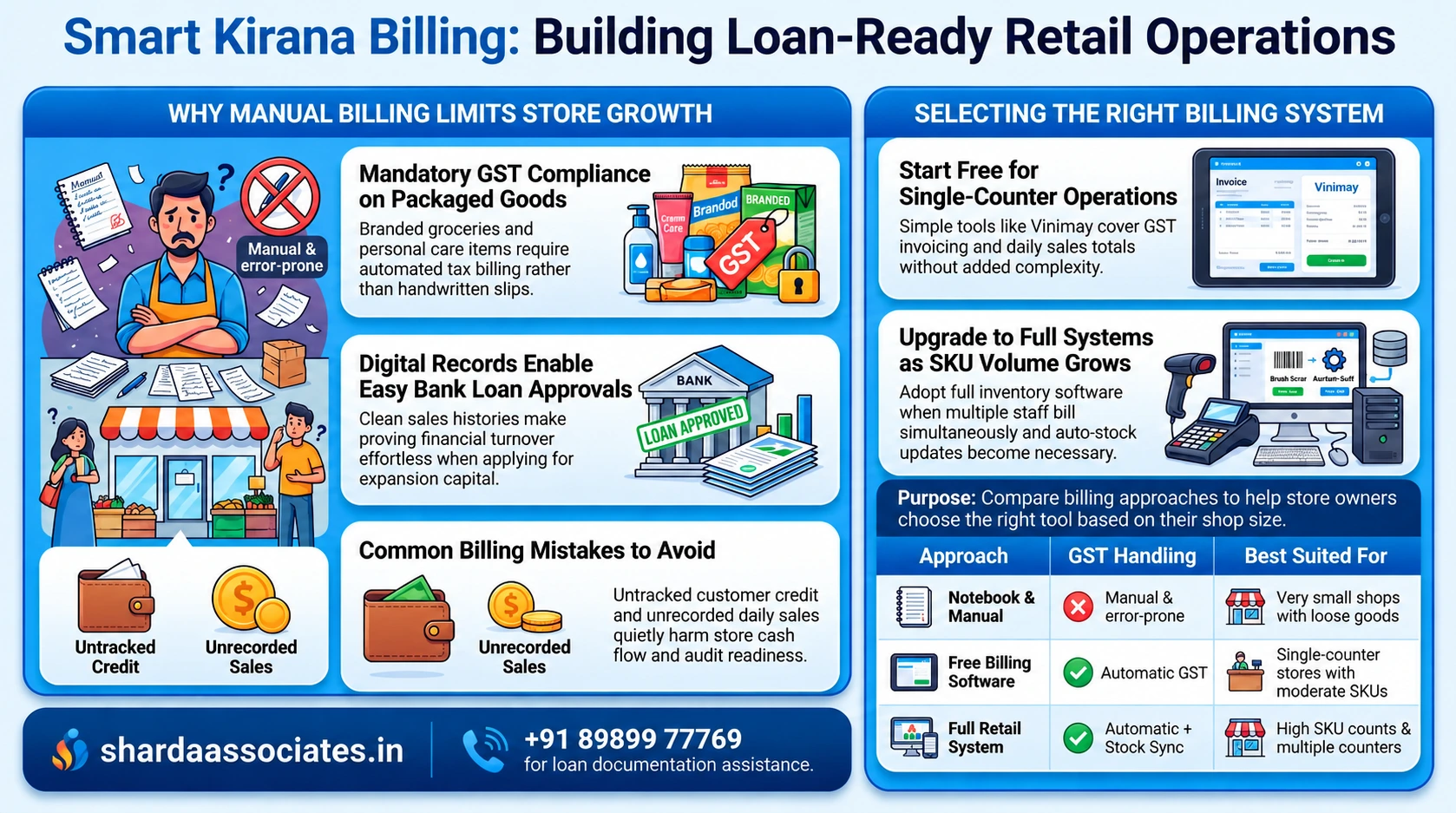
Loose, unbranded staples are largely outside GST, but a growing share of a typical kirana store’s stock, packaged snacks, branded groceries, and personal care items now falls under it. Billing these correctly on a printed or digital bill matters both for compliance and because customers increasingly expect a proper bill rather than a handwritten slip.
Free Billing Software vs. a Full Retail Management System
A free, simple billing tool such as Vinimay fits well when:
- The shop has one counter and moderate daily transaction volume
- Stock tracking is still manageable through physical checks and reordering habits
- The main need is a clean, GST-compliant bill for customers who ask for one
A fuller retail or inventory-linked system becomes worth it when:
- The shop carries a large number of SKUs across categories
- Stock needs to auto-reduce against every sale to stay accurate
- Multiple family members or staff are billing at the same counter or across counters
Comparing Billing Options for a Kirana Store
| Approach | Setup Effort | GST Handling | Best Suited For |
| Notebook and manual bills | Minimal | Manual, error-prone | Very small shops with mostly loose goods |
| Free billing software (e.g. Vinimay) | Low | Automatic | Single-counter kirana stores with moderate SKU count |
| Full retail/inventory system | Higher, needs setup | Automatic, plus stock sync | Larger stores with high SKU count and multiple counters |
Common Billing Mistakes Kirana Store Owners Make
- Billing packaged, GST-applicable goods the same way as loose staples, without applying the correct tax
- Not keeping any digital record of daily sales, which makes reconstructing figures for a loan application slow and error-prone
- Letting credit given to regular customers go untracked, which quietly affects real cash position over time
How Proper Billing Helps When You Need a Loan Later
Shop owners looking to expand, add a cold storage unit, or take working capital finance are asked for sales history and financial documentation, and a shop with clean, GST-compliant billing records has a noticeably easier time putting this together than one relying on memory and a notebook. This is one of the most common reasons Sharda Associates recommends kirana store owners move to at least basic billing software well before they actually need the loan.
Conclusion
A kirana store does not need complicated software to run well, it needs billing that is fast at the counter, correct on GST, and consistent enough to actually mean something when sales records are needed later.
A free tool like Vinimay covers this well for a single-counter shop, and a fuller system earns its place only once SKU count, stock tracking, or multiple counters genuinely demand it. Call +91 89899 77769 if you would like help getting your billing records loan-ready or preparing a project report for shop expansion.
Frequently Asked Questions
1. Does a small kirana store really need billing software, or is a notebook enough?
A notebook works for very small shops with mostly loose goods, but once packaged, GST-applicable items make up a meaningful share of stock, billing software reduces errors and builds a usable sales record.
2. Is GST applicable on all kirana store items?
No, loose, unbranded staples generally stay outside GST, but packaged and branded goods increasingly fall under it, which is why correct billing matters more than owners often expect.
3. Can free billing software handle a kirana store’s daily sales properly?
Yes, for GST-compliant billing and a daily sales total, free software such as Vinimay is generally sufficient for a single-counter shop with moderate transaction volume.
4. When should a kirana store move to a fuller retail management system?
Once SKU count grows large, stock needs to auto-update against every sale, or multiple people are billing at once, a fuller system starts to justify its cost.
5. How does proper billing help with a bank loan for shop expansion?
Clean, GST-compliant sales records make it much easier to demonstrate turnover and prepare the financial documentation banks ask for during loan evaluation.
6. What is the most common billing mistake in kirana stores?
Treating packaged, GST-applicable goods the same as loose staples during billing is one of the most frequent errors, along with keeping no digital sales record at all.
7. Can Sharda Associates help kirana store owners with loan documentation?
Yes, Sharda Associates prepares project reports and CMA data for small retail businesses, including kirana stores, applying for expansion or working capital finance.