
Short answer: Sometimes, but not always. Many capital subsidy schemes are designed for new capacity or technology upgradation, and some do not cover plain replacement of old machinery. Whether you can claim depends on the exact scheme guidelines, so read the eligibility rules and confirm with the implementing agency before you buy.
Introduction
An old machine breaks down often, and you want to replace it with a newer one. Naturally, you ask whether you can claim a capital subsidy on the new machine, just like a new unit would.
The answer is not the same for every scheme. Some schemes support modernisation and technology upgradation, while others focus on setting up new units or adding new capacity. Whether a replacement qualifies depends on how the scheme defines eligible investment.
At Sharda Associates, we prepare CA-certified project reports and CMA data, and we help MSMEs with bank loan documentation. In this guide, we explain how subsidy schemes usually treat replacement of machinery, what makes a purchase eligible, and what to check before you spend any money.
Is Replacement of Old Machinery Eligible for Capital Subsidy?
It depends on the scheme. A scheme meant for new units may not cover a replacement. A scheme meant for upgradation may cover it if the new machine brings better technology or higher efficiency. Never assume. Check the current guidelines.
- New-unit schemes: replacement often not covered
- Upgradation or modernisation schemes: may cover, subject to conditions
- The rules can change, so use the latest guidelines
What Is the Difference Between Replacement and Technology Upgradation?
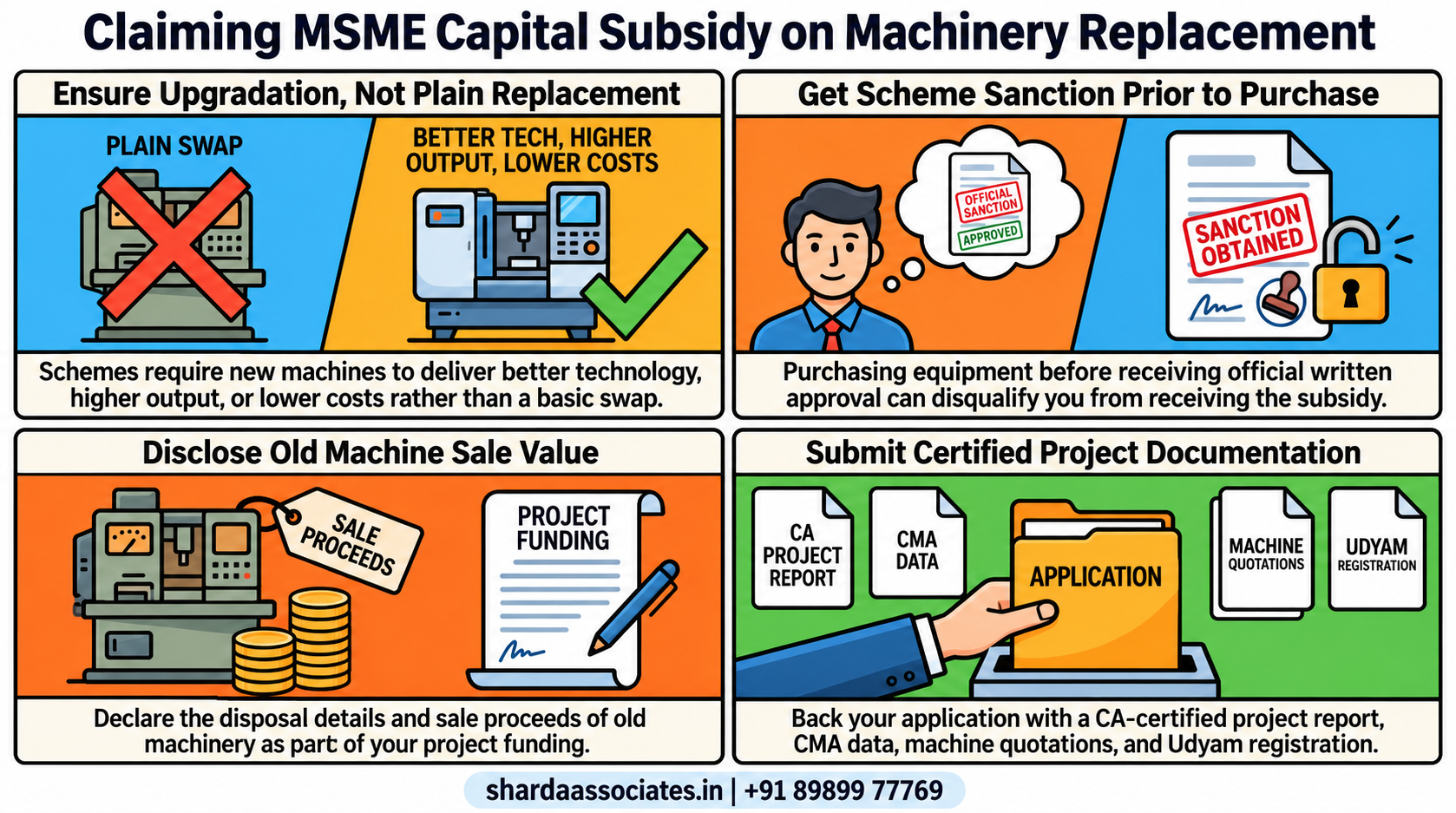
Replacement usually means swapping an old machine for a similar one. Upgradation means moving to a better technology, with higher output, lower cost or better quality. Schemes that support upgradation usually want to see this improvement.
- Same machine, same capacity: looks like replacement
- Better technology, higher efficiency: looks like upgradation
- Your project report should show the improvement clearly
Does the Scheme Require Prior Approval Before I Buy?
Many schemes expect approval or sanction before the purchase. Buying first and applying later is one of the common ways people lose a subsidy. If your scheme follows this rule, the machine bought earlier may not be counted.
- Confirm if the sanction must come before the purchase
- Do not place the order until you are sure
- Get the guidelines and the agency’s reply in writing
What Happens to the Old Machine?
Some schemes or banks may ask what you will do with the old machine, such as sell it, scrap it or keep it. Its sale value may also affect the project cost and the means of finance. Declare it honestly in the project report.
- Disposal details may be asked
- Sale proceeds can be shown as a source of funds
- Do not hide the old machine from the application
Will My Business Qualify as an Existing Unit?
Existing units can be eligible under some schemes and not under others. The scheme may check your Udyam registration, your category, your past performance and whether you have already taken benefits earlier. Read the eligibility section closely.
- Udyam registration is commonly needed
- Previous subsidy claims may be checked
- Defaults on earlier loans can affect eligibility
What Documents Are Usually Needed?
The agency and the bank will want to confirm that the purchase is genuine and fits the scheme. Keep all documents consistent.
- Project report with the reason for replacement
- Quotations of the new machine
- Udyam registration and KYC
- Details of the old machine and its disposal
- Bank loan sanction, where the subsidy is linked to a loan
- Invoice, payment proof and installation proof after purchase
Example: A Printing Unit Replacing an Old Press
(Illustrative example. Figures and rules are not from any real case.)
A printing unit wants to replace an old press that breaks down often. The owner finds a modern press with better output and lower wastage. Before ordering, she reads the scheme guidelines and finds that upgradation is covered, but purchases made before sanction are not.
She prepares a project report showing how the new press improves output and reduces cost, mentions the old press and its sale value, and applies through her bank. The purchase is made only after approval, and the subsidy is processed on the documents she submits.
If she had bought the press first, she might have lost the subsidy.
Conclusion
Whether replacement of old machinery earns a capital subsidy depends on what the scheme covers. Some schemes help with technology upgradation, while others support only new capacity. A plain swap of one machine for the same one may not qualify.
Before you buy, read the latest guidelines, confirm the rule on prior approval and ask the implementing agency for a written reply. Show clearly in your project report how the new machine improves your business.
A well-prepared, CA-certified project report with accurate CMA data helps present your upgradation case clearly. If you need help with scheme eligibility or documentation, call or message our team directly. Contact us: +91 89899 77769
FAQs
1. Can an MSME claim a capital subsidy on the replacement of old machinery?
Sometimes. It depends on the scheme. Some schemes support modernisation or upgradation, while others cover only new capacity. Read the eligibility rules and confirm with the implementing agency before you purchase the machine.
2. Is technology upgradation eligible for subsidy?
Often it is, under schemes meant for modernisation. You usually need to show that the new machine improves efficiency, quality or output. Your project report should explain this improvement clearly with supporting quotations.
3. Should I buy the machine before applying for a subsidy?
Usually not. Many schemes expect approval or sanction before the purchase, and machinery bought earlier may not be counted. Check the guidelines and get the agency’s confirmation in writing before placing the order.
4. What if I sell the old machine?
The sale value may be shown as part of your funds in the project report. Some schemes or banks may ask for disposal details. Declare it honestly, because hiding it can cause trouble during verification.
5. Do I need a bank loan to get the subsidy?
Many capital subsidy schemes are linked to a bank loan, but not all of them. Check whether your scheme requires term loan finance and what share of the project must come from the bank.
6. Can I claim a subsidy if I already took one earlier?
It depends on the scheme. Some limit repeated benefits or ask you to wait for a period. The guidelines usually explain this, so check them before applying a second time.
7. Who decides whether my replacement is eligible?
The scheme’s implementing agency and the sanctioning bank usually decide, based on the guidelines. Get their view in writing before purchase instead of relying on verbal advice from the supplier.
8. What documents prove that the replacement is genuine?
Typically the invoice, payment proof, delivery and installation proof, along with the project report and old machine details. The agency may also inspect the unit. Keep every document consistent in names and details.