
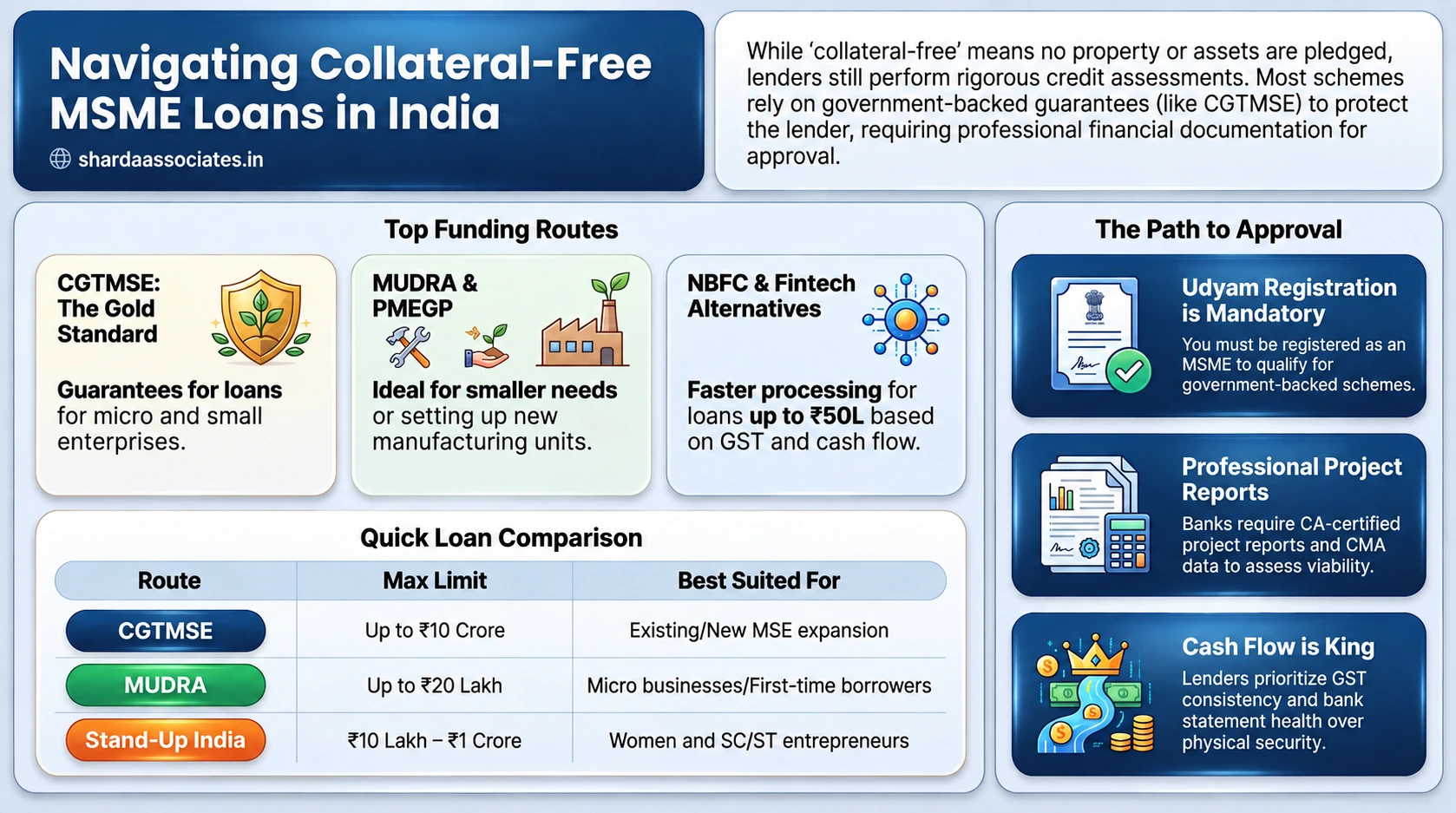
A MSME collateral-free loan means the bank doesn’t ask you to pledge property, gold, or other assets as security — but it’s rarely “no questions asked” credit. Most collateral-free MSME lending in India works through a government-backed guarantee mechanism (most commonly CGTMSE) that protects the bank against default, or through a bank/NBFC’s own unsecured lending policy based on cash flow and credit history. Either way, the bank still fully appraises the business before sanctioning — “collateral-free” removes the security requirement, not the credit assessment. Sharda Associates, a CA-certified project report and financial documentation provider, prepares the project reports and CMA data MSMEs need to apply for collateral-free loans under these routes.
What Does “Collateral-Free” Actually Mean?
It means the lender isn’t requiring you to pledge a specific asset (property, machinery, gold, or fixed deposit) as security for the loan. It does not mean the loan is unsecured against risk altogether — in most collateral-free MSME lending, a third party (typically a government trust) guarantees a portion of the loan to the bank, which is what lets the bank lend without asking you for collateral. The bank still assesses your business’s viability, repayment capacity, and credit history before sanctioning.
What Are the Main Ways to Get a Collateral-Free MSME Loan?
1. CGTMSE-Backed Bank Loans
The Credit Guarantee Fund Trust for Micro and Small Enterprises (CGTMSE) is the primary mechanism behind most collateral-free MSME lending in India. Banks and NBFCs registered as Member Lending Institutions can extend loans to eligible micro and small enterprises without collateral, with CGTMSE guaranteeing a large portion of the loan amount (commonly cited in the 75–85% range, sometimes higher for smaller loans) to the lender in case of default. Sources indicate the maximum guarantee cover has been raised significantly in recent years — most current figures put the ceiling around ₹10 crore for standard MSEs, though some sources still cite ₹5 crore, so it’s worth confirming the current limit with your specific bank at the time of applying.
An Annual Guarantee Fee (starting from roughly 0.37% per year for smaller loans) is charged, which the bank typically factors into your loan pricing.
- How to access it: You don’t apply to CGTMSE directly—you apply for the loan at an eligible bank/NBFC, and the lender applies for the guarantee cover on your behalf if your proposal qualifies.
- What it doesn’t do: CGTMSE doesn’t sanction or disburse the loan itself, and it doesn’t guarantee approval—the bank still independently assesses viability, financials, and repayment capacity.
2. MUDRA Loans (PMMY)
Pradhan Mantri Mudra Yojana provides collateral-free loans to micro and small businesses in three categories — Shishu (up to ₹50,000), Kishore (₹50,001 to ₹5 lakh), and Tarun (₹5,00,001 to ₹10 lakh), with a Tarun Plus category extending up to ₹20 lakh for repeat borrowers with a good repayment track record on a previous Mudra loan. These are inherently designed to be collateral-free for eligible micro and small business borrowers, covered under a separate guarantee mechanism (CGFMU) rather than CGTMSE.
3. PMEGP (Prime Minister’s Employment Generation Programme)
For new manufacturing and service units set up under PMEGP, loans are generally extended without collateral up to the scheme’s applicable project cost ceiling, alongside a capital subsidy component. This route is specifically for setting up a new unit, not for financing an existing, established business’s working capital or expansion.
4. Stand-Up India
Aimed specifically at women entrepreneurs and SC/ST entrepreneurs setting up a new greenfield enterprise, Stand-Up India facilitates bank loans between ₹10 lakh and ₹1 crore, with the collateral-free component typically routed through the CGTMSE/CGFSI guarantee mechanism as well.
5. NBFC and Fintech Unsecured Business Loans
Many NBFCs and digital lenders offer unsecured business loans (commonly up to roughly ₹50 lakh, sometimes higher) based primarily on GST returns, bank statement analysis, and cash flow — without routeing through a government guarantee scheme at all. These tend to have faster processing but often carry a higher interest rate than a bank/CGTMSE-backed loan, reflecting the lender’s own higher risk exposure.
6. Invoice/Bill Discounting (TReDS)
Not a traditional loan, but a genuinely collateral-free way for MSMEs to access working capital — TReDS lets an MSME discount its unpaid invoices from corporate buyers to get early payment, without pledging any asset, since the receivable itself is what’s being financed.
Comparing the Main MSME Collateral-Free Routes
| Route | Typical Loan Size | Best Suited For |
| CGTMSE-backed bank loan | Up to ~₹10 crore (confirm current limit) | Existing or new MSEs needing term loan/working capital |
| MUDRA (Shishu/Kishore/Tarun/Tarun Plus) | Up to ₹20 lakh | Micro and small businesses, especially first-time borrowers |
| PMEGP | Scheme-defined project cost ceiling | New manufacturing/service unit setup |
| Stand-Up India | ₹10 lakh – ₹1 crore | New enterprise by women/SC-ST entrepreneurs |
| NBFC/fintech unsecured loan | Up to ~₹50 lakh (varies by lender) | Fast processing, existing businesses with GST/bank statement history |
| TReDS invoice discounting | Based on invoice value | Working capital against pending corporate receivables |
What Do Banks Actually Check for a Collateral-Free Loan?
- Business viability and the project report or financial projections submitted
- Credit history — of the business and, for smaller entities, the promoter
- Bank statement and GST turnover consistency
- Udyam/MSME registration status
- Repayment capacity (DSCR, cash flow) — collateral-free doesn’t mean this check is skipped
- Existing debt obligations and overall exposure
Why Does “Collateral-Free” Not Mean “Automatic Approval”?
Because the guarantee mechanism protects the lender’s exposure, it doesn’t remove the lender’s responsibility to assess whether the business can actually repay. A weak project report, inconsistent financials, or a business with genuine viability concerns can still be declined even under CGTMSE cover — the guarantee changes what security is required, not whether the underlying proposal has to be sound.
What Documents Are Typically Needed?
- Udyam/MSME registration certificate
- PAN, Aadhaar, and KYC of promoters
- Project report or business plan, with financial projections
- Bank statements (typically last 6–12 months) and GST returns
- Past financial statements, for existing businesses
- Quotations for machinery/equipment, where the loan is for a specific asset purchase
How Can You Improve Your Chances of Approval?
- Get Udyam registration done before applying, since eligibility under most schemes depends on it
- Present a well-prepared, realistic project report or CMA data rather than a generic template
- Keep GST filings and bank statements consistent with the turnover and income you’re declaring
- Choose the scheme/route that actually matches your loan size and purpose, rather than applying broadly
- Maintain a clean repayment history on any existing credit, since this affects both bank appraisal and guarantee eligibility
FAQs
1. What are the main ways to get a collateral-free MSME loan in India?
The primary routes are CGTMSE-backed bank loans, MUDRA loans, PMEGP for new units, Stand-Up India for specific categories, NBFC/fintech unsecured loans, and TReDS invoice discounting for working capital.
2. What is the maximum loan amount available without collateral under CGTMSE?
Most current sources cite a ceiling of around ₹10 crore for standard micro and small enterprises as of 2026, though limits have changed over recent years, so it’s worth confirming the current figure with your bank.
3. Does collateral-free mean the bank won’t check my creditworthiness?
No — the bank still fully assesses business viability, credit history, and repayment capacity; collateral-free only removes the requirement to pledge a specific asset as security.
4. Can a new business (not yet operational) get a collateral-free loan?
Yes, through routes like PMEGP (for setting up a new unit) or CGTMSE-backed bank loans for new MSEs, subject to a credible project report and meeting the lender’s eligibility criteria.
5. Is there a fee for the CGTMSE guarantee, and who pays it?
Yes — an Annual Guarantee Fee (starting from roughly 0.37% per year for smaller loans) is charged; this is paid by the bank to CGTMSE but is often factored into the interest rate or charges passed to the borrower.
6. What is the difference between MUDRA and CGTMSE?
MUDRA loans (up to ₹20 lakh) are covered under a separate guarantee mechanism (CGFMU) specifically for micro-business lending, while CGTMSE covers a broader range of MSE loans up to a much higher ceiling.
7. Can I apply for a CGTMSE guarantee directly?
No — you apply for the loan at an eligible bank or NBFC, and the lender applies for the CGTMSE guarantee cover on your behalf if your proposal qualifies.
8. Do collateral-free loans have higher interest rates than secured loans?
Often yes, to some degree, since the lender’s risk (even with a guarantee covering part of the exposure) is generally higher than with a fully secured loan; rates vary by lender and loan type.
9. Is Udyam registration mandatory for a collateral-free MSME loan?
For most government-backed schemes (CGTMSE, PMEGP, MUDRA), Udyam/MSME registration status is a key eligibility factor, so it’s advisable to complete this before applying.
10. Can an NBFC give a collateral-free loan without any government guarantee scheme?
Yes — many NBFCs and digital lenders offer unsecured business loans based on their own credit assessment (GST turnover, bank statement analysis), independent of CGTMSE or other government-backed guarantee mechanisms.