
Project Report For Civil Engineering
Introduction
The civil engineering project report is as follows:
The Project Report for Civil Engineering provides a detailed blueprint for establishing a civil engineering firm, construction company, infrastructure consultancy, or project management service in 2026. Civil engineering is one of the oldest and most essential branches of engineering, responsible for designing, constructing, and maintaining infrastructure that supports modern society. From roads, bridges, railways, and airports to residential complexes, skyscrapers, sewage systems, dams, and smart cities—civil engineers are the backbone of development.
In 2026, the scope of civil engineering has expanded far beyond traditional construction. Modern civil engineers integrate sustainability practices, green building standards, smart infrastructure technology, Building Information Modeling (BIM), and advanced construction materials into their projects. The industry now emphasizes energy-efficient buildings, climate-resilient infrastructure, and eco-friendly urban planning.

Civil engineers not only design and execute construction projects but also manage financial planning, budgeting, safety compliance, and risk assessment. They play a key role in both public sector infrastructure projects and private real estate developments. This project report outlines the operational structure, investment requirements, service offerings, and market potential for launching or expanding a civil engineering venture aligned with 2026 industry trends.
Project Report Sample On
Civil Engineering

Get Completely Custom Project Report
Infrastructure, Services & Operational Model
Starting a civil engineering business in 2026 requires technical expertise, regulatory approvals, modern equipment, and skilled manpower. Infrastructure requirements may include surveying instruments, construction machinery, design software (such as AutoCAD and BIM tools), safety equipment, office setup, and transportation facilities. For large-scale infrastructure projects, heavy machinery such as excavators, cranes, concrete mixers, and road-laying equipment may be required.
The services offered by a civil engineering firm can include structural design, project planning and management, road and bridge construction, residential and commercial building construction, water supply and sewage system design, land development, industrial infrastructure projects, and environmental impact assessment. In 2026, there is a strong demand for smart city projects, metro rail systems, renewable energy infrastructure foundations, and sustainable housing developments.
The estimated initial investment for a small to mid-scale civil engineering company in India ranges between ₹50 lakhs to ₹2 crores depending on project size, equipment ownership, staffing levels, and operational scope. Major expenses include machinery procurement or leasing, skilled labor salaries, raw materials, project approvals, insurance, and working capital.
Revenue is typically generated through government contracts, private real estate projects, industrial construction contracts, infrastructure tenders, and consultancy services. Long-term contracts with public authorities or private developers ensure stable income streams. A professionally structured project report for civil engineering clearly defines project feasibility, cost estimation, projected cash flows, and return on investment, making it suitable for bank financing or investor funding.
Market Potential Of Civil Engineering
The global civil engineering market was valued at approximately USD 7.74 trillion in 2020 and has continued to grow steadily. By 2026, the industry has expanded significantly due to rapid urbanization, infrastructure modernization, and government investment programs. The sector is projected to grow at an average CAGR of around 5–6% in the coming years.
Emerging economies, including India, are driving this growth through increased spending on highways, metro rail projects, smart cities, airports, renewable energy infrastructure, and industrial corridors. Rising population levels and traffic congestion worldwide are fueling demand for improved transportation networks, tunnels, bridges, and sustainable urban infrastructure.
The infrastructure segment is expected to witness the highest growth due to increasing public and private investments. Governments are focusing on flexible, climate-resilient, and environmentally sustainable infrastructure systems. Green building certifications, energy-efficient construction, and advanced materials are becoming standard industry practices.
The industrial construction segment is also expanding as manufacturing activities increase globally. Demand for warehouses, R&D centers, logistics hubs, and processing facilities contributes to consistent industry growth. Planning and design services are seeing rapid demand due to the integration of digital tools like BIM and smart monitoring systems.
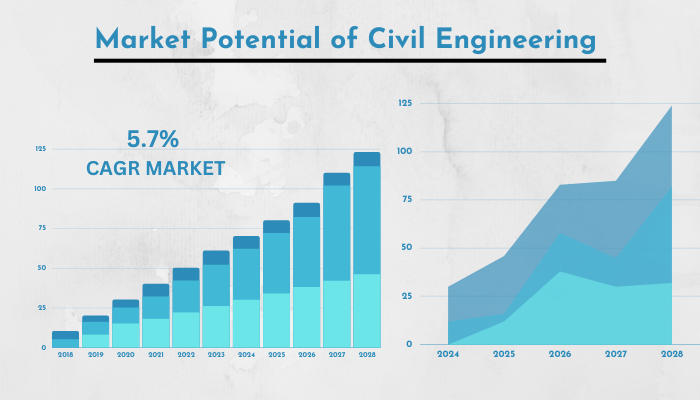
Financially, civil engineering ventures offer stable long-term returns. Profit margins typically range between 10% to 25% depending on project scale and cost control efficiency. Large infrastructure projects may offer higher profitability but require substantial capital investment. Break-even is generally achievable within 3–5 years with consistent contract acquisition and effective project management.
This project report concludes that civil engineering remains a strong and sustainable sector in 2026. With increasing infrastructure development, smart city initiatives, and global urbanization trends, the industry offers significant growth opportunities. Proper financial planning, skilled workforce management, regulatory compliance, and adoption of modern construction technology are key factors for long-term success.
If required, detailed 5-year financial projections, break-even analysis, cost of project statements, and means of finance sections can be added to further strengthen this Project Report for Civil Engineering for bank or investor presentation purposes.