
Project Report for Non-Woven Bag
A CA-certified Non-Woven Bag Manufacturing Project Report is required to obtain bank loans under PMEGP, MUDRA, CGTMSE, and other government programs. It covers machinery, industrial processes, investment details, and financial estimates. Sharda Associates offers bank-approved project reports starting at ₹2,999 and delivered within 24-48 hours.
Get Your Report
What Is a Project Report for Non-Woven Bag Manufacturing
A project report for non-woven bag manufacturing tells a bank what your production unit will produce, how much investment is required in machinery and raw materials, how you will generate revenue from retail packaging supply, corporate orders, and institutional customers, and how the loan will be repaid.
For a non-woven bag unit, the report covers your bag type mix (D-cut, W-cut, box bag, or loop handle), target customer segments such as retail stores, supermarkets, garment exporters, and promotional event companies, machinery specifications for spunbond PP fabric cutting and stitching or ultrasonic welding, and detailed financial projections showing unit economics at various production volumes.
Banks require this paperwork before approving an MSME loan for a packaging or textile manufacturing facility. The study also assesses the manufacturing unit’s technical and financial feasibility by outlining production capacity, raw material consumption, power requirements, labor planning, quality control methods, and projected operating expenses.
It contains projected profit and loss statements, cash flow, balance sheet, break-even analysis, and debt service coverage ratio (DSCR), which allow banks to determine the project’s feasibility and repayment capacity.
Non-Woven Bag Business in India
The non-woven bag manufacturing industry in India is one of the most constantly increasing MSME categories in the packaging sector, with structural and permanent causes driving the expansion rather than cyclical ones. The worldwide nonwoven fabric market was valued at over USD 33.27 billion in 2022 and is expected to reach USD 53.43 billion by 2030, increasing at a 7% CAGR. India’s domestic non-woven bag market is expanding even faster, driven by three converging forces that every entrepreneur in this field should grasp.
The single most powerful demand driver is the national prohibition on single-use plastic bags. The Government of India’s plastic ban under the Plastic Waste Management Amendment Rules 2021, which prohibits plastic carry bags smaller than 75 microns and single-use plastic items, has forced every retail store, supermarket, vegetable market, pharmacy, and clothing shop in India to switch to alternative bags. Non-woven polypropylene bags are the most popular option because they are inexpensive, reusable, printed for branding, and come in a variety of sizes. Every new retail shop that opens — and India’s organised retail industry adds thousands of stores each year — brings a new customer to non-woven bag producers. This demand will not slow down or reverse.
Types of Non-Woven Bags Your Manufacturing Unit
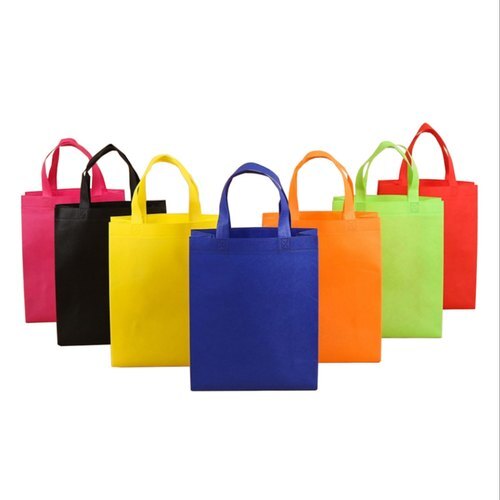
A well-equipped non-woven bag manufacturing facility can create a variety of bag varieties using the same basic machinery by altering cutting dies and stitching patterns. Understanding the various types helps you plan your product mix and customer targeting approach.
- D-Cut bags are the most basic non-woven bag design, with a die-cut handle punched right into the top of the bag body, resulting in a hand loop with no additional handle connection. D-cut bags are the most often used type in retail, with large quantities being utilized at vegetable markets, grocery shops, and pharmacies. They are the least expensive product in your line and act as the volume driver, keeping your machines working at full capacity. D-cut bags have narrower margins, but volume is considerable and orders are frequent.
- W-Cut bags include a W-shaped cut at the top, resulting in two independent handle loops. They are slightly more expensive than D-cut and are chosen by clothing retailers, boutiques, and supermarkets. W-cut bags require slightly different cutting machinery, although they use the same stitching infrastructure and are significantly more expensive.
- Box bags (gusset bags) include side and bottom gussets that create a three-dimensional box form when full, making them ideal for heavy loads such as groceries, books, and packaged goods. Box bags are a premium product with increased material usage, resulting in higher selling prices and profit margins. They are popular among supermarkets and food stores.
- Loop handle bags have a separately created PP rope or fabric loop attached to the bag body at the top, resulting in a shoulder carry bag. These are the highest-quality non-woven bags, and they are utilized by garment exporters, luxury retail outlets, and corporate gifts. They require an extra handle-making process yet have the highest per-bag pricing.
- Multi-pocket promotional bags are custom-made bags with various compartments, zippers, or extra pockets. These are created to order for corporate clients, conference organizers, and event organizations, and have the biggest profit margin of any non-woven bag type since they are entirely customizable and priced based on design complexity rather than commodity rates.
Non-Woven Bag Manufacturing Process
The non-woven bag manufacturing method is one of the simplest of all packaging production categories, which is why it is very popular with first-time MSME manufacturers. Sharda Associates’ non-woven bag project reports include a detailed process flow.
The principal raw material is polypropylene spunbond non-woven fabric, which is obtained in big rolls from fabric producers or importers in widths ranging from 100 cm to 320 cm and weights ranging from 40 to 100 GSM, depending on bag strength requirements. The fabric is either unrolled on the cutting table or fed automatically into the cutting machine. Automated cutting machines employ pre-set die patterns to precisely cut fabric rolls into bag panel specifications with minimal waste.
Cut fabric panels are sewn or ultrasonically welded along the sides and bottom to create the bag body. Ultrasonic seaming machines use high-frequency vibration to bind polypropylene fibers without the need of thread, resulting in a cleaner seal, avoiding the cost of thread, and running faster than traditional sewing. Stitching machines are less expensive and suitable for regular market bags, but ultrasonic machines are chosen for premium bags and export quality.
Handle attachment is the following stage for W-cut, loop handle, and box bag types; handles are cut separately and stitched or heat sealed. Printing takes place either before cutting (flexographic printing directly on the fabric roll) or after bag assembly (screen printing on finished bags). Inline roll printing produces superior print quality and consistency for large orders, whereas screen printing on finished bags is more adaptable for small bespoke orders and design modifications.
Before counting and packing for shipment, finished bags are quality-checked for stitching strength, handle pull strength, GSM consistency, print clarity, and dimensions.
What Does Sharda Associates' Non-Woven Bag Project Report Include?
Sharda Associates’ non-woven bag project reports include all of the information required by your bank. The executive summary provides the bank with a comprehensive overview of your bag kinds, production capacity, customer segmentation, and financing requirements. The promoter profile includes information about your company background. The product description discusses bag kinds, GSM range, handle types, printing capability, and target markets.
The market research considers the impact of India’s plastic prohibition, organised retail expansion, corporate promotional demand, and your specific regional and institutional customer opportunities. The manufacturing process section outlines the entire production flow, including equipment specifications and quality control. The machinery section discusses the automatic bag producing machine, ultrasonic welding machine, screen printing machine or flexographic printer, cutting equipment, and packing setup, along with specifications and costs.
The raw materials division includes PP spunbond fabric rolls, thread and ultrasonic supplies, printing inks, and packaging. The project cost statement includes machinery, civil or factory space, working capital, and pre-operational expenses. Five-year financial predictions include revenue from retail, corporate, and institutional supply channels, together with costs, margins, and net profit. The document concludes with a break-even analysis, a loan repayment schedule, and a compliance checklist.
Investment Cost and Financial Overview
A small-scale non-woven bag manufacturing business that produces 50,000-1,50,000 bags per day requires a total project expenditure of ₹25 lakh to ₹80 lakh. This includes an automatic bag making machine (₹8-20 lakh), an ultrasonic welding equipment (₹3-8 lakh), a screen printing machine (₹2-5 lakh), two months’ worth of raw material stock (₹8-20 lakh), factory space and working capital. A medium-sized unit with flexographic inline printing and various bag production lines costs ₹80 lakh to ₹2 crore.
Profit margins in non-woven bag production range from 20 to 40% gross. D-cut and W-cut commodity bags have 20-25% margins at high volume. Box bags and loop handle bags have 30-40% margins. Custom corporate printed and promotional bags generate 35-45% margins. The most profitable units keep a balanced order book, with commodity retail bags for volume and specialized corporate bags for margin.
Bank loans cover 70-75% of the project costs. PMEGP offers a 15-35% government subsidy for manufacturing units with project costs up to ₹50 lakh, making it the most beneficial initiative for first-time entrepreneurs. MUDRA Tarun provides coverage of up to ₹50 lakh without collateral. CGTMSE offers collateral-free guarantee insurance of up to ₹2 crore for larger units. Every financial prediction in your Sharda Associates report is tailored to your individual machine setup, bag mix, and sales channel assumptions.
Government Loan Schemes for Non-Woven Bag Manufacturing
The PMEGP scheme offers a 15-35% non-repayable subsidy on project costs up to ₹50 lakh, making it the best option for new non-woven bag manufacturing units. MUDRA Loan Tarun offers ₹10-50 lakh without collateral for small businesses. CGTMSE provides collateral-free guarantees for mid-scale units up to ₹2 crore. Stand-Up India offers funding for SC/ST and women entrepreneurs ranging from ₹10 lakh to ₹1 crore. Several state government schemes promote eco-friendly packaging manufacturing as part of the plastic ban implementation — Madhya Pradesh, Maharashtra, Karnataka, and Tamil Nadu all have state-level incentives for non-woven and biodegradable bag manufacturers that can be included in your Sharda Associates project report.
Why Choose Sharda Associates for Your Non-Woven Bag Project Report?
- Sharda Associates has provided more than 45,500 CA-certified project reports in all 28 states.
- Our packaging and textile manufacturing project studies are approved by SBI, PNB, Bank of Baroda, Canara Bank, and all major NBFCs.
- Experienced Chartered Accountants prepare each report from scratch, rather than using AI technologies or generic templates.
- Your report is tailored to your exact bag mix, machine configuration, target customer segmentation, location, and lending scheme.
- Delivery within 24 to 48 hours. If your bank demands adjustments, there will be no charge for revision. Price starts at ₹2,999.
Frequently Asked Questions
A project report for non-woven bag manufacturing is a CA-certified document that includes the manufacturing process, machinery, raw materials, investment cost, 5-year financial projections, and all loan documentation required by banks and government programs such as PMEGP, MUDRA, and CGTMSE to approve business loans for PP spunbond non-woven bag production units.
A small-scale operation producing 50,000-1,50,000 bags per day requires a total project expenditure of ₹25-80 lakh, which includes the bag production machine, ultrasonic welder, screen printing machine, raw material stock, and working capital. A medium-scale plant with inline flexographic printing and many lines costs ₹80 lakh to ₹2 crore.
Non-woven bag production is eligible for PMEGP as a manufacturing unit with a project cost of up to ₹50 lakh and government subsidies ranging from 15-35%. A CA-certified PMEGP project report from Sharda Associates is required for approval.
The primary raw material is polypropylene (PP) spunbond non-woven fabric in rolls with widths of 100-320 cm and weights of 40-100 GSM. Supporting materials include PP rope or fabric strips for loop handles, sewing thread, water- or solvent-based printing inks, and final bag packaging. PP spunbond fabric typically accounts for 60-70% of the overall raw material cost.
The core machinery consists of an automatic nonwoven bag producing machine (D-cut or W-cut type), an ultrasonic seaming machine, a screen printing machine or flexographic printer, loop bag handle cutting and attaching equipment, and a packing station. A basic D-cut and W-cut setup requires ₹12-25 lakh in gear.
D-cut bags contain a single die-cut opening at the top that forms a loop handle; they are simple and inexpensive, and are commonly used in grocery and retail stores. W-cut bags contain a W-shaped cut at the top, resulting in two independent handle strips – slightly more expensive and commonly used in clothing stores and supermarkets. Both use the same PP spunbond fabric, but have different cutting dies and bag-making machine settings.
Gross margins vary from 20 to 45% depending on bag type and customer mix. Commodity D-cut and W-cut bags generate 20-25% margins at high volume. Box bags and loop handle bags yield between 30 and 40%. Custom corporate printed bags produce 35-45%. A balanced mix of commodity and specialized orders maximizes overall profitability.
PMEGP (15-35% subsidy, up to ₹50L project cost), MUDRA Tarun (₹10-50L, no collateral), CGTMSE (collateral-free up to ₹2Cr), Stand-Up India (SC/ST and women), and state-level eco-friendly packaging initiatives throughout various states. Sharda Associates creates reports designed for all of these schemes.
Sharda Associates will deliver within 24-48 hours after acquiring your bag types, manufacturing capacity, location, investment plan, and target loan scheme. Urgent same-day delivery is available.
Yes, Sharda Associates creates integrated project reports for several packaging product lines – non-woven bags, HDPE woven sacks, tarpaulins, or carry bags — in a single combined manufacturing unit report, complete with appropriate financial predictions for your whole product mix and investment.