
Project Report for Smith Machine Manufacturing
India’s fitness business is quickly growing, with new gyms sprouting in every city, corporate wellness programs, home gym investment, and institutional fitness infrastructure in schools, hotels, and defense facilities. A Smith machine manufacturing operation manufactures one of the most popular pieces of gym equipment, and the same facility can also make multi-gyms, cable stations, and strength equipment. Sharda Associates develops CA-certified gym equipment project reports and has over 45,500 of them. Starting at Rs. 2,999.
Get Your Report
What Is a Smith Machine
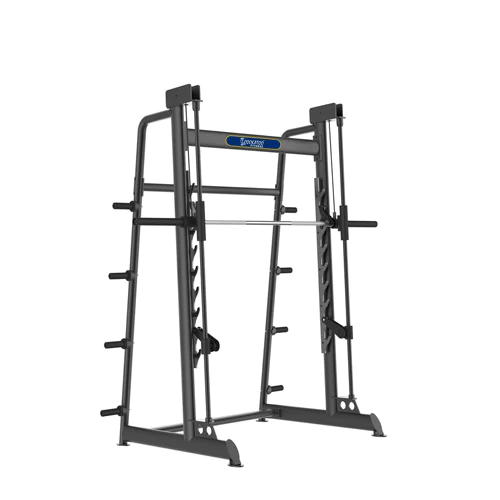
A Smith machine is a strength training device that consists of a barbell mounted between vertical or near-vertical steel guide rails, allowing for controlled linear barbell movement during squats, bench press, shoulder press, and other compound exercises. The guided rail system ensures safety (the barbell can be locked at any point in the movement range) and variety for exercisers who do not have a training partner.
A Smith machine is a structural steel fabrication product consisting primarily of a steel tube/channel frame, precision guide rail columns, a linear bearing or nylon guide block system for smooth rail travel, a counterbalance mechanism (pulley + weight plate or gas spring), and adjustable J-hook safety catchers.
The gym equipment manufacturing industry in India is a promising MSME opportunity since it combines high market demand with very low production costs. Manufacturing consists mostly of structural steel fabrication, welding, powder coating, and precision machining of components such as guide rails, pulleys, and bearing assemblies, making it ideal for well-equipped metal fabrication facilities. Demand is increasing as more commercial gyms, fitness centers, hotels, corporate wellness facilities, and institutional gyms run by schools, police, and defense organizations open. Indian manufacturers also profit from a growing demand for locally manufactured equipment, as purchasers value speedier service support, spare parts availability, and warranty assistance over imported products.
What Gym Equipment Can Be Manufactured on the Same Plant?
A Smith machine manufacturing unit can produce a variety of related strength equipment with the same structural steel fabrication capability:
Smith machines come in a variety of forms, including the standard dual-rail Smith machine, the 3D Smith machine (which has a tilted 7-degree rail angle for more natural movement), and the commercial heavy-duty Smith machine.
Multi-gym / cable station: Multi-function cable pulley station with weight stack, including sitting lat pulldown, cable row, cable crossover, and push-down. The structural steel fabrication remains the same, with the addition of a cable and pulley system.
Power cage or squat rack: A free-standing cage structure with adjustable J-hooks and safety bars for free-weight squatting and bench pressing. Simpler than a Smith machine (no guide rail system), and in high demand.
Functional trainer: Dual adjustable cable pulleys with weight stacks are increasingly popular in high-end gyms for functional training.
Plate-loaded strength equipment includes leg press, leg extension/curl, chest press, and shoulder press machines that use plate loading rather than weight stacks, which are simpler and less expensive than stack machines.
Commercial benches and racks: flat, inclination, and decline benches; dumbbell racks; weight plate trees—simpler production, high volume demand with each gym opening.
Manufacturing Process for Smith Machine
Frame fabrication: Structural steel rectangular tubing (50x50mm to 100x100mm depending on weight rating) is cut, mitered, and welded into the main frame — upright columns, base frame, and top cross member. TIG or MIG welding.
Precision-machined steel guide rails (or chrome-plated steel columns) form the linear bearing surface on which the barbell assembly slides. The dimensional correctness of the guide rails directly influences smooth operation and product durability. This is the most precise component.
Bearing/guide block: Linear bearing blocks (ball bearings or UHMW polyethylene guide blocks) that run on guide rails must be precisely sized and set to provide smooth movement with little play.
Counterbalance system: A pulley-and-cable counterbalance with a weight stack or gas spring lowers the perceived weight of an empty barbell. Pulleys, cables, and cable clamps are either manufactured or sourced.
J-hooks and safety catchers: Adjustable height J-hooks on which the barbell rests when at rest; safety catchers that catch the barbell if it falls. There are multiple height adjustment positions.
Market — Who Buys Smith Machines in India?
Commercial gyms (primary): Every new gym opening requires a Smith machine, which is standard equipment in any strength training facility. Gym equipment manufacturers usually sell directly to gym owners or through fitness equipment dealers.
Hotel and resort fitness facilities: Corporate hotel brands (Marriott, Taj, Hyatt, ITC, and regional hotel chains) install fitness centres as a guest amenity – gym equipment is purchased in bulk.
Corporate wellness facilities: Large corporations (IT parks, manufacturing factories, government offices) are establishing staff fitness rooms, which is becoming an increasingly popular procurement category.
GeM is used by institutional buyers such as government hospitals, defense installations (army, air force, navy), police training academies, central government offices, CISF, and educational institutions to purchase exercise equipment. A GeM-registered gym equipment manufacturer with the right product listings can enter this channel, which is often less price-sensitive than retail.
Project Cost for Smith Machine Manufacturing
Configuration | Capital Cost (Rs.) |
Small unit (bench/rack focus, basic welding) | Rs.12-22 lakh |
Medium unit (Smith machine + cable station) | Rs.22-45 lakh |
Larger commercial gym equipment factory | Rs.50 lakh-1.20 crore |
Equipment: Heavy-duty MIG welding machine set (Rs.1,50,000-3,50,000), plasma cutter or angle grinder (Rs.50,000-1,50,000), drill press and lathe for rail machining (Rs.2,00,000-5,00,000), powder coating setup (Rs.3,00,000-8,00,000) or outsourced, surface treatment (shot blast), welding positioner. Raw material: structural steel tube, guide rail steel, hardware (pulleys, cables, bearings, hardware).
Small to medium units fit PMEGP manufacturing ceiling (Rs.50 lakh) with 15-35% subsidy. Larger factories suit MSME term loans.
Why Choose Sharda Associates
- 45,500+ Project Reports — Metal Fabrication and Manufacturing Experience Gym equipment is structural steel fabrication, and we accurately document the welding and machining processes, raw material cost structure, and market channels.
- Product Range Correctly Identified Smith machine alone vs. whole gym equipment range (multi-gym, power cage, benches, racks) — we confirm your product scope before drafting to ensure capital and revenue estimates match your actual plan.
- Guide Rail Precision as a Key Quality Factor Precision machining of guide rails and bearing blocks determines product quality and brand recognition, which is described in the technical part as a vital manufacturing competency.
- GeM Channel for Institutional Supply. Noted government, defense, and institutional procurement via GeM — noted as a planned sales channel where appropriate, with GeM registration serving as a milestone.
- Export Potential to the Gulf and Southeast Asia Middle East, Southeast Asia, and Africa – for firms with quality goals, exporting is documented as a revenue diversification strategy.
- Starting at ₹2,999 · 24–48 working hours ·
- 📞 +91 89899 77769 | All India service
Frequently Asked Questions
A Smith machine is a strength training equipment that uses a barbell guided by vertical steel rails to provide safe, controlled movement for squats, bench press, and shoulder press exercises. Each commercial gym requires one as basic equipment. India's rapid gym expansion (new gyms opening in tiers 1, 2, and 3 cities) generates steady demand. Domestic manufacturers can compete with foreign equipment on price, warranty, and local service.
Structural steel tube frame fabrication (MIG welding), precision guide rail machining (the most important component for smooth operation), linear bearing or guide block fitting, counterbalance system assembly (pulleys, cable, weight stack, or gas spring), J-hook and safety catcher fabrication, surface treatment (shot blast and powder coat), and final assembly and load testing.
Multi-gym cable stations, power cages, squat racks, functional trainers, plate-loading machines (leg press, leg extension, chest press), commercial benches, dumbbell racks, and weight plate trees. All use the same structural steel manufacturing technique; diversifying the product line increases machine utilisation and revenue stability.
Commercial gyms (primary), hotel fitness centers (institutional), corporate wellness facilities, government/defense establishments through GeM (less price-sensitive), and the expanding home gym market. Export to the Middle East (UAE, Oman, Saudi Arabia), Southeast Asia, and Africa—markets where Indian prices are competitive.
The guide rails are precision-machined steel columns on which the barbell assembly glides; their dimensional accuracy and surface polish dictate the smoothness of movement, bearing system longevity, and overall product durability. Imprecise rails cause noise, binding, and premature wear. The most quality-critical phase in Smith machine production is the manufacture or acquisition of guide rail.
Yes. Small units focused on benches and racks (Rs.12-22 lakh) and medium plants producing Smith machines and cable stations (Rs.22-45 lakh) are both eligible for PMEGP's Rs.50 lakh manufacturing limit with a capital subsidy of 15-35%. Larger commercial gym equipment firms are suitable for MSME term loans. A CA-certified project report containing details on the steel fabrication process and market channels is required.
The key materials are mild steel tubes, guide rods, bearings, pulleys, cables, weight plates, powder coating materials, and fasteners for assembly and durability.
A project report assists banks in assessing project viability, machinery requirements, manufacturing capacity, market demand, profitability, and repayment capability, increasing the likelihood of loan acceptance.