
Project Report for Grater Manufacturing
India’s vending machine industry is evolving from a niche corporate cafeteria product to a mainstream retail and public-space staple, owing to UPI-enabled cashless payments, smart office culture, and metro/airport infrastructure expansion. Sharda Associates has delivered over 45,500 project reports, including CA-certified vending machine manufacturing project reports for PMEGP and MSME bank loans. Starting at ₹2,999.
Get Your Report
What Is a Vending Machine
A vending machine is an automated retail unit that delivers products (snacks, beverages, packaged food, personal care items, or other minor consumer goods) in exchange for cash and without the need for a salesman. The machine integrates mechanical dispensing systems (coil spirals for nibbles, drop mechanisms for cans and bottles, and cup-and-dispense systems for hot beverages) with computerized payment acceptance and inventory management.
India’s vending machine business has always been small in comparison to countries such as Japan and the United States, but it is now experiencing true growth, thanks to a distinct structural shift: the UPI. Cash-based vending machines required coin mechanics and cash collecting infrastructure, limiting deployment to high-traffic, supervised areas. This constraint is removed by UPI and card-based payment connection, which allows a vending machine to be placed in any area with adequate footfall and run with no cash-handling expense, with sales data flowing directly to the operator’s phone.
Types of Vending Machines a Manufacturing Unit Can Produce
- Snack and Food Vending Machine – A multi-shelf coil mechanism dispenses packaged snacks and food products.
- Beverage Vending Machines – Refrigerated machines that dispense cold cans, bottles, and beverages.
- Coffee and Tea Vending Machine – Automatically mixes and dispenses hot beverages.
- Smart/IoT Vending Machine – Supports UPI payments, remote monitoring, and real-time inventory tracking.
- Combo Vending Machine – Combines food and beverages in one machine for optimum product variety.
- Specialty Vending Machine – Intended for sanitary napkins, PPE kits, stationery, and other necessities.
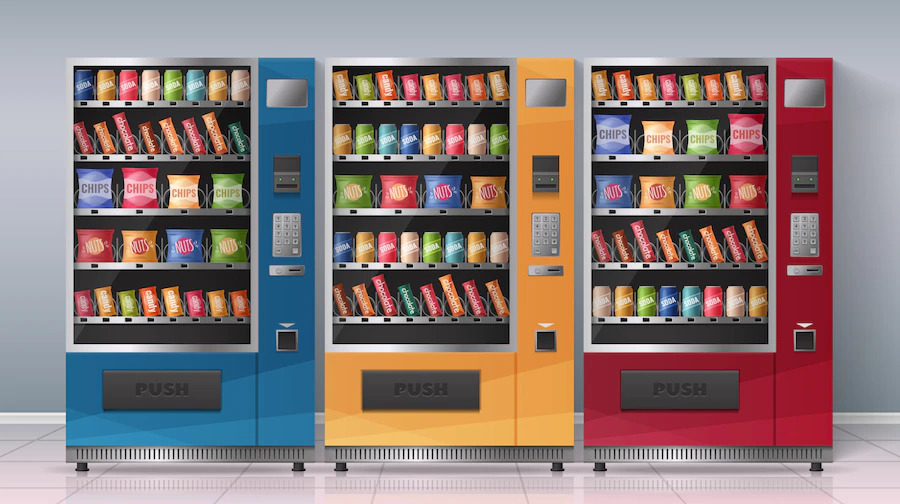
Market Demand — Why Vending Machine Manufacturing Is Bankable
Corporate & Office Spaces: As India’s office real estate market grows (IT parks, co-working spaces, corporate campuses), there is a steady need for snack, beverage, and coffee vending machines as a common workplace amenity.
Educational Institutions: Colleges and universities are rapidly installing vending machines for student convenience, which is a rising institutional procurement channel.
Transport Hubs: Railway stations, metro stations, and airports are high-traffic sites where UPI-enabled vending eliminates the need for manpower in traditional kiosks.
Healthcare Facilities: Vending machines are installed in hospitals and diagnostic centers for the convenience of visitors and personnel, as well as specialty dispensers (sanitary items, PPE) to ensure institutional compliance.
Gyms & Fitness Centers: With India’s fitness boom, protein supplements, beverages, and snack vending are becoming increasingly popular.
Government/Smart City Deployments: A GeM-linked institutional procurement channel, municipal corporations are installing public vending at metro stations and public areas as part of smart city programmes.
Project Cost for Vending Machine Manufacturing Unit
Cost Component | Small Unit (₹) | Medium Unit (₹) |
Sheet metal cutting, bending, welding machines | 3,00,000–6,00,000 | 7,00,000–14,00,000 |
Powder coating setup | 1,50,000–3,00,000 | 3,00,000–6,00,000 |
Dispensing mechanism assembly tooling | 1,50,000–3,00,000 | 3,00,000–6,00,000 |
Refrigeration unit sourcing (for beverage type) | — (per unit, outsourced) | — |
IoT/payment module sourcing | — (per unit, outsourced) | — |
MS sheet, glass, electronics (3 months) | 2,00,000–4,00,000 | 4,00,000–8,00,000 |
Assembly, testing + working capital | 1,50,000–2,50,000 | 2,50,000–5,00,000 |
Total Project Cost (excl. IoT/refrigeration modules) | ₹9.50–18.50 lakh | ₹19.50–39 lakh |
PMEGP: Up to ₹50 lakh → 15–35% capital subsidy.
Manufacturing Process
Cabinet fabrication: Sheet steel cut, bent, and welded to form the main body, door frame, and internal shelving structure. The door typically incorporates a toughened glass panel for product visibility.
Dispensing mechanism: Coil springs (for snack machines) or drop-shelf mechanisms (for cans/bottles) with small geared motors that rotate or release when the control board commands them.
Electronics integration: The control board, payment module (UPI QR code reader, card reader), display screen, and selection keypad are pre-assembled modules purchased from electronics integrators specializing in vending payment systems, which are then wired into the cabinet.
Refrigeration (for beverage machines): A compressor-based cooling unit is installed in the lower section of the cabinet and is sourced from refrigeration component providers, similar to commercial refrigerator compressors.
Powder coating and finishing: Cabinet surfaces are powder-coated for durability and branding; vending machines are frequently modified with operator or brand graphics.
Testing: Each unit was evaluated for dispensing accuracy (releasing the correct product based on the selection), payment module functionality, and cooling performance in beverage machines.
Why Choose Sharda Associates
- 45,500+ project reports delivered by experts in equipment manufacture, sheet metal fabrication, and electronics-integrated products.
- IoT and payment modules are accurately considered as sourced components, resulting in realistic project cost estimates.
- UPI-enabled vending machine industry possibilities and demand patterns are well established.
- Refrigeration system costs for beverage vending machines have been accurately estimated and incorporated.
- B2B and institutional income models are discussed, including vending machines, offices, hospitals, and educational institutions.
- Before delivery, the DSCR was certified to be more than 1.25, improving loan approval possibilities.
- Starting at ₹2,999 · 24–48 working hours
+91 89899 77769 | Documents on WhatsApp → Report by email → All India service
Frequently Asked Questions
Snack and packaged food vending (coil-spiral mechanism), beverage/can vending (with refrigeration), hot beverage (coffee/tea) vending, smart/IoT vending with UPI payment integration, combo machines, and specialty dispensers (sanitary products, PPE). Cabinet fabrication is shared across types; dispensing mechanism and electronics modules vary.
Yes. Equipment manufacturing with electronics integration qualifies for PMEGP 15–35% capital subsidy on projects up to ₹50 lakh. CA-certified KVIC format project report mandatory. Starting at ₹2,999.
UPI-enabled payment integration has removed the cash-handling constraint that previously limited vending machines to high-supervision locations. A vending machine can now operate in any reasonably high-footfall location with minimal cash logistics, with sales data flowing directly to the operator's phone — significantly expanding viable deployment locations.
Vending operators (companies that place and service machines across offices, colleges, hospitals, and transport hubs on a B2B contract basis) are the primary buyers — not end consumers. Corporate facility managers, educational institutions, and government/smart city procurement (via GeM) are secondary direct-purchase channels.
Basic snack vending machine (40-slot, coil mechanism): ₹35,000-60,000. Beverage/can vending machine (with refrigeration): ₹65,000-1,20,000. Hot beverage vending machine: ₹40,000-80,000. Smart/IoT-enabled combo machine: ₹80,000-1,80,000.
The unit usually requires sheet metal fabrication equipment, CNC machines, welding machines, powder coating systems, assembling tools, and testing equipment.
Investment decisions are based on production capacity, automation level, product range, and machinery choices. The project report includes thorough capital and working capital estimates.
Corporate offices, hospitals, educational institutions, shopping malls, hotels, factories, airports, railway stations, and professional vending operators are the most common buyers of vending machines. These organizations employ vending machines to provide easy access to snacks, beverages, and other necessities.