
If your bank has suddenly asked for a “TEV report” instead of the usual project or feasibility report you were expecting, you’re not the only one confused about why the same loan application sometimes needs a simple feasibility report and sometimes needs a full techno-economic viability (TEV) study.
The answer depends on your loan size, project type, and your specific bank’s internal policy, all of which now sit under RBI’s revised project finance framework introduced If you’re unsure which report your bank actually wants, Sharda Associates’ CA-led team can help you figure this out before you commission the wrong document—call or WhatsApp tel:+918989977769.
What Changed Under RBI’s Project Finance Directions?
In June 2025, RBI notified the Reserve Bank of India (Project Finance) Directions, effective from October 1, 2025. These directions apply to commercial banks, NBFCs, housing finance companies, urban cooperative banks, and All India Financial Institutions, bringing project financing under one harmonised rulebook instead of scattered earlier circulars.
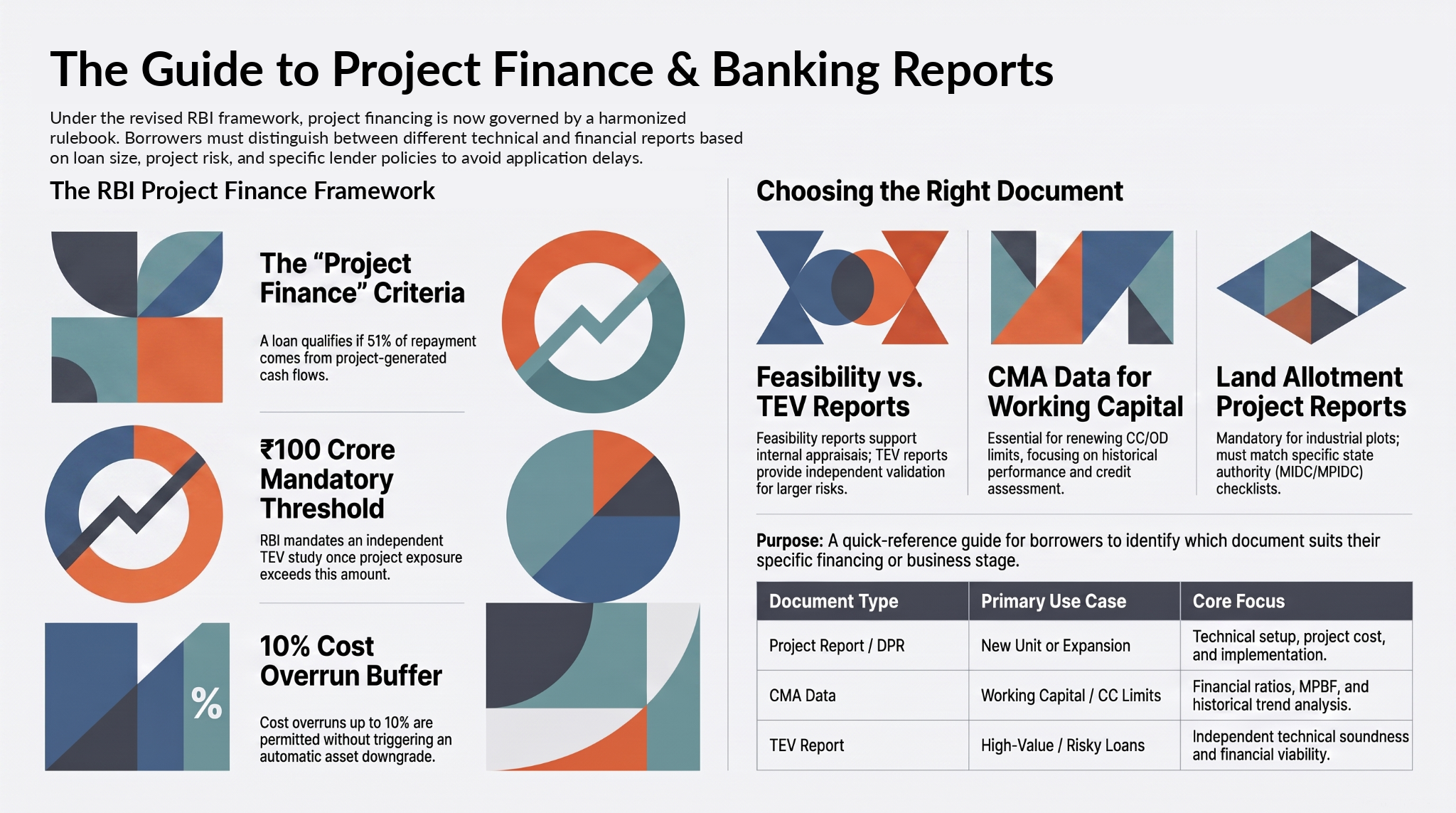
- A loan only qualifies as “project finance” under these rules when at least 51% of the expected repayment comes from the project’s own cash flows
- When multiple lenders are involved, they must all sign a common loan agreement with a shared Date of Commencement of Commercial Operations (DCCO)
- Cost overruns of up to 10% of the original project cost are allowed without an automatic asset downgrade, provided the project’s financial health stays stable
What Is a TEV Report, and When Does RBI Actually Require One?
A Techno-Economic Viability (TEV) report is a detailed, independent study of whether a project is technically sound and financially viable, usually prepared by a bank-empanelled agency rather than the borrower’s own consultant. Under the new RBI directions, a TEV study becomes mandatory once a lender’s aggregate exposure to a single project crosses ₹100 crore. Below that threshold, RBI itself doesn’t mandate a TEV study — but that doesn’t mean smaller borrowers are automatically off the hook.
Why Your Bank Might Ask for One Well Below ₹100 Crore
This is where most of the confusion happens. Individual banks set their own internal TEV thresholds, and these are usually much lower than RBI’s ₹100 crore trigger:
- Industry practice suggests many banks look for a TEV study somewhere between ₹50 lakh and ₹10 crore, though this varies considerably by bank and branch
- Projects involving new or unfamiliar technology, or a sector the bank hasn’t financed before, are more likely to need a TEV study even at a moderate loan amount
- Infrastructure and renewable energy financing, and accounts undergoing restructuring after financial stress, are also common triggers
- For most standard MSME and small business loans, banks are comfortable relying on their own in-house credit appraisal supported by a project or feasibility report, without a separate TEV study
Feasibility Report vs. TEV Report—What’s the Difference?
| Aspect | Feasibility Report | TEV Report |
| Typical loan size | Smaller MSME/business loans | Larger term loans, generally above a bank-specific threshold |
| Who prepares it | CA/financial consultant chosen by the borrower | Agency from the bank’s empanelled TEV consultant list |
| Who pays | Borrower | Borrower, even though the bank selects the agency |
| Depth of review | Business model, cost, and financial projections | Adds independent technology, market, and site-visit assessment |
| Purpose | Support the bank’s internal credit appraisal | Independently validate viability for larger, riskier exposures |
What a TEV Study Typically Covers
A TEV study generally works through the promoter’s background and management capability, technical design and machinery selection, current and projected market demand, detailed project cost and means of finance, and financial viability metrics such as projected cash flow, DSCR, break-even point, and repayment capacity. A site visit by the consultant is standard practice, since the report needs to confirm what’s on paper actually matches what’s on the ground.
Common Mistakes Borrowers Make
Borrowers often assume a TEV study is only for large infrastructure projects and get caught off guard when their bank asks for one on a moderate-sized MSME loan. Others submit a generic project report when the bank specifically wanted a TEV study from its empanelled list, causing avoidable delays. It’s also worth remembering that the ₹100 crore RBI trigger is a regulatory floor, not a ceiling — your bank’s own policy can, and often does, ask for a TEV study well before that.
What You Should Do Before You Commission Any Report
Because the requirement depends on lender policy, project category, and loan amount, the most reliable step is to check directly with your bank’s credit or loan department before commissioning any report — this avoids preparing the wrong document altogether.
Conclusion
The confusion around feasibility reports versus TEV studies usually comes down to one thing: RBI’s ₹100 crore threshold is a national floor, not the number that decides what your specific bank will ask for. Most MSME and small business loans never need a TEV study at all, but the moment your project involves new technology, a new sector for that lender, or a loan size your bank’s own policy flags as higher-risk, the requirement can kick in well before you’d expect. Getting this wrong is one of the more avoidable causes of delay in project finance applications.
If you’re not sure which report your loan actually needs, or you want a CA-certified feasibility report prepared correctly the first time, Sharda Associates can guide you through it—call or WhatsApp tel:+918989977769, or fill out the enquiry form on our Feasibility Report or Project Report page to get started.
FAQs
1. What is the RBI threshold for a mandatory TEV study?
Under the RBI Project Finance Directions, 2025, a TEV study is mandatory when a lender’s aggregate project exposure exceeds ₹100 crore.
2. Does that mean loans below ₹100 crore never need a TEV report?
Not necessarily — individual banks set their own internal TEV thresholds, which are often much lower, so check with your specific lender.
3. What loan amount usually triggers a bank-level TEV requirement?
Industry practice suggests many banks look for a TEV study somewhere between ₹50 lakh and ₹10 crore, but this varies by bank and project type.
4. Who prepares a TEV report?
Typically an agency from the bank’s empanelled TEV consultant list, though the borrower usually bears the cost.
5. Is a feasibility report the same as a TEV report?
No — a feasibility report is usually prepared by the borrower’s own consultant for smaller loans, while a TEV study is an independent, bank-directed assessment.
6. When did the new RBI Project Finance Directions take effect?
They were notified in June 2025 and came into effect from October 1, 2025.
7. Does a new business always need a TEV study for a term loan?
Not always — many MSME loans are appraised using the bank’s own internal process along with a project or feasibility report, without a separate TEV study.
8. What does a TEV report check on-site?
It typically verifies land, building, machinery, and project progress against what’s stated in the project cost and implementation schedule.
9. What happens if the project cost overruns after the report is submitted?
Under the new directions, cost overruns up to 10% of the original project cost may be allowed without an automatic asset downgrade, if financial metrics remain stable.
10. Does the RBI directions framework apply to NBFCs too?
Yes — the June 2025 directions apply to commercial banks, NBFCs, housing finance companies, urban cooperative banks, and All India Financial Institutions.