
Rice Mill Business in India Subsidy, Loan
Plan your rice mill business with guidance on machinery, investment, licences, subsidy options, bank loans, and project report requirements. Sharda Associates, a CA-certified project report consultancy, helps entrepreneurs prepare customized, bank-ready project reports for rice mill projects across India.
Get your Report
Rice Mill Business
What Is a Rice Mill Business?
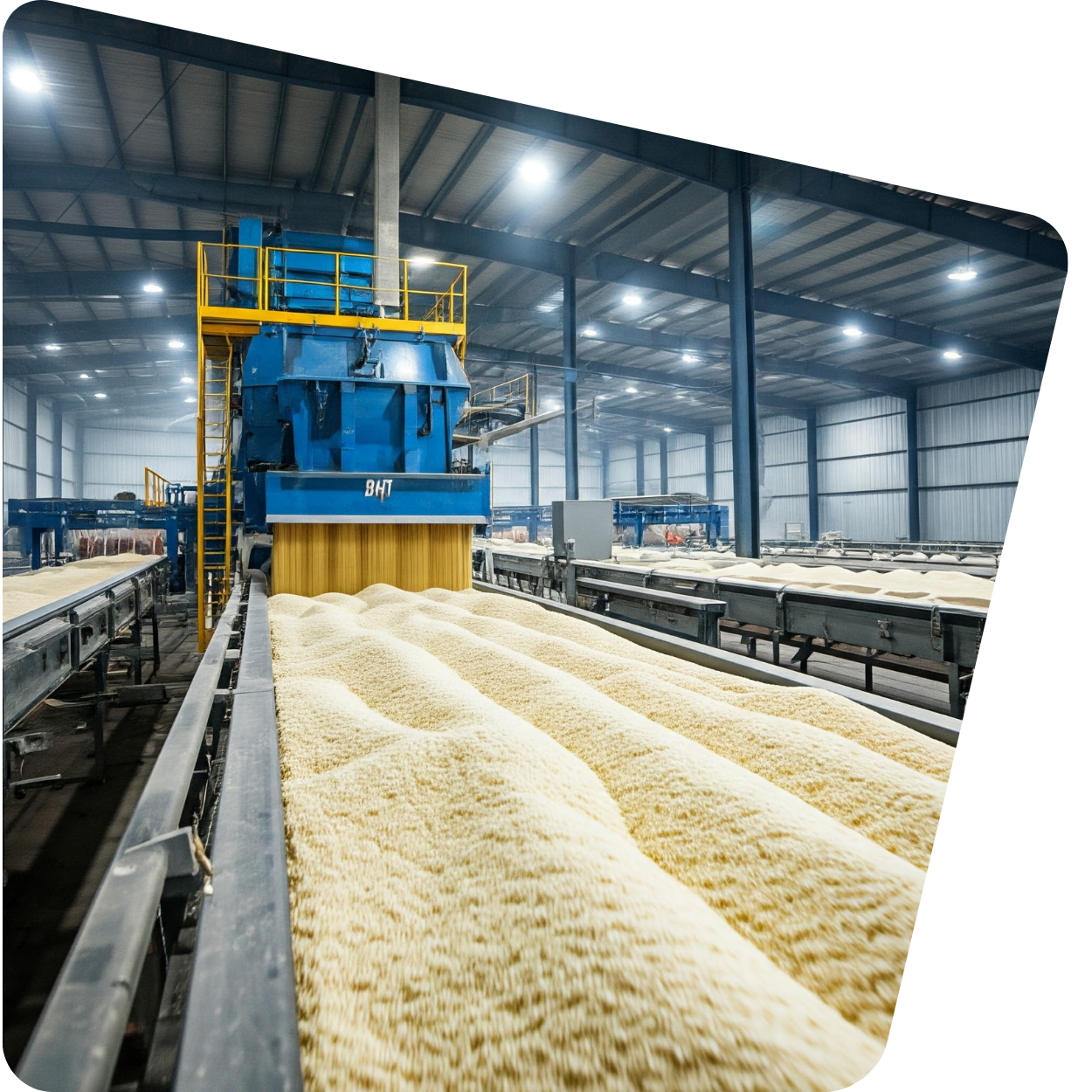
A rice mill business processes harvested paddy into edible rice — cleaning, dehusking, polishing, and grading it for sale. Most units set up today are modern rice mills (using a rubber-roll sheller and polisher), which give better milling yield and rice quality than older single/double-huller mills. Rice can be processed as raw rice or parboiled rice, depending on the mill’s setup and the market it’s selling into.
Why Start
Why Start a Rice Mill Business in India?
Steady Raw Material Supply
India is among the world’s largest paddy producers, with a well-established procurement and mandi network.
Consistent Domestic Demand
Rice is a daily staple across most of the country — demand doesn’t swing the way discretionary products do.
Export Opportunity
India is a major global rice exporter, in both basmati and non-basmati segments.
Byproduct Income
Bran, husk, and broken rice all have separate commercial value, adding to the core milling margin.
Government Support
Schemes like PMFME specifically support food processing units, including rice milling.
How to Start
How to Start a Rice Mill Business?
| STEP | WHAT IT INVOLVES |
|---|---|
| 1. Plan & Location | Choose a site close to paddy-growing/procurement areas, with road and power access |
| 2. Decide Capacity & Type | Mini, small, or commercial mill; raw rice, parboiled, or both |
| 3. Register the Business | Business entity registration, Udyam/MSME, GST |
| 4. Prepare the Project Report | Machinery, cost, financing, and repayment plan for the bank/scheme |
| 5. Arrange Financing | Own contribution, bank loan, and applicable subsidy |
| 6. Procure Machinery & Set Up | Installation, electrical/civil work, trial run |
| 7. Obtain Licenses | FSSAI, pollution consent, factory license, and others as applicable |
| 8. Start Operations | Paddy procurement, milling, and sales/distribution |
What Machinery
What Machinery Is Required for a Rice Mill?
1
Paddy Cleaner
2
Destoner
3
Husker / Sheller
4
Paddy Separator
5
Whitener / Polisher
6
Grader
7
Colour Sorter (optional)
8
Bagging & Packing Unit
9
Boiler (for parboiling)
Exact machine specification and count depend on your target capacity (tonnes/hour) and whether you’re processing raw rice, parboiled rice, or both—this is one of the first things we confirm before costing your project.
How Much Investment
How Much Investment Is Required to Start a Rice Mill?
Total investment varies widely — a small-capacity mill and a large commercial modern rice mill sit at very different ends of the cost scale. Rather than quoting one figure that won’t apply to most readers, here’s what actually drives your project cos
- Milling capacity (tonnes/hour) — the single biggest cost driver
- Machinery brand, automation level, and whether parboiling is included
- Electrical infrastructure and power connection cost
- Land and shed/building cost, owned vs leased
- Working capital for paddy stock — often the largest ongoing
- Pre-operative and licensing expenses
We prepare an accurate project cost estimate once we know your target capacity and location — call +91 89899 77769 for a figure specific to your plan.
What Government Subsidies
What Government Subsidies Are Available for a Rice Mill?
Rice milling is eligible under the PMFME Scheme (Pradhan Mantri Formalisation of Micro Food Processing Enterprises), which offers a credit-linked capital subsidy for individual micro food processing units, structured roughly like this:
35% Subsidy
10% Own
55% Bank Loan
- 35% credit-linked capital subsidy, capped at ₹10 lakh per individual unit
- Minimum 10% beneficiary contribution
- Remainder financed through a bank loan
Beyond PMFME, state-level agro-processing and MSME subsidy schemes may also apply depending on your state and unit size. Exact eligibility, current caps, and application windows should always be confirmed against the live scheme guidelines at the time you apply — we check this against the current notification before advising on your specific project.
How to Get
How to Get a Bank Loan for a Rice Mill?
MSME term loan for machinery and civil work
Working capital / CC limit for paddy procurement
PMFME credit-linked loan with subsidy component
CGTMSE collateral-free cover, up to ₹5 crore for eligible MSME loans
Whichever route you use, the bank will ask for a project report and CMA data before sanctioning — this is where your machinery cost, working capital need, and repayment capacity all get demonstrated with numbers, not just described
What Licenses
What Licenses Are Required for a Rice Mill?
- Udyam (MSME) Registration
- GST Registration
- FSSAI Registration/License (mandatory for a food business)
- State Pollution Control Board Consent
- Factory License (based on employee count/power load)
- Weights & Measures (Legal Metrology) Registration
- Fire NOC and local Trade License
- Warehouse/Godown License, if storing paddy stock
Not every license applies to every mill size — a small mini rice mill and a large commercial unit have different thresholds for factory licensing and pollution consent. We confirm the exact applicable list for your specific capacity and state.
How Can Rice Mill
How Can Rice Mill Byproducts Generate Additional Revenue?
Rice Bran
Sold for rice bran oil extraction or as a component in animal feed.
Rice Husk
Used as boiler fuel, in husk-fired power generation, or for particle board and briquette manufacturing.
Broken Rice
Sold for animal feed, starch production, and use in the brewing industry.
Husk Ash
Contains silica, used in cement, insulation, and certain industrial applications.
Whichever route you use, the bank will ask for a project report and CMA data before sanctioning — this is where your machinery cost, working capital need, and repayment capacity all get demonstrated with numbers, not just described
What Documents Are Required
What Documents Are Required for a Rice Mill Project Report?
| Category | Documents |
|---|---|
| Identity & Business | PAN, Aadhaar, Udyam registration, GST registration |
| Land & Site | Land ownership or lease documents, site/location details |
| Machinery | Supplier quotations for all planned machinery |
| Licenses (where obtained) | FSSAI, pollution consent, factory license, if already applied for |
| Financial | Bank statements, existing loan details, promoter’s own contribution proof |
How Sharda Associates
How Sharda Associates Helps With Rice Mill Project Setup and Finance
Project Report Preparation
Built around your actual machinery quotations, capacity, and location — starting at ₹2,999.
PMFME & Subsidy Application Support
Guidance through scheme eligibility, documentation, and application.
License Guidance
Clarity on which licenses actually apply to your specific mill size and state.
45,500+ Reports Delivered
Across agro-processing and food manufacturing units nationwide.
FAQ
Frequently Asked Questions
Rice milling can be profitable given steady domestic demand and additional byproduct revenue (bran, husk, broken rice), but actual margins depend on paddy procurement cost, milling efficiency, and local market pricing — this needs to be evaluated for your specific location and capacity.
Yes, in almost all cases — banks need a project report to assess machinery cost, capacity, and repayment capacity before sanctioning a loan, whether it's a standard MSME loan or a PMFME-linked one.
What subsidy is available for a rice mill under PMFME?Is FSSAI registration mandatory for a rice mill?Can I get a collateral-free loan for a rice mill?How much investment does a rice mill need?What is the difference between a modern rice mill and a huller mill?Can rice mill byproducts really add meaningful revenue?How long does it take to prepare a rice mill project report?Does Sharda Associates help with the PMFME application itself, or only the project report?Plan Your Rice Mill With a CA-Certified Project Report
Share your target capacity, location, and machinery plan — we'll prepare a bank-ready project report and guide you through subsidy and licensing requirements.
Eligible individual micro units can get a 35% credit-linked capital subsidy, capped at ₹10 lakh per unit, with a minimum 10% own contribution and the balance financed through a bank loan. Confirm current terms against the live scheme guidelines before applying.
Yes — as a food processing business, FSSAI registration or licensing is mandatory, with the specific category (registration vs license) depending on your production capacity/turnover.
Yes, eligible MSME loans can be covered under CGTMSE for collateral-free financing up to ₹5 crore, subject to the bank's and CGTMSE's own eligibility criteria.
This varies significantly by capacity — a small mini rice mill and a large commercial unit sit at very different investment levels. Share your target capacity and location and we'll prepare an accurate cost estimate.
A modern rice mill uses a rubber-roll sheller and polisher, giving better milling yield and rice quality. Older huller mills are simpler but generally give lower yield and more broken rice — most new setups today go with the modern rice mill configuration.
Yes — bran, husk, and broken rice all have established markets (oil extraction, boiler fuel, animal feed, starch), and treating them as a revenue stream rather than waste can meaningfully improve overall unit economics.
Plan Your Rice Mill With a CA-Certified Project Report
Share your target capacity, location, and machinery plan — we’ll prepare a bank-ready project report and guide you through subsidy and licensing requirements.