
Short answer: Yes, it is possible. Banks do sanction a second term loan to a running business, but only if the first loan is being repaid regularly and the business can afford both instalments. The bank will check your repayment record, cash flow and security, and your first loan agreement may also need the lender’s consent.
Introduction
Your business is growing, orders are rising and the current machinery is no longer enough. But your first term loan is still running, and you wonder whether any bank will lend to you again. This is a very common situation for growing MSMEs.
Banks do not say no just because a loan is already running. In fact, a regular repayment record often helps. What the bank really wants to know is whether the business can pay both loans comfortably from its own earnings.
At Sharda Associates, we prepare CA-certified project reports and CMA data, and we help MSMEs with bank loan documentation. In this guide, we explain how banks look at a second term loan, what can block it, and how to prepare your proposal.
Can I Get a Second Term Loan While the First One Is Still Running?
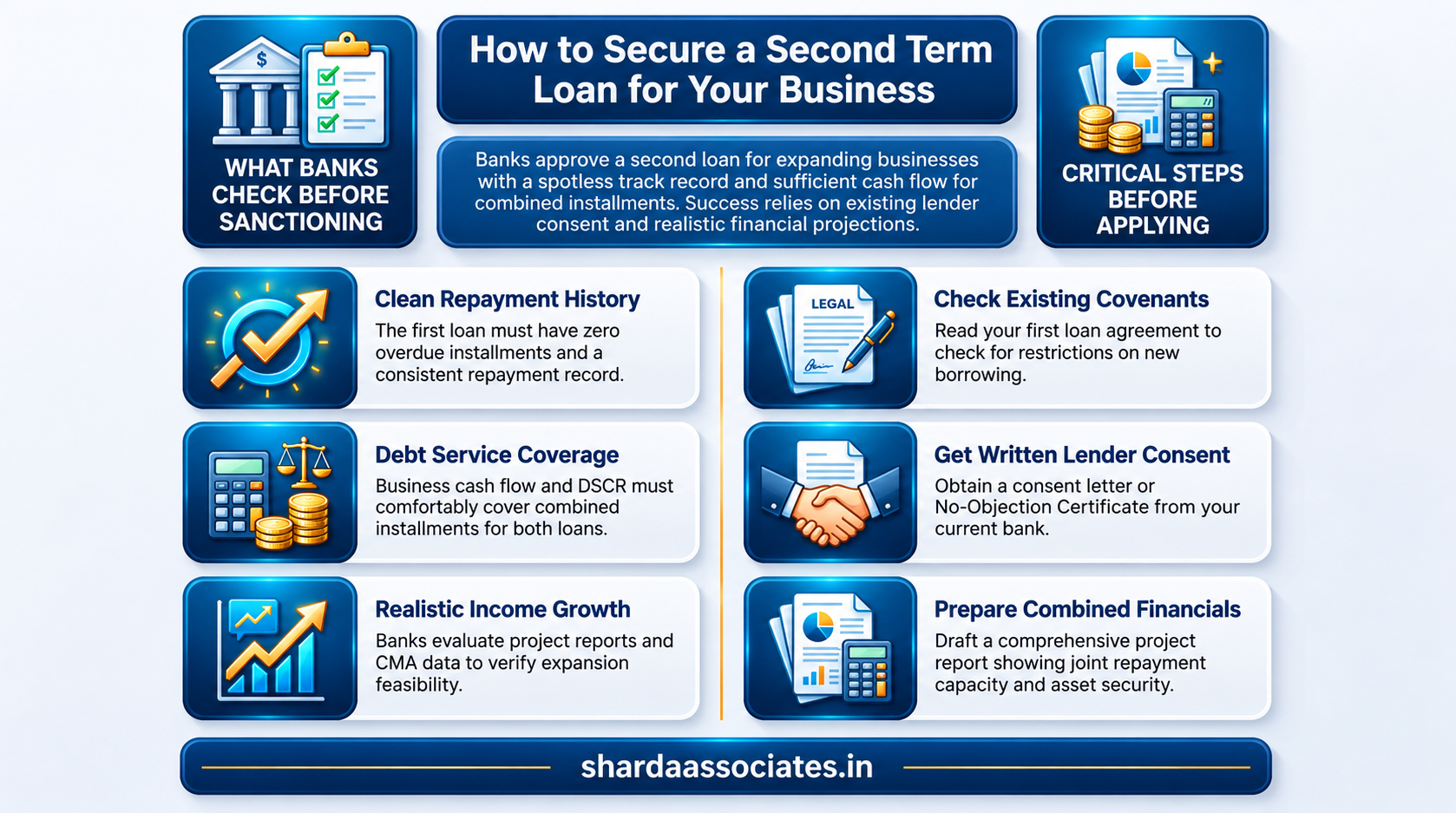
Yes, if your account is clean and your business can support the extra burden. The bank treats it as a new proposal for expansion, and it studies the whole business again, not just the new project.
- The first loan should be regular, with no overdue instalments
- The expansion should have a clear plan and expected income
- The combined repayment should fit within your cash flow
Do I Need Permission From My Existing Lender?
Often, yes. Your first loan agreement may have a clause that stops you from taking new borrowing or creating new charges on assets without the existing lender’s consent. If you ignore it, the bank can treat it as a breach.
- Read the covenants in your first loan agreement
- Ask the existing bank for written consent if required
- Do this before applying elsewhere
Should I Go to the Same Bank or a Different Bank?
Both are possible. The same bank already knows your account, so the process can be smoother. A different bank may offer better terms, but it will ask for the existing lender’s details and may need a no-objection letter.
- Same bank: familiar with your conduct and records
- Different bank: fresh appraisal, more paperwork
- Compare interest rate, margin and processing charges before deciding
What Does the Bank Check Before Sanctioning the Second Loan?
The bank looks at how well the business has performed since the first loan, and whether the expansion is realistic. It will not rely only on your word.
- Repayment history of the first loan
- Recent financial statements and bank account conduct
- Whether the earlier project met its projections
- Projected cash flow after the expansion
- Your credit record and existing liabilities
How Does the Bank Know I Can Afford Both Loans?
Banks calculate whether your expected income can cover all instalments together, with some cushion for slow months. This is usually shown through a debt service coverage ratio (DSCR) in your CMA data. The acceptable level depends on the bank’s policy.
- Your project report should show combined repayment, not just the new loan
- Unrealistic sales projections are a common reason for rejection
What Happens to Security and Charges on Assets?
The first lender may already hold a charge on your existing assets. The new machinery usually becomes security for the new loan, and the bank may ask for extra security if the value is not enough. Two lenders sharing the same asset needs proper arrangement and consent.
- The new machinery can be hypothecated to the new lender
- Existing assets may need a consent or a second charge arrangement
- Do not pledge the same asset twice without informing both banks
Example: A Growing Packaging Unit
A packaging unit took a term loan three years ago for one machine and has paid every instalment on time. Orders have grown, and the owner wants a second machine costing ₹25 lakh.
She first reads her loan agreement and informs her existing bank in writing. Then she prepares a new project report showing the combined repayment of both loans, supported by recent sales and orders in hand. The bank studies her record, finds the account regular and the projections reasonable, and sanctions a second term loan with a margin from her own funds.
If her first loan had overdue instalments, the bank would likely have asked her to clear them first.
Conclusion
A running term loan does not stop you from borrowing again for expansion. What matters is whether your first loan is regular and whether your business can carry both instalments from its own earnings.
Before you apply, read your first loan agreement, inform the existing lender where needed, and prepare numbers that show the combined repayment honestly. Overstated projections do more harm than a smaller, realistic request.
A realistic, CA-certified project report with accurate CMA data helps the bank see your expansion and repayment capacity clearly. If you need help with your proposal or documentation, call or message our team directly. Contact us: +91 89899 77769
Frequently Asked Questions
1. Can a business have two term loans at the same time?
Yes. Many MSMEs have more than one term loan, provided the business earns enough to repay all instalments. The bank checks your repayment record, cash flow and security before approving the second loan.
2. Will a running loan reduce my chance of getting another?
Not necessarily. A regular repayment record can help. But if the combined instalments strain your cash flow, or the first account has delays, the bank may reduce the amount or decline the proposal.
3. Do I need NOC from my existing bank?
Often you need the existing lender’s consent if your loan agreement restricts new borrowing or new charges on assets. Check the covenants, and ask the existing bank in writing before you approach another lender.
4. Can I apply to a different bank for the second loan?
Yes. A different bank will do a fresh appraisal and ask for details of your existing loan. It may also require a no-objection from the first lender, depending on the security arrangement.
5. Will the bank ask for more security?
It may. The new machinery usually serves as security for the new loan, but if its value is not enough, the bank can ask for additional security or a guarantee, as per its policy.
6. Is a new project report needed for the second loan?
Yes. The bank treats it as a new proposal for expansion, so you need a project report with CMA data showing the new project cost, income and combined repayment of both loans.
7. Can I take a second loan if my first loan has a moratorium?
It depends on the bank. The bank will check how your cash flow looks once the first loan’s full instalments begin, and whether the new loan’s repayment fits on top of it.
8. What if my first loan is overdue?
The bank is unlikely to approve a new loan until the overdue amount is cleared and the account becomes regular. Speak to your existing bank first and fix the account before applying.