
How Sharda Associates Helps You
Sharda Associates offers comprehensive help with income tax planning, deduction claims, tax compliance, paperwork management, and professional financial advice. Our professionals help taxpayers understand deduction eligibility, prepare documentation, file income tax returns, and ensure simple compliance with tax regulations.
We also provide professional assistance with GST registration, MSME registration, project reports, CMA reports, tax filing services, startup registration, financial planning, and compliance solutions for individuals, startups, professionals, and enterprises throughout India.
Introduction
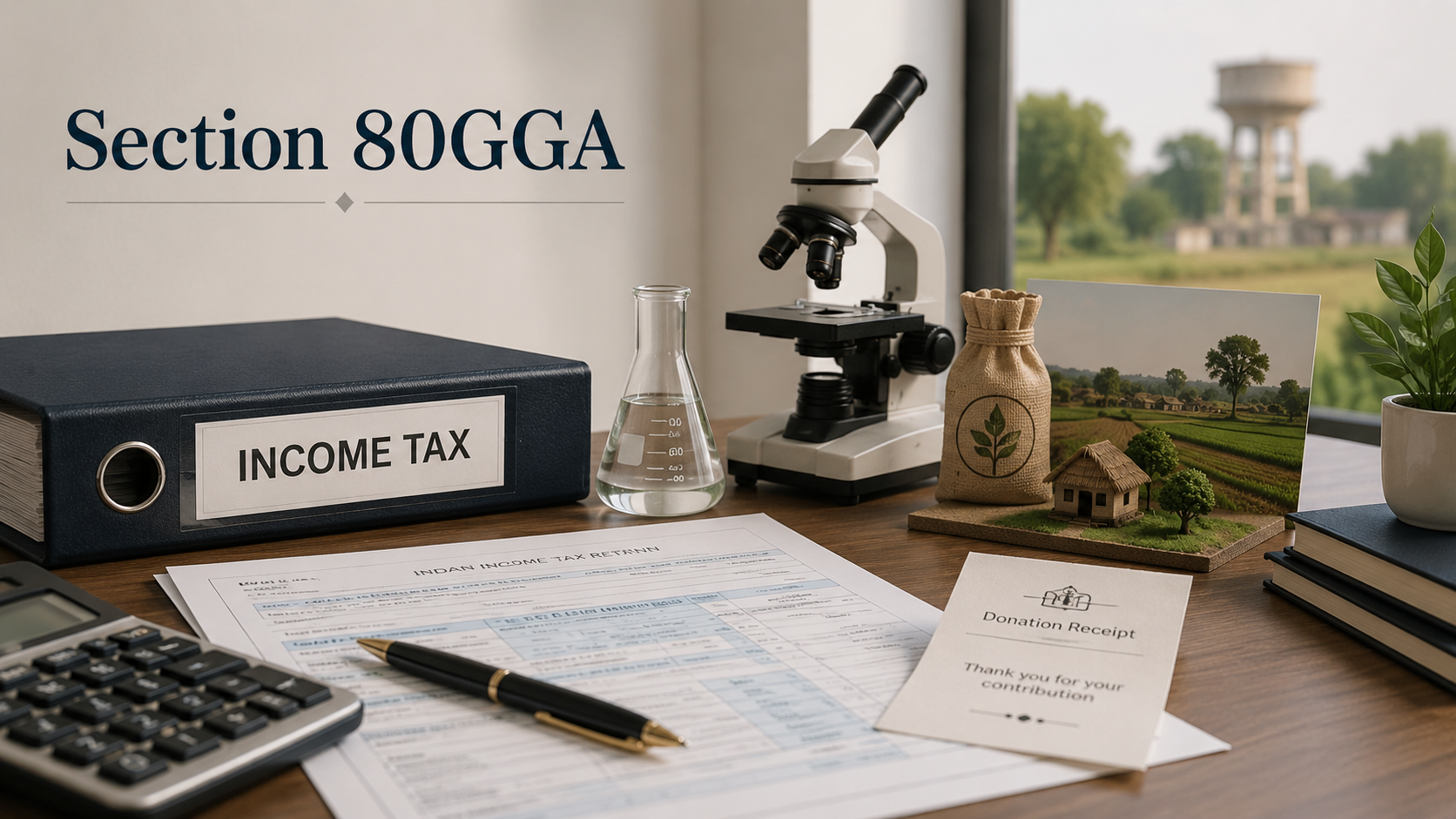
Section 80GGA of the Income Tax Act is a significant tax-saving provision that allows taxpayers to deduct donations given to scientific research, rural development, and recognized social welfare projects. This deduction encourages individuals to contribute to national development efforts while also reducing their taxable income legitimately.
In 2026, India’s tax compliance processes will be more computerized, transparent, and rigorously regulated by the Income Tax Department. Taxpayers must now keep accurate documentation, thoroughly verify qualifying institutions, and ensure that deduction claims are properly reported when submitting income tax returns.
This clause only allows for a deduction for taxpayers who do not make income from a business or profession. Proper compliance and documentation are required to avoid rejection of deduction claims or tax letters throughout the assessment process.
This tutorial describes the entire concept of the Section 80GGA deduction in India, including eligibility criteria, permissible donations, deduction limitations, paperwork requirements, compliance standards, penalties, and the most recent modifications under the 2026 taxation system.
Understanding Section 80GGA.
Section 80GGA is a tax deduction provision in the Income Tax Act that allows taxpayers to donate to approved scientific research institutes, rural development programs, afforestation initiatives, and other notified social welfare activities.
The fundamental goal of this deduction is to promote social development by encouraging public engagement in research and rural improvement efforts. Eligible taxpayers can lower their taxable income by claiming deductions for eligible donations made throughout the fiscal year.
This deduction is mostly applicable to salaried individuals, retirees, and non-business taxpayers who contribute to approved programs and institutions.
Eligibility for Section 80GGA Deduction
The deduction under Section 80GGA is only accessible to taxpayers who did not earn income from a business or profession in the relevant fiscal year.
Eligible taxpayers often include:
- salaried employees
- Pensioners
- Freelancers Without Business Income
- Individuals with capital gains income.
- Individuals earn rental income
- Other nonbusiness taxpayers
Taxpayers involved in commercial or professional activities are generally not eligible to claim a deduction under this section since the Income Tax Act has specific provisions for them.
Donations are eligible for deduction.
Section 80GGA allows taxpayers to deduct gifts given to designated scientific research institutes, rural development programs, afforestation projects, environmental protection initiatives, and notified social welfare schemes. Contributions made to qualified universities, research societies, colleges, and organizations working for rural development may also be eligible for tax breaks under this clause.
The deduction is only applicable for donations made to recognized and approved institutions or funds under Income Tax legislation. Taxpayers should carefully check the organization’s approval status before making contributions to ensure eligibility for deduction claims. Proper receipts, payment proof, and institution information must also be kept for compliance and verification during income tax filing.
The importance of proper documentation
Maintaining correct documentation is critical for claiming deductions under Section 80GGA. Accurate records allow taxpayers to show the authenticity of gifts and guarantee a seamless verification process during income tax assessment procedures. Incorrect, incomplete, or missing papers may result in the rejection of deduction claims, increased tax liability, or notices from the Income Tax Department.
Donation receipts, payment evidence, acknowledgment copies, institution approval data, and bank transaction records should all be kept carefully for future reference by taxpayers. Using digital payment methods is often recommended because it results in more transparent financial records and facilitates compliance verification. Proper documentation not only aids in legal tax savings, but it also decreases the likelihood of compliance challenges and assessment complications.
Updated Tax Compliance Framework for 2026
The tax system in 2026 is more digital and data-driven. Most deduction claims are now electronically checked via PAN-linked reporting systems and online compliance portals.
Tax authorities use modern verification tools to detect incorrect deduction claims and mismatched gift records. Taxpayers are obliged to keep correct records and make valid claims when filing returns.
Online filing systems, pre-filled return forms, and digital verification have made compliance easier for taxpayers across India.
However, authorities have improved monitoring procedures to combat bogus deduction claims and tax evasion.
Modes of Donation Allowed
Donations qualified for Section 80GGA should be made through traceable financial channels to ensure proper documentation and compliance.
Accepted payment methods often include:
- Bank transfer
- Cheque payment.
- Demand draft.
- UPI transactions.
- Net Banking
- Debit or credit card payments
Large cash donations may not be eligible for deductions under tax laws. Taxpayers should always retain payment proof safe for future reference.
Deduction Limit under Section 80GGA
The deduction permitted under this provision may be up to 100% of the qualified donation amount, depending on the institution’s category and approval status.
However, only gifts given to recognized institutions are eligible for tax breaks. The deduction amount must be supported by appropriate paperwork and receipts.
Taxpayers should verify current government notifications and institution approvals before claiming deductions on their income tax filings.
Common Mistakes When Claiming Deductions
Many taxpayers make mistakes while claiming deductions owing to a lack of knowledge or improper documentation techniques.
Common mistakes include:
- Claim deduction for non-approved institutions.
- Missing payment proof
- Incorrect PAN details.
- Duplicate deduction claims.
- Claiming cash donations that exceed the limitations
- Entering improper deduction amounts.
These inaccuracies may result in tax notices, deduction rejections, or increased scrutiny during the assessment process.
Penalties for incorrect tax claims
Incorrect or incorrect deduction claims under Section 80GGA may result in penalties, notices, or scrutiny from the Income Tax Department. If taxpayers claim deductions without adequate documentation, provide false information, or disclose donations made to non-approved institutions, authorities may reject the deduction and impose additional tax liabilities and interest charges.
In significant circumstances, repeated noncompliance or willful misreporting can result in assessment proceedings, financial fines, and legal issues under tax rules. Taxpayers should keep correct records, thoroughly evaluate institution eligibility, and file legitimate deduction claims to avoid compliance concerns and ensure smooth income tax processing.
Why is Proper Tax Compliance Important?
Proper tax compliance allows taxpayers to avoid legal complications while also maintaining financial openness. Accurate deduction claims lower the risk of scrutiny and increase return processing efficiency.
Compliant taxpayers are more likely to receive speedier refunds, fewer notices, and more efficient financial record management. Proper tax preparation also allows individuals to make the most of permissible tax-saving opportunities.
Maintaining accurate records and properly submitting taxes is critical for long-term financial stability and legal compliance.
How To Maintain Tax Compliance Easily
Before submitting returns, taxpayers should keep organized financial records, save receipts, and double-check their deduction eligibility.
It is vital to:
- Keep donation receipts carefully.
- Verify the institution’s approval status.
- Use digital payment methods.
- File returns before deadlines.
- Maintain good financial records.
- Consult tax professionals when necessary.
Regular financial reviews and professional tax consultations can help taxpayers avoid compliance mistakes and maximize valid deductions.
Government’s Role in Tax Regulation
The Income Tax Department is responsible for reviewing deduction claims and ensuring compliance with India’s tax rules.
Authorities deploy digital verification systems, PAN-based tracking, and online assessment procedures to increase transparency and deter tax evasion. To improve tax administration, the government adjusts deduction rules and reporting criteria on a regular basis.
Strict monitoring promotes fairness, accountability, and openness in the tax system.
Conclusion
Section 80GGA is a significant tax-saving provision that encourages contributions to scientific research, rural development, and social welfare programs. With new compliance systems in 2026, taxpayers must keep accurate documentation and follow proper procedures when claiming deductions.
From eligibility verification and gift records to return filing and compliance monitoring, each step is critical to ensuring tax compliance and avoiding fines.
Taxpayers who follow right legal procedures not only legally lower their taxable income, but they also responsibly contribute to national development and social welfare programs.
Sharda Associates provides Tax Deduction and Compliance Support.
Sharda Associates is a reputable financial and business consultancy organization in India that provides professional services in taxation, accounting, auditing, GST compliance, project reports, MSME registration, startup registration, financial planning, and legal paperwork assistance.
Our skilled consultants offer accurate, dependable, and speedy tax and compliance support to salaried individuals, startups, professionals, and enterprises throughout India. We simplify complex financial and tax procedures, allowing businesses to focus on growth while remaining completely compliant with regulatory laws.
Sharda Associates believes in providing transparent, competent, and result-oriented advisory services that promote long-term financial growth and stability.
Call: +91 79870 21896 /WhatsApp: +91 89899 77769
Frequently Asked Questions.
- What is the Section 80GGA deduction under the Income Tax Act of India for taxpayers?
Section 80GGA allows qualifying taxpayers to lawfully deduct gifts to scientific research, rural development, afforestation projects, and approved social welfare agencies.
- Who can claim a deduction under Section 80GGA while submitting an income tax return in India?
Individuals who do not have company or professional income, including as salaried employees, retirees, and non-business taxpayers, may legitimately claim qualified deductions under Section 80GGA.
- Are financial donations lawfully eligible for a deduction under Section 80GGA tax provisions?
Cash donations that exceed the stipulated limitations are generally ineligible for deduction benefits. Taxpayers should preferably use banking channels and keep payment records for tax compliance purposes.
- Which types of donations are eligible for deductions under Section 80GGA in India?
Donations to scientific research institutes, rural development programs, afforestation initiatives, approved educational institutions, and reported social welfare operations are all tax-deductible.
- What documentation are required to claim a deduction under Section 80GGA during tax filing?
Donation receipts, institution approval details, PAN information, bank transaction proof, acknowledgment receipts, and supporting paperwork are all necessary for deduction verification during the assessment process.
- Can business owners in India legally claim a Section 80GGA deduction for acceptable donations?
No, taxpayers who make income from a business or profession are normally ineligible because they are subject to separate deduction provisions under other parts of the Income Tax laws.
- What happens if an inaccurate deduction claim is filed under Section 80GGA during return filing?
Incorrect claims may result in deduction rejection, increased tax liabilities, penalties, notices, scrutiny assessments, or legal procedures, depending on the severity of the compliance violation and documentation problems.
- Why is sufficient paperwork required when claiming deductions under Section 80GGA provisions legally?
Proper documentation ensures deduction validity, prevents rejection during assessment, facilitates compliance verification, lowers the risk of notices, and assists taxpayers in keeping correct financial and tax records efficiently.