
In India, there isn’t a single project report format that works for all bank loans. Depending on whether you are launching a new company, purchasing equipment, growing an existing firm, looking for working capital, applying under a government-affiliated programme, or funding a technically challenging project, different documents are needed. Sharda Associates prepares CA-expert-led Project Reports, Detailed Project Reports and CMA-related financial documentation according to the actual financing requirement rather than treating every loan application as the same. The first step should therefore be to understand what the lender wants to evaluate, not simply ask for a generic “bank project report”.
Which Types of Project Reports Do You Need for Your Bank Loan?
A practical way to understand the different reports is to look at the purpose of the borrowing.
| Your Loan Requirement | Report/Financial Document Commonly Relevant |
| New small or medium business | Standard Bank Loan Project Report |
| Machinery or fixed-asset term loan | Project Report or DPR |
| Large manufacturing/technical project | Detailed Project Report / TEV where applicable |
| Existing business expansion | Expansion/Modernisation Project Report |
| Cash Credit or working-capital finance | CMA Data / projected financial information |
| Term loan + working capital | Project Report/DPR and CMA may both be required |
| Government-linked scheme | Scheme-specific Project Report |
| Project with uncertain viability | A feasibility/TEV study may be requested |
These are practical categories, not universal banking rules. Requirements may vary depending on the lender, loan amount, project, scheme and applicant.
1. What Is a Standard Project Report for a Bank Loan?
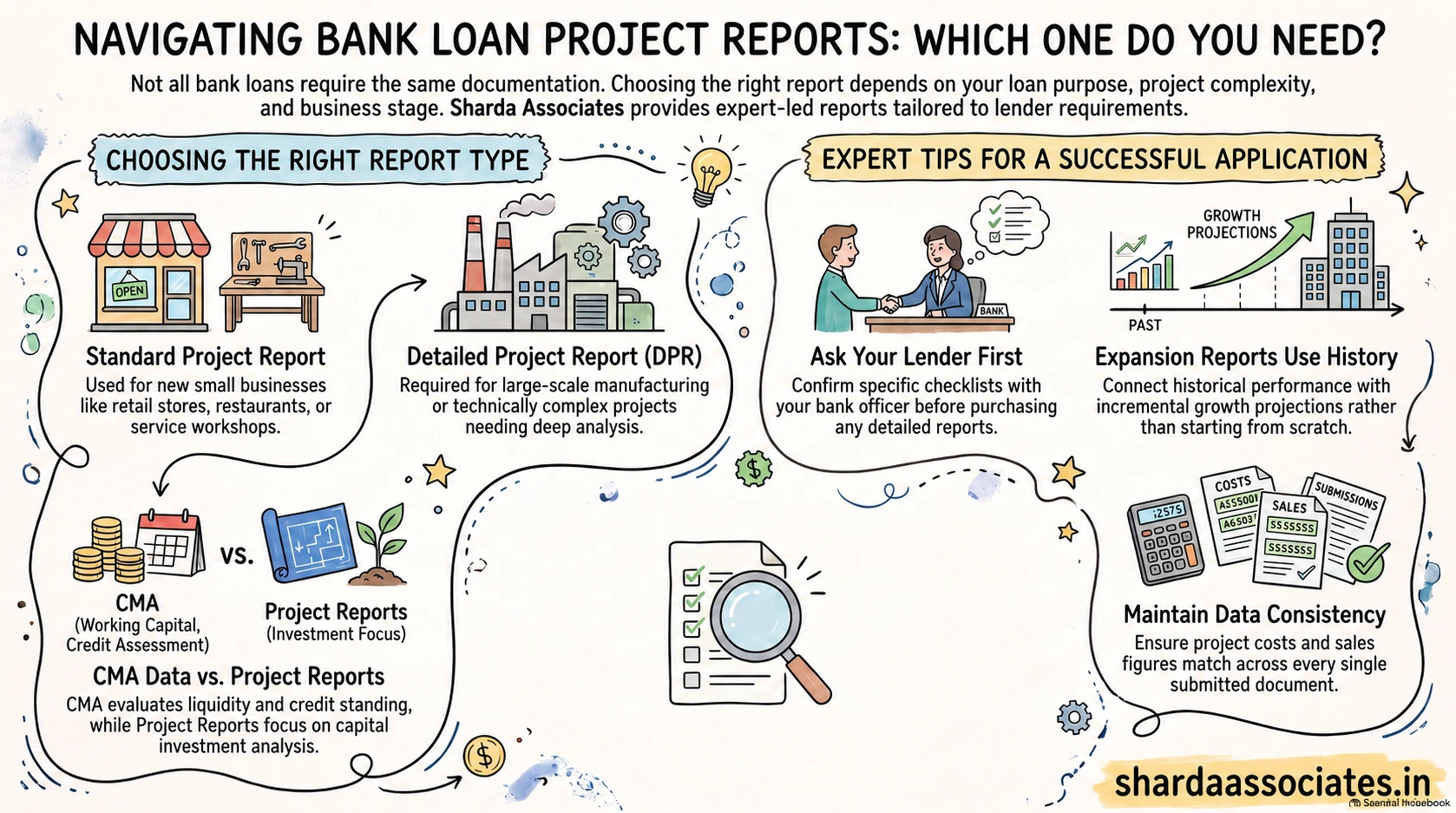
A standard Project Report is commonly used when an entrepreneur wants funding for a new business or a relatively straightforward investment.
For example, someone may want to establish:
- Retail store
- Restaurant
- Small manufacturing unit
- Service business
- Workshop
- Trading operation
The report explains the project from a lender’s perspective.
Instead of merely saying:
“I need a ₹25 lakh business loan.”
the report should explain:
What will be purchased → Total project cost → Applicant’s contribution → Bank finance required → Expected operations → Sales → Expenses → Profitability → Repayment capacity
Therefore, the business and promoter background, project cost, financing options, machinery/equipment, working capital, projected profit and loss, balance sheet, cash flow, and payback details may all be included in a typical report.
For pertinent term-funding situations, the Ministry of MSME’s Know Your Lender, Grow Your Business guidelines provide an example: a project report may comprise machinery, suppliers, price, capacity, expected capacity utilisation, production, sales, and projected financial statements.
2. When Do You Need a Detailed Project Report (DPR)?
A Detailed Project Report is generally more appropriate when the project cannot be properly explained through a relatively simple financial report.
Consider a ₹10 crore food-processing plant.
The bank may need to understand much more than sales and profits.
A DPR may examine:
Technical aspects
Machinery, production process, plant capacity, utilities, raw-material requirements and technical infrastructure.
Project implementation
Construction, machinery delivery, installation, trial production and commercial operation.
Market assumptions
Products, customers, competition, selling prices and marketing arrangements.
Detailed financial analysis
Project cost, means of finance, profitability, working capital, cash flow, repayment and financial ratios.
A term-loan project report, with a TEV report when appropriate, is specifically described in Union Bank’s current checklist for larger credit proposals. It covers topics like project background, projections, cost and means of finance, machinery quotations, capacity, statutory approvals, marketing arrangements, raw materials, implementation, and repayment.
This demonstrates why a technically challenging project could need a lot more work than a simple project report.
3. What Report Is Required for an Existing Business Expansion?
An existing business adding a new plant, branch, machinery line or production capacity may need an Expansion or Modernisation Project Report.
This report has an advantage that a new-business report does not have:
actual historical performance.
Suppose a manufacturer currently has:
Annual turnover: ₹3 crore
Existing capacity: 70,000 units
Proposed new machinery: ₹80 lakh
The expansion report should not start financial projections from scratch.
It should connect:
existing performance + additional machinery + additional capacity + additional working capital = future projected business
Historical financial statements can then help the lender judge whether the projected expansion is reasonable.
An expansion report may therefore discuss:
- Existing operations
- Existing machinery
- Present production
- Historical turnover
- Current borrowing
- Proposed additional machinery
- Incremental capacity
- Additional sales
- Incremental working capital
- Revised profitability
- Combined debt repayment
This type of report should clearly distinguish the existing business from the proposed expansion.
4. Is CMA Data Another Type of Project Report?
Technically, CMA Data and a Project Report serve different purposes, although banks may ask for both as part of the same credit proposal.
This distinction is important because many online articles incorrectly treat CMA as simply another name for a project report.
A Project Report primarily explains:
the project and proposed investment.
CMA-related financial information focuses more heavily on:
historical performance + projected performance + Balance Sheet position + working-capital requirement + credit assessment.
CMA may become particularly relevant for existing businesses applying for:
- Cash Credit
- Overdraft
- Working-capital enhancement
- Renewal of existing limits
- Larger combined credit facilities
For working-capital proposals, financial information such as sales, inventory, receivables, creditors and projected Balance Sheets can become particularly important.
Therefore, if your banker says “Project Report plus CMA required,” do not assume one document automatically replaces the other.
5. What If You Need Both a Term Loan and Working Capital?
This is common in manufacturing and trading businesses.
Consider this Illustrative Example:
Machinery Term Loan: ₹60 lakh
Working-Capital Requirement: ₹30 lakh
The bank has two different questions.
For the term loan:
What assets are being purchased, and can the project repay the long-term borrowing?
For working capital:
How much money will remain blocked in stock, receivables and day-to-day operations?
In such cases, the applicant may need:
Project Report/DPR + detailed working capital/CMA information.
Trying to cover both requirements with a two-page generic report may leave important questions unanswered.
6. What Is a Scheme-Specific Project Report?
Certain government-linked business-finance schemes can require project information in a particular application context.
A good example is PMEGP.
Current official PMEGP guidelines include a Project Report among the documents required with the applicable application. The PMEGP portal also provides project-report resources for applicants.
A scheme-related project report may therefore need to reflect:
- Proposed activity
- Project cost
- Applicant contribution
- Financing
- Employment
- Machinery
- Working capital
- Scheme-specific information
The important rule is:
Do not take a normal bank DPR and simply add the name of a government scheme to the heading.
The current scheme conditions should first be checked from the official source.
7. When Might a Bank Ask for a Feasibility or TEV Report?
A feasibility study or Techno-Economic Viability (TEV) report is not automatically required for every small business loan.
It becomes more relevant when the lender needs deeper independent assessment of a substantial or technically complex project.
For example:
- Large manufacturing plant
- Renewable-energy project
- Major hotel/hospital project
- Industrial infrastructure
- New/unproven technology
- Large project expansion
A feasibility or TEV study may examine whether:
the technology works + project cost is reasonable + market assumptions are credible + project economics support the investment.
This is different from simply documenting the project.
A Project Report says:
“This is the project we propose.”
A feasibility study asks:
“Does this proposed project actually make sense?”
Which Report Should a First-Time Borrower Ask For?
Do not begin by purchasing the biggest report available.
Start with these three questions:
What type of finance am I applying for?
Term loan, machinery loan, CC/OD, composite business loan or scheme-linked finance?
Is my project simple or technically complex?
A salon does not need the same DPR depth as a chemical-manufacturing facility.
What has my bank specifically requested?
Ask whether it needs:
Project Report, DPR, CMA Data, projected financials, feasibility/TEV or a particular bank format.
This small clarification can prevent you from paying for unnecessary documents.
What Information Should Stay Consistent Across Every Report?
If more than one document is prepared, all of them should describe the same financing proposal.
Suppose:
Project Report sales = ₹2 crore
CMA projected sales = ₹2.8 crore
Loan application sales = ₹1.6 crore
That inconsistency may require explanation.
The same applies to:
- Project cost
- Machinery value
- Loan requirement
- Promoter contribution
- Capacity
- Working capital
- Profit projections
The lender should not see a different version of the project in every document.
Can One Standard Template Work for Every Bank Loan?
Not reliably.
Templates can provide a useful structure, but the actual report should reflect:
business activity + project size + financing type + lender requirement.
A service business may need strong customer and revenue assumptions.
A manufacturing DPR may require machinery, capacity, raw materials and utilities.
An existing company may require historical financial analysis.
A working-capital proposal may need much deeper attention to inventory and receivables.
The correct report is therefore the one that helps answer the specific questions raised by that financing proposal.
Frequently Asked Questions
1. What type of project report is required for a term loan?
A standard project report, or DPR may be required depending on the size and complexity of the project and lender requirements.
2. What report is required for a machinery loan?
The lender may require a Project Report/DPR containing machinery details, quotations, project cost, funding and projected operations.
3. Is CMA Data required for every bank loan?
No. CMA or equivalent structured financial information is more commonly associated with credit assessment and working-capital requirements. Exact requirements vary.
4. What is the difference between Project Report and DPR?
A DPR generally contains deeper technical, implementation, market and financial details, although lenders may sometimes use the terms interchangeably.
5. Is a feasibility report required with a DPR?
Not always. Feasibility/TEV assessment may be requested for larger, technically complex or higher-risk projects.
6. Does PMEGP require a Project Report?
Current official PMEGP documentation includes a Project Report among relevant application documents.
7. Can I use the same Project Report for term loan and working capital?
Some information can be shared, but the bank may require additional CMA or detailed working-capital information.
8. Does an existing business need a new Project Report for expansion?
A lender may require an expansion/project report explaining the new investment, incremental operations and financial impact.
9. Is there one RBI format for every Project Report?
No single universal Project Report format applies identically to every borrower, lender and loan. Banks can have their own documentation and appraisal requirements.
10. How do I know exactly which report my bank needs?
Ask the branch or credit officer for the required document name, financial schedules and applicable checklist before finalising the report.