
GST registration is the procedure by which a firm registers for the Goods and Services Tax (GST) and obtains a unique GSTIN.
Once registered, the business becomes legally authorized to:
- Collect GST from customers
- Claim input tax credit (ITC)
- File GST returns
Who is Required to Register under GST?
A. Mandatory Registration (irrespective of turnover)
- Inter-state suppliers
- E-commerce sellers (via Amazon, Flipkart, etc.)
- Casual taxable persons
- Non-resident taxable persons
- Input service distributors (ISD)
- Persons liable under reverse charge
B. Based on Turnover Limit
- Based on Turnover Limit
|
Type of Business |
Threshold Limit |
|
Goods supply |
₹40 lakhs (₹20 lakhs for special category states) |
|
Services |
₹20 lakhs (₹10 lakhs for special category states) |
Types of Entities Eligible for GST Registration
GST registration is available for almost all business structures:
- Proprietorship
- Partnership Firm
- Limited Liability Partnership (LLP)
- Private Limited Company
- Public Limited Company
- Hindu Undivided Family (HUF)
- Trust / Society / NGO
- Government departments
- Foreign companies operating in India
Types of GST Registration
1. Regular Taxpayer
- Most common type
- Eligible for Input Tax Credit
- Monthly/quarterly return filing
2. Composition Scheme
- For small taxpayers
- Turnover limit: up to ₹1.5 crore (₹50 lakh for services – special scheme)
- Lower tax rates, but:
- No ITC available
- Cannot collect tax from customers
3. Casual Taxable Person
- For temporary businesses (e.g., exhibitions, events)
4. Non-Resident Taxable Person
- For foreign businesses supplying in India
5. Input Service Distributor (ISD)
- Distributes ITC to branches
6. E-commerce Operator
- For companies operating platforms like marketplaces
7. TDS/TCS Deductor
- Government or notified entities deducting tax
Documents Required for GST Registration
A. For Proprietorship
- PAN Card of proprietor
- Aadhaar Card
- Photograph
- Bank account details (cancelled check / bank statement)
- Address proof of business:
- Electricity bill / rent agreement / property tax receipt
B. For Partnership / LLP
- PAN of firm
- Partnership deed
- PAN & Aadhaar of partners
- Address proof of business
- Authorization letter
C. For Company
- PAN of company
- Certificate of Incorporation
- MOA & AOA
- PAN & Aadhaar of directors
- Board resolution
- Address proof of business
D. Common Documents (All Entities)
- Digital Signature Certificate (DSC) – for companies/LLPs
- Email ID & mobile number
- Bank details
Types of GST Returns & Due Dates (India)
1. Regular Taxpayer Returns
GSTR-1 (Outward Supplies)
- Purpose: Details of sales (outward supplies)
- Who files: Regular taxpayers
Due Dates:
- Monthly filers: 11th of next month
- QRMP scheme: 13th of month following quarter
GSTR-3B (Summary Return)
- Purpose: Summary of sales, ITC & tax payment
- Who files: Regular taxpayers
Due Dates:
- Monthly: 20th of next month
- QRMP Scheme:
- 22nd (Category X states)
- 24th (Category Y states)
QRMP Scheme (Quarterly Return Monthly Payment)
- Applicable if turnover ≤ ₹5 crore
- File GSTR-1 quarterly and pay tax monthly
2. Composition Scheme Returns
CMP-08
- Purpose: Payment of tax by composition dealers
- Due Date:
- 18th of month following quarter
GSTR-4 (Annual Return)
- Purpose: Annual summary for composition taxpayers
- Due Date:
- 30th April following financial year
3. Annual Returns
GSTR-9
- Purpose: Annual return for regular taxpayers
- Due Date:
- 31st December following financial year
GSTR-9C (Reconciliation Statement)
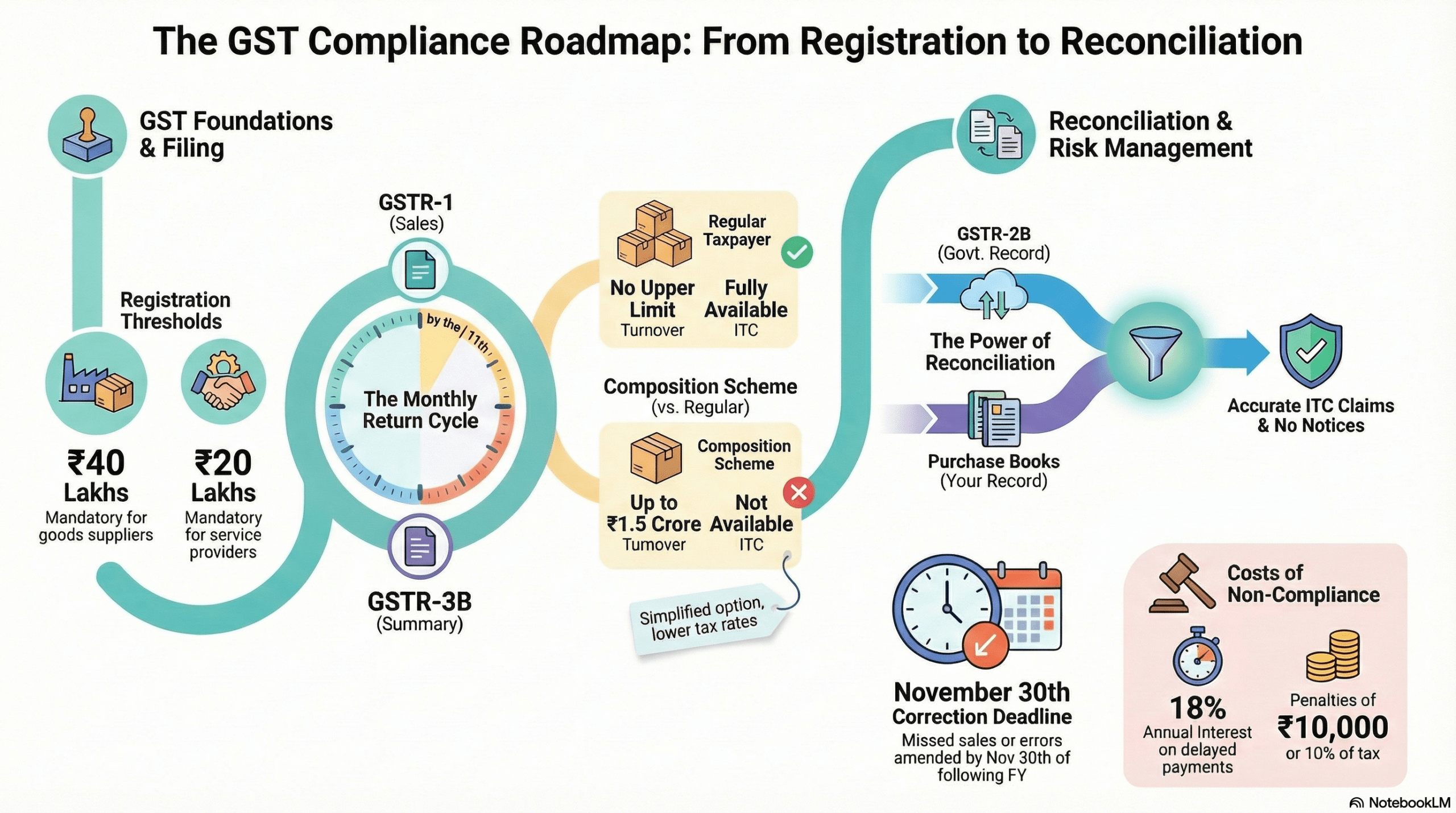
GST Reconciliation
1. What is GST Reconciliation?
GST reconciliation is the process of matching data between books of accounts and GST returns filed under the Goods and Services Tax.
It ensures:
- Correct tax payment
- Accurate Input Tax Credit (ITC) claim
- No mismatch notices from department
2. Why GST Reconciliation is Important
- Avoid GST notices & scrutiny
- Ensure correct ITC availed
- Detect unreported sales or excess ITC
- Maintain compliance & audit readiness
- Required for annual return (GSTR-9) & reconciliation (GSTR-9C)
3. Types of GST Reconciliation
A. GSTR-1 vs Books (Sales Reconciliation)
- Compare:
- Sales as per books
- Sales reported in GSTR-1
Common Differences:
- Missing invoices
- Timing differences
- Debit/credit notes mismatch
- Amendments in returns
B. GSTR-3B vs Books
- Compare:
- Tax liability in books
- Tax paid in GSTR-3B
Focus Areas:
- Output tax mismatch
- ITC claimed vs actual
- Incorrect tax payment
C. GSTR-1 vs GSTR-3B
- Match:
- Sales declared in GSTR-1
- Tax paid in GSTR-3B
Important: This mismatch is a major trigger for GST notices
D. ITC Reconciliation (GSTR-2B vs Purchase Register)
- Compare:
- ITC as per GSTR-2B (auto-generated)
- ITC for purchasing books
Common Issues:
- The supplier has not filed GSTR-1
- Wrong GSTIN or invoice details
- Blocked credits (e.g., personal expenses)
- Ineligible ITC claimed
E. GSTR-2A vs 2B (Trend Analysis)
- 2A: Dynamic
- 2B: Static (used for ITC claim)
F. E-way Bill vs GSTR-1
- Compare goods movement with reported sales
G. GSTR-9 vs All Returns
- Annual reconciliation:
- GSTR-1
- GSTR-3B
- Books of accounts
If a Business Forgets to Report Sales in GST – Timeline & Consequences
A taxpayer can declare/amend missed sales up to:
30th November of the following financial year
(or date of filing GSTR-9, whichever is earlier)
Example:
- FY 2024–25 sale missed
- Can be reported till 30th November 2025
How to Correct the Mistake
- Add missed invoice in:
- GSTR-1 (amendment or current period)
- Pay tax through:
- GSTR-3B (with interest)
Case Analysis: Before Due Date vs After Due Date
CASE 1: Error Identified BEFORE Time Limit
What you can do:
- Report sales in upcoming GSTR-1
- Pay tax in GSTR-3B
- Pay interest @ 18% p.a.
Impact:
- No major penalty
- Compliance remains clean
- ITC flow to buyer (in B2B) is preserved
CASE 2: Error Identified AFTER Time Limit (Serious Issue)
· Once 30th November passes, you cannot amend GSTR-1.
Consequences if Not Reported Within Time
A. Tax Liability Still Payable
- GST must still be paid
- Along with interest (18%)
B. Penalty Risk
- Penalty under GST:
- 10% of tax or ₹10,000 (whichever higher)
- If fraud suspected → 100% penalty
C. GST Notices
- Likely notices:
- ASMT-10 (scrutiny)
- DRC-01 (demand notice)
D. No Amendment Allowed
- Cannot update GSTR-1
- Books and GST returns mismatch permanently
Special Impact: B2B vs B2C
A. B2B Transactions (Very Critical)
If NOT reported on time:
- The buyer cannot claim ITC
- Business relationship impacted
- Buyer may:
- Withhold payment
- Demand compensation
B2C Transactions
Impact:
- No ITC issue (customer is end consumer)
- Only tax + interest + penalty risk
Conclusion
GST registration in India is not just a legal requirement but a crucial step for running a compliant and scalable business. From obtaining a GSTIN to filing GST returns and performing GST reconciliation, every process plays a vital role in maintaining transparency and avoiding penalties. Proper understanding of GST compliance, input tax credit (ITC), and return filing timelines helps businesses operate smoothly without facing notices or financial risks.
In 2026, businesses must focus on accurate reporting, timely GST return filing, and regular reconciliation to stay compliant. Ignoring GST rules or delaying corrections can lead to interest, penalties, and loss of ITC benefits. A proactive approach to GST compliance ensures better financial control, improved credibility, and long-term business growth. You can contact us at +91 8989977769 for any query or if you require our services to prepare a project report or a bank loan.
FAQ
1. What is GST registration in India and why is GSTIN important?
GST registration in India is the process of obtaining a GSTIN to legally collect and pay GST. It allows businesses to claim input tax credit and file GST returns. GSTIN is essential for compliance and smooth business operations.
2. Who is required to take GST registration in India?
GST registration in India is mandatory for inter-state suppliers, e-commerce sellers, and businesses under reverse charge. It is also required if turnover exceeds ₹40 lakh for goods or ₹20 lakh for services. Certain entities must register irrespective of turnover.
3. What are the types of GST registration in India?
Types of GST registration in India include regular taxpayer, composition scheme, casual taxable person, and non-resident taxable person. Each type has different compliance requirements and benefits. Choosing the right type is important for tax efficiency.4. What documents are required for GST registration in India?
Documents required for GST registration include PAN, Aadhaar, bank details, and address proof of business. Additional documents depend on business type like proprietorship, LLP, or company. Proper documentation ensures smooth GST registration approval.
5. What are GST returns and their due dates in India?
GST returns in India include GSTR-1, GSTR-3B, GSTR-9, and others based on business type. Due dates vary from monthly, quarterly, and annual filings. Timely filing is important to avoid penalties and ensure compliance.
6. What is GST reconciliation and why is it important?
GST reconciliation is the process of matching books of accounts with GST returns. It ensures correct tax payment and accurate input tax credit claims. Proper reconciliation helps avoid notices and compliance issues.
7. What is ITC reconciliation under GST and how does it work?
ITC reconciliation under GST matches input tax credit in GSTR-2B with purchase records. It helps identify missing invoices and ineligible ITC claims. This ensures accurate credit and reduces tax risk.
8. What happens if sales are not reported in GST returns?
If sales are not reported in GST returns, tax along with interest at 18% must be paid. Penalties may apply, and GST notices can be issued. Delayed reporting can also affect business compliance and ITC flow.