
The Income Tax Amendment Rules 2026 bring significant changes in the way taxpayers in India file their income tax returns (ITR). These new updates aim to make the tax filing system more transparent, digital, accurate, and data-driven.
With the introduction of enhanced reporting requirements, updated ITR forms, and stronger integration with the Annual Information Statement (AIS), taxpayers must now be more careful while filing returns.
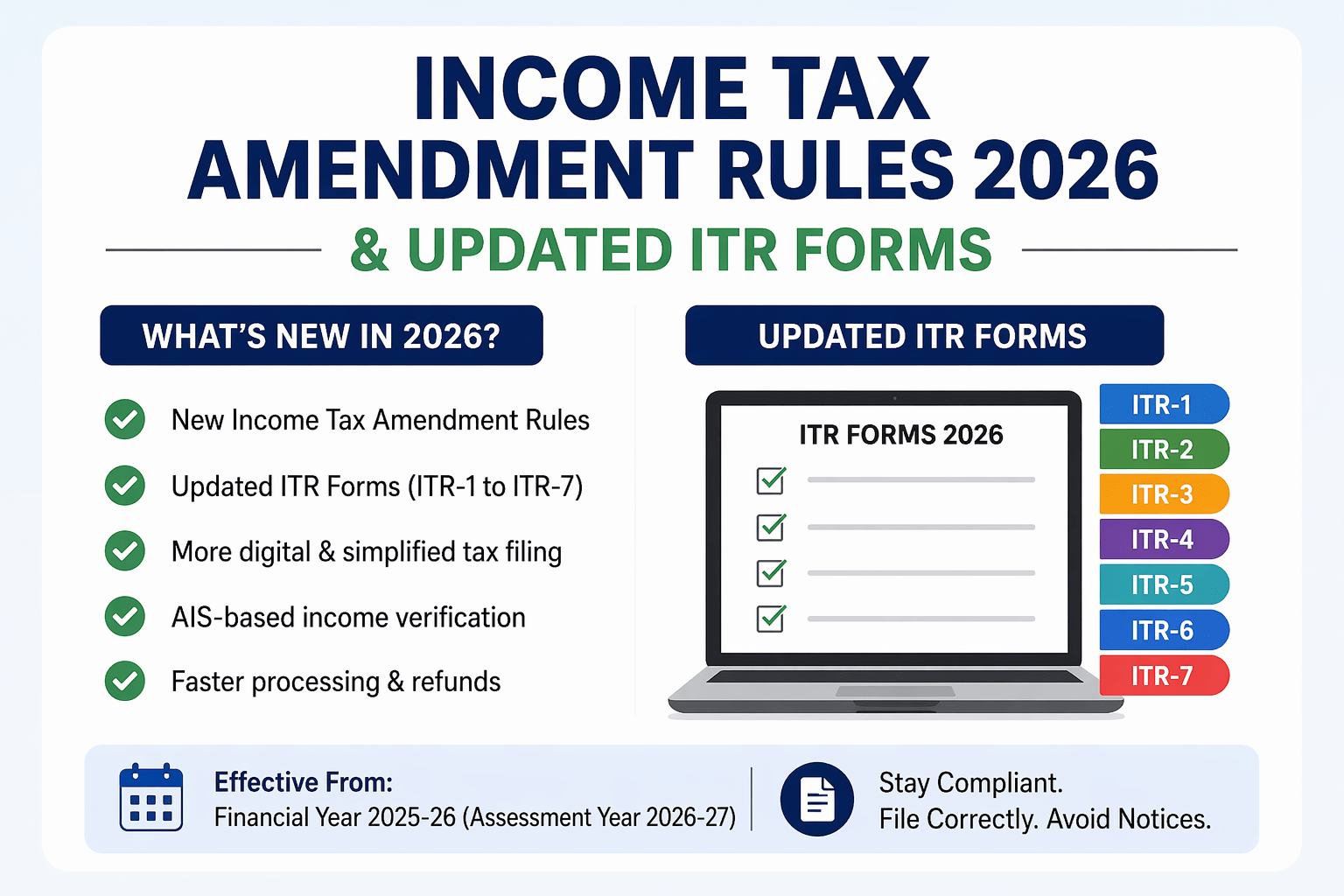
Whether you are a salaried employee, business owner, freelancer, or investor, these changes will directly impact your tax filing process in 2026.
How Sharda Associates Can Help You
Understanding income tax amendment rules and updated ITR forms can be complex for many individuals and businesses. This is where Sharda Associates plays an important role.
Sharda Associates provides end-to-end assistance in:
- Income Tax Return (ITR) filing for individuals and businesses
- Updated ITR forms filing support for AY 2026-27
- GST registration and return filing
- TDS reconciliation and mismatch resolution
- AIS (Annual Information Statement) verification and correction
- Tax planning and financial advisory services
With expert guidance, Sharda Associates ensures that your tax filing is error-free, compliant, and optimized for maximum benefits.
What Are Income Tax Amendment Rules 2026
The Income Tax Amendment Rules 2026 refer to the updated regulations issued by the Income Tax Department to improve tax compliance and reporting accuracy.
These rules mainly focus on:
- Updated ITR forms structure
- Expanded income disclosure requirements
- Integration of AIS and bank data
- Better tracking of digital and freelance income
- Strengthened capital gains reporting system
- Enhanced verification of high-value transactions
The main objective is to reduce tax evasion and improve transparency in the Indian taxation system.
Key Highlights of Income Tax Amendment Rules 2026
1. AIS-Based Automatic Data Matching
The Annual Information Statement (AIS) has become the backbone of income verification. Under the new rules:
- All bank transactions are auto-tracked
- Salary and TDS data are pre-filled in ITR
- Mutual funds, stocks, and dividend income are reported automatically
- Any mismatch between AIS and ITR may trigger notices
This makes tax filing more accurate but also more strict.
2. Major Changes in ITR Forms 2026
The updated ITR forms have been redesigned for better clarity and detailed reporting.
ITR-1 (Salaried Individuals)
- Expanded salary breakdown
- Additional disclosure of interest income
- More detailed deduction reporting
ITR-2 (Capital Gains Earners)
- Separate reporting for short-term and long-term gains
- Detailed asset-wise disclosure
- Property and investment tracking included
ITR-3 (Business & Professionals)
- Mandatory digital income reporting
- Platform-wise income disclosure for freelancers
- Enhanced profit & loss reporting structure
ITR-4 (Presumptive Income)
- Simplified filing format
- But stricter validation checks introduced
3. Freelancers and Digital Income Reporting
One of the biggest changes in 2026 is the focus on digital economy earnings.
If you are a freelancer, content creator, or online worker:
- You must report income from platforms like Fiverr, Upwork, YouTube, etc.
- UPI and digital payments will be tracked automatically
- Platform-wise income breakup is required
- GST compliance may also be applicable
This ensures complete transparency in online earnings.
4. Capital Gains Reporting Becomes More Strict
Capital gains reporting has been significantly strengthened:
- Every stock market and mutual fund transaction must be reported
- Real estate transactions require detailed disclosure
- Crypto and digital assets must be separately declared
- Automated tax calculation based on transaction data
This reduces the chances of under-reporting investment income.
5. Monitoring of High-Value Transactions
The Income Tax Department now closely monitors high-value financial activities such as:
- Large bank deposits
- Credit card spending above threshold limits
- Property purchases and sales
- Luxury expenses and investments
These are cross-verified with AIS and banking data.
6. Integration of GST and Income Tax Data
For businesses, GST and income tax systems are now fully connected:
- GST turnover must match income declared in ITR
- Fake invoicing detection system is active
- Business income is automatically verified
- Real-time mismatch alerts are generated
This ensures higher compliance for business taxpayers.
Impact of Income Tax Amendment Rules 2026
For Salaried Individuals
- Pre-filled returns make filing easier
- But incorrect data can lead to notices
- More accuracy is required in deductions and exemptions
For Business Owners
- GST and income tax data must match
- Detailed reporting of expenses and revenue required
- Higher compliance burden
For Freelancers
- Platform-based income tracking introduced
- Full transparency of online earnings
- GST registration may become necessary
For Investors
- Capital gains reporting is more detailed
- Automated tax calculations reduce manual errors
- Full transparency of investments
Why These Changes Are Important
The primary goal of the Income Tax Amendment Rules 2026 is to transform India’s tax system into a fully digital and transparent ecosystem.
Key objectives include:
- Reducing tax evasion
- Increasing accuracy in reporting
- Automating income verification
- Faster refund processing
- Eliminating manual errors
This shift ensures better governance and improved taxpayer compliance.
Common Mistakes to Avoid in 2026
Taxpayers should avoid the following mistakes:
- Ignoring AIS mismatches
- Reporting incorrect income details
- Choosing the wrong ITR form
- Not reporting digital income
- Missing capital gains details
Even small mistakes can lead to tax notices or penalties.
Conclusion
The Income Tax Amendment Rules 2026 represent a major shift toward a fully automated and data-driven tax system in India. While these changes improve transparency and efficiency, they also increase the responsibility of taxpayers to maintain accurate financial records.
Proper understanding of updated ITR forms and compliance rules is essential to avoid errors, penalties, and delays in refunds.
If you need professional assistance for income tax filing, GST compliance, or financial reporting, Sharda Associates is here to help you.
Get your free sample consultation today and simplify your tax filing process with expert guidance. You can contact us at +91 8989977769 for any query or if you require our services to prepare a project report or a bank loan
FAQ
1. What are the Income Tax Amendment Rules 2026?
Income Tax Amendment Rules 2026 are updated guidelines issued by the Income Tax Department to improve tax filing accuracy and transparency. They include changes in ITR forms, digital income reporting, AIS integration, and stricter verification of financial transactions to reduce errors and ensure better compliance across all taxpayer categories in India.
2. What is new in ITR Forms 2026?
ITR Forms 2026 now include more detailed income reporting sections. Taxpayers must disclose capital gains, freelance income, and digital earnings more clearly. AIS auto-filled data is expanded, making filing easier but more strict. Each ITR form has been redesigned for better accuracy, transparency, and automated cross-verification with financial records.
3. Who is affected by these new rules?
These rules affect all taxpayers including salaried individuals, freelancers, business owners, companies, and investors. Anyone earning income in India must follow updated reporting requirements. Even small digital earnings or investments now require proper disclosure to avoid mismatches and notices from the Income Tax Department during return processing.
4. Why is AIS important in 2026 tax filing?
AIS is important because it automatically shows your financial data like salary, bank interest, TDS, and investments. In 2026, ITR forms are matched directly with AIS. If there is any mismatch, it can trigger verification or notice. That’s why accurate AIS checking before filing is very important.
5. How can Sharda Associates help in income tax filing?
Sharda Associates helps taxpayers with complete income tax filing services including ITR preparation, AIS reconciliation, GST compliance, and tax planning. They ensure accurate reporting, error-free filing, and maximum tax benefits. Their expert support reduces chances of notices and makes the entire filing process simple and stress-free for individuals and businesses.