
By Sharda Associates | CA Firm, Bhopal
Every year, thousands of entrepreneurs across India walk into a bank with a strong business idea — and walk out empty-handed. Not because their business was weak. But because their CMA Report or Project Report was not prepared correctly — or worse, was rejected by the bank without any clear explanation.
You may be facing one of these problems right now. Your bank is asking for a CMA Report and you do not know what it is or where to get it prepared. Your Project Report was submitted and returned with queries you do not understand. You paid someone Rs.10,000 or Rs.15,000 and your loan still did not get approved. You are applying for PMEGP, CMEGP, or Mudra loan and the format required by the scheme portal is completely confusing. You are a first-time entrepreneur with no financial history and no idea how to create realistic financial projections from scratch.
If any of these situations describe you — you are not alone. And Sharda Associates can help. We are a qualified CA firm based in Bhopal, Madhya Pradesh, and we have helped 12,500 plus businesses across India prepare bank-ready loan documentation that actually gets approved. Our CA-Certified CMA Reports, Project Reports, Detailed Project Reports, and Feasibility Reports are accepted by SBI, PNB, Bank of Baroda, SIDBI, and every major bank across India.
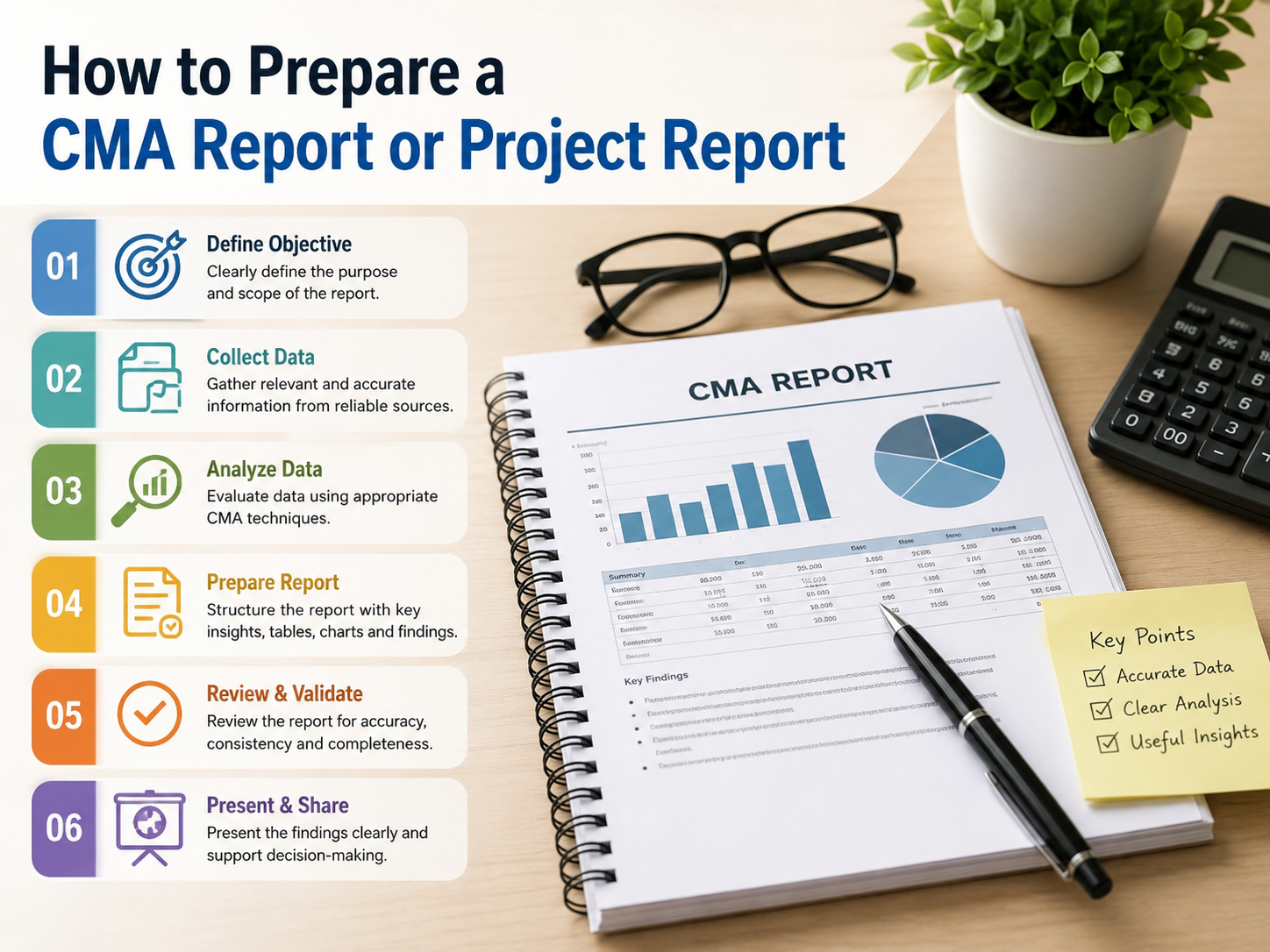
In this complete guide, we explain everything you need to know about preparing a CMA Report and Project Report for bank loan approval in 2026 — what they are, why banks require them, what mistakes lead to rejection, and exactly how to prepare them step by step.
What is a CMA Report for Bank Loan
A CMA Report — full form Credit Monitoring Arrangement Report — is a structured set of financial statements that banks require from businesses before approving a loan. It was introduced by the Reserve Bank of India in October 1988 to give banks a standardised, reliable way to evaluate every borrower’s financial health using the same format.
In simple terms, a CMA Report answers four critical questions for the bank — how has your business performed financially in the past 2 to 3 years, how is your business currently performing, how will your business perform over the next 3 to 5 years based on realistic projections, and most importantly — does your business generate enough cash to repay the loan on time every month without defaulting.
Most Indian banks require a CMA Report for business loans above Rs.10 lakh — including term loans, working capital loans like Cash Credit and Overdraft, PMEGP loans, CGTMSE loans, MSME loans, and large project finance applications.
Get Your CA-Certified CMA Report →
What is a Project Report for Bank Loan
A Project Report — also called a Detailed Project Report or DPR — is a comprehensive business document that explains your entire business plan to the bank in a structured, credible format. It answers every question a bank credit officer needs answered before recommending your loan for approval.
What exactly does your business do? How much money do you need and for what specific purpose? Is there genuine, verifiable market demand for your product or service? How will your business generate revenue month by month? What are your realistic costs and expenses? And most critically — how will you repay the loan within the agreed repayment period?
While a CMA Report focuses purely on financial data and standardised statements, a Project Report covers both the complete business plan and the detailed financial analysis together. For most businesses applying for term loans, MSME loans, or government scheme loans, banks require both documents submitted together as part of a single loan file.
Get Your Bank-Ready Project Report →
CMA Report vs Project Report — What is the Difference
This is one of the most frequently asked questions we receive at Sharda Associates — and confusing these two documents is one of the most common reasons loan applications get delayed or returned.
A CMA Report focuses only on standardised financial statements. It follows a fixed RBI format with exactly 7 specific statements. It is required for working capital loans, term loans, and CC or OD limit applications. It must be prepared and certified by a Chartered Accountant. It is typically 10 to 20 pages in length.
A Project Report covers both the complete business plan and the financial analysis together. It has a structured but more flexible format that allows for industry-specific customisation. It is required for new loans, government scheme applications like PMEGP, Mudra, and Stand Up India, and startup finance. It is typically 20 to 50 pages in length.
A Detailed Project Report is the most comprehensive version of all — covering multi-scenario financial projections, complete market research with competitor analysis, detailed technical and operational plans, and fully integrated CMA data. It is mandatory for loans above Rs.25 lakh and for large-scale project finance.
In most cases — especially for new businesses, government schemes, or loan amounts above Rs.10 lakh — banks require the Project Report and CMA Report submitted together as a package.
Get Your CMA Report → Get Your Project Report
Why Do Banks Require CMA Report and Project Report
This is a question many first-time borrowers ask — and understanding the real answer behind it will completely change how you approach your loan application and your documentation.
When your loan file reaches the bank’s credit department, the credit officer has one job — to determine whether lending money to your business is a safe and recoverable credit decision. To make that determination, they need to answer three specific questions.
First — does your business generate enough revenue consistently to meet its operating costs and still have surplus cash left over for loan repayment? This is answered by the Operating Statement in your CMA Report.
Second — are your cost estimates, investment plans, and revenue projections grounded in real market data — or are they just optimistic guesses? This is answered by the detailed sections of your Project Report.
Third — can you repay the full loan within the agreed repayment period without defaulting — even if business conditions are slightly tougher than expected? This is answered by the DSCR calculation in your CMA Report.
Without a properly prepared CMA Report and Project Report together, the credit officer literally cannot complete the loan appraisal. The file gets returned — causing weeks or months of unnecessary delay, multiple follow-up visits to the bank, and growing frustration.
A professionally prepared CMA Report and Project Report dramatically increases your loan approval chances, reduces the number of queries from the bank credit team, speeds up loan processing significantly, and ensures you receive the full loan amount your business actually needs — not a reduced amount caused by an incorrectly calculated MPBF.
Get Your CA-Certified CMA Report →
All 7 Statements of CMA Report — Explained Simply
Every CMA Report prepared as per RBI guidelines contains exactly 7 standardised financial statements. Here is what each statement covers and why it directly affects your loan approval outcome.
Statement 1 — Particulars of Existing and Proposed Limits. This statement shows the bank all your current loans, all existing credit facilities across all lenders, and the new loan or credit limit you are applying for. It gives the bank’s credit team a complete, instant picture of your total debt exposure before they begin any deeper analysis.
Statement 2 — Operating Statement. This is the core Profit and Loss section of your entire CMA Report. It covers your actual revenue and sales figures for the past 2 to 3 years and projected figures for the next 3 to 5 years, your raw material costs and all operating expenses, depreciation and interest charges, and net profit before and after tax for each year. Banks use this statement to verify that your business generates consistent and sufficient profit to service the loan EMI every single month without stress.
Statement 3 — Analysis of Balance Sheet. This statement shows your business’s complete financial position — fixed assets, current assets, total liabilities, and net worth — across the entire projection period year by year. Banks check this to assess the overall financial health, stability, and growth trajectory of your business over time.
Statement 4 — Comparative Statement of Current Assets and Liabilities. This is the detailed working capital analysis — how much money is tied up in stock, trade debtors, and trade creditors at any given point in time. This statement is critically important for Cash Credit and Overdraft applications because banks use it to scientifically determine your exact working capital requirement before setting your credit limit.
Statement 5 — MPBF Calculation. MPBF stands for Maximum Permissible Bank Finance — it is the specific RBI formula that banks use to calculate the maximum working capital loan your business is actually eligible for. Errors in MPBF calculation are the single most common reason businesses receive a loan sanction that is lakhs of rupees lower than what they actually applied for. A correctly prepared CMA Report from Sharda Associates ensures your MPBF is calculated precisely so you receive the complete loan amount your business genuinely needs.
Statement 6 — Fund Flow Statement. This statement shows exactly how funds moved in and out of your business during the projection period — where every rupee of money came from and where every rupee was used. Banks use this statement to verify that you are deploying funds responsibly and that your business generates real, usable cash flow — not just accounting profits that exist only on paper.
Statement 7 — Ratio Analysis. This is the final and often most decisive statement in the entire CMA Report. It is where banks check the three key financial ratios that directly determine your loan eligibility. DSCR or Debt Service Coverage Ratio must be above 1.25 to 1.5 for most Indian banks. Current Ratio must be above 1.17 as per Tandon Committee banking norms. Debt-to-Equity Ratio shows the balance between bank finance and your own promoter contribution. If any one of these three ratios falls outside the bank’s acceptable range, your loan application will be rejected — regardless of how strong every other aspect of your file looks.
Get Your CA-Certified CMA Report with All 7 Statements Verified →
How to Prepare a Project Report for Bank Loan — Step by Step
A complete and bank-accepted Project Report must contain all of the following sections in the correct sequence. Missing even a single section can result in your entire loan application being returned without processing.
Step 1 — Executive Summary. Write a concise one-page summary of your entire business and loan requirement. Include your business name and legal structure, the exact loan amount you are applying for and its specific purpose, your expected annual turnover and net profit in the first three years, and the proposed repayment period. This is the very first thing a bank credit officer reads — it must be specific, factual, and compelling enough to make them want to read the rest.
Step 2 — Promoter’s Profile. Banks assess the person behind the business as carefully as they assess the business plan itself. Include your complete educational qualifications, all relevant industry experience and previous work history, any previous business ventures and their outcomes, and your current personal financial net worth. A strong promoter profile builds the bank’s confidence before they even look at your financial numbers.
Step 3 — Business Description. Explain your business clearly and specifically — the nature of operations (manufacturing, trading, or services), the exact products or services you will offer, your business model and primary revenue sources, your chosen business location with available infrastructure, and the legal status of your business registration.
Step 4 — Market Analysis. This is the section that proves to the bank that genuine, verifiable demand exists for your product or service — and that your revenue projections are grounded in real market conditions rather than wishful thinking. Cover your identified target market and customer profile in detail, the total market size and its growth trajectory, your key competitors with an honest assessment of their strengths, your specific competitive advantages and differentiation, and your pricing strategy with comparison to current market rates.
Step 5 — Cost of Project and Means of Finance. This is consistently the most scrutinised section of any Project Report across all bank credit departments. Break down your total project cost in complete detail — land and building costs, machinery and equipment with actual supplier quotations, working capital requirement, pre-operative and preliminary expenses, and a reasonable contingency provision. Show your promoter’s contribution — your own investment — clearly and separately from the bank loan being requested. Banks need to see that you have genuine financial commitment to the project — not that you are expecting the bank to fund the entire venture.
Step 6 — Financial Projections for 3 to 5 Years. Prepare a complete year-by-year Profit and Loss Statement showing revenue, all operating expenses, and net profit. Prepare a Balance Sheet showing all assets and liabilities for each projection year. Prepare a monthly Cash Flow Statement for at least the first two years showing cash inflows and outflows in detail. Prepare a complete Loan Repayment Schedule with DSCR calculation for every year of the repayment period. Every number in these projections must be realistic, internally consistent, and supported by actual market data — not aspirational figures designed to look impressive.
Step 7 — DSCR Calculation. DSCR equals Net Cash Accruals for the year divided by the total of Loan Repayment and Interest for the same year. A DSCR above 1.5 is considered strong and comfortable by most Indian banks. A DSCR below 1.25 will result in automatic rejection of your term loan application regardless of everything else in the file. Getting this calculation right — and structuring your projections to support a healthy DSCR — is one of the core services our CA team at Sharda Associates provides with every Project Report and CMA Report.
Step 8 — Break-Even Analysis. Calculate and clearly present the exact level of annual or monthly sales at which your business covers all its costs and begins generating net profit. This analysis gives the bank concrete confidence that even if your actual business performance is somewhat below the projected levels — you can still meet your loan repayment obligations without defaulting.
Step 9 — Implementation Schedule. Present a realistic month-by-month timeline from loan disbursement to commercial production start. Include all major milestones — land acquisition, civil construction, machinery procurement, installation and commissioning, trial production, and commercial launch. Banks check this timeline against your moratorium period to confirm that revenue generation will begin before your first EMI becomes due.
Step 10 — Documents Checklist. List every supporting document being submitted with the loan application — KYC documents of all promoters, GST registration certificate, Udyam registration, ITR for last 2 to 3 years, audited financial statements, bank statements for last 6 months, machinery quotations, and any scheme-specific documents required by your bank or government portal.
Get Your Complete Bank-Ready Project Report →
7 Common Mistakes That Lead to Loan Rejection
Based on our experience of preparing reports for 12,500 plus businesses at Sharda Associates, these are the seven most common and most costly mistakes we see — and every single one of them is completely avoidable with professional preparation.
Mistake 1 — Unrealistic Financial Projections. Projecting 200 or 300 percent revenue growth in Year 1 without any supporting market research or data is an immediate red flag for every experienced bank credit officer. They have reviewed thousands of reports and can identify aspirational projections instantly. Unrealistic numbers do not just fail to impress — they actively destroy your credibility and make the credit officer question every other number in your file.
Mistake 2 — Mismatch Between Financial Statements. In a CMA Report, all 7 statements are tightly interconnected — every single number must reconcile perfectly across all statements. One error in your Balance Sheet that does not match the Fund Flow Statement is enough to trigger a cascade of additional queries from the bank’s credit team — and in many cases results in the entire file being returned for correction.
Mistake 3 — DSCR Below Bank Minimum. Most Indian banks require a minimum DSCR of 1.25 for term loan approval. Many banks prefer 1.5 and above. If your financial projections produce a DSCR below the bank’s minimum threshold — your term loan will not be sanctioned regardless of how strong every other aspect of your application is.
Mistake 4 — Incorrect MPBF Calculation. An incorrectly calculated MPBF in your CMA Report can result in you receiving a working capital credit limit that is lakhs of rupees lower than your business genuinely needs — even if the bank is willing to lend more. This single error silently costs businesses enormous amounts in lost credit every year.
Mistake 5 — Missing or Incomplete Sections. Bank credit departments work from detailed checklists. If your Project Report is missing the market analysis section, does not include a break-even calculation, has an incomplete promoter profile, or is missing an implementation schedule — your entire file will be returned without any further processing.
Mistake 6 — Inconsistency Between CMA Report and Project Report. The financial figures in your Project Report and CMA Report must be completely identical across both documents. Any inconsistency between the two — even a small difference in projected turnover or profit figures — immediately raises serious credibility questions about the reliability of all your data.
Mistake 7 — Generic Software-Generated Template Reports. Bank credit officers process hundreds of loan files every month. A software-generated template report filled with your name and numbers is instantly recognisable — and it signals to the bank that the borrower has not seriously thought through their project. These reports consistently receive more queries, more scrutiny, and more rejections than personally prepared, business-specific reports.
Get a Customised CA-Prepared CMA Report →
Documents Required
To prepare your CMA Report and Project Report, gather the following documents before contacting us. If you do not have some of these documents — especially if you are a new business — contact us first and we will guide you on exactly what to do.
Aadhaar Card and PAN Card of all promoters and directors. GST Registration Certificate or Udyam Registration Certificate. Last 2 to 3 years ITR with computation sheet if available. Last 2 to 3 years audited Balance Sheets and Profit and Loss Statements for existing businesses. Last 6 months business bank account statements. Existing loan sanction letters and current repayment schedules if any outstanding loans exist. Your estimated project cost, expected revenue figures, and planned expenses — even rough estimates are perfectly fine at this stage, our CA team will structure and verify them correctly. Machinery quotations, land or building details, and raw material cost information for manufacturing or processing businesses.
For new businesses with absolutely no financial history — do not worry. At Sharda Associates our CA team will guide you through developing realistic projections from industry benchmarks and real market research specific to your business type and location.
Get Started with a Free Consultation →
How Long Does Preparation Take
At Sharda Associates we deliver your CMA Report within 3 to 5 working days from the date we receive your complete set of documents. Your Project Report or Detailed Project Report is delivered within 4 to 7 working days. For urgent bank deadlines — where your bank has given you a specific submission date — we offer fast-track delivery within 24 to 48 hours. Contact us to confirm fast-track availability before placing your order.
Why Choose Sharda Associates
At Sharda Associates every CMA Report, Project Report, Detailed Project Report, and Feasibility Report is personally prepared and verified by a qualified Chartered Accountant with direct, hands-on experience in bank credit appraisal. Not generated by software. Not outsourced to freelancers. Not copy-pasted from templates.
CA-Prepared and Not Software-Generated. Bank credit officers are specifically trained to identify template-generated reports and they treat them with significantly less credibility than personally prepared reports. Every report we prepare is researched and written specifically for your business, your industry, your loan amount, and your specific bank’s credit appraisal requirements.
12,500 Plus Reports Accepted by All Major Banks. We have prepared CMA Reports and Project Reports for businesses across every major industry — manufacturing, trading, agriculture, healthcare, food processing, construction, hospitality, and service businesses — all accepted by SBI, PNB, Bank of Baroda, Union Bank, Bank of India, Canara Bank, SIDBI, and all major NBFCs across India.
100 Percent Bankable with Unlimited Free Revisions. Every statement in every CMA Report is internally cross-verified before delivery. DSCR and MPBF calculations are checked against your specific bank’s minimum lending norms. Financial projections are grounded in real industry data — not aspirational numbers. And we offer unlimited free revisions until your bank is fully satisfied and your loan is approved.
All Loan Types and Schemes Covered. Mudra Loan across all four categories. PMEGP Loan in exact KVIC and KVIB format. CGTMSE Loan. MSME Term Loan. Working Capital including Cash Credit and Overdraft. Large Project Finance. CMEGP for Madhya Pradesh businesses. Stand Up India. NABARD schemes.
Get Your CA-Certified CMA Report →
Conclusion
Preparing a CMA Report or Project Report correctly is not just a paperwork requirement — it is the single most important factor that determines whether your business loan gets approved or rejected. Banks do not lend money based on ideas or intentions. They lend based on structured, verified, credible financial documentation that gives their credit team the confidence to say yes.
At Sharda Associates, we have helped 12,500 plus businesses across India avoid these mistakes and get their loans approved — by preparing every CMA Report, Project Report, Detailed Project Report, and Feasibility Report personally, carefully, and with real banking knowledge built over years of experience.
Your business idea deserves proper documentation. Your loan application deserves a genuine chance of approval. And you deserve a CA team that stays with you — with unlimited free revisions — until that approval comes through. 91 89899 77769
Get Your CA-Certified CMA Report →
Frequently Asked Questions
Q1 — Is a CMA Report mandatory for all bank loans?
For most business loans above Rs.10 lakh — yes. This includes term loans, working capital loans, CC and OD limits, PMEGP, CGTMSE, and all major MSME scheme loans. For very small Mudra Shishu loans below Rs.50,000 a simplified project report may be enough. Contact us for a free consultation to confirm exactly what your specific bank requires.
Q2 — Can I prepare a CMA Report or Project Report myself?
Technically yes — but the risk is very high. A CMA Report has 7 interconnected statements where every number must reconcile precisely across all statements. One formula error creates inconsistencies that experienced bank credit officers identify immediately — usually resulting in multiple queries or outright rejection.
Q3 — What is a good DSCR for loan approval?
Most Indian banks require minimum DSCR of 1.25. Many banks prefer 1.5 and above for comfortable approval. At Sharda Associates we structure your projections to ensure DSCR stays comfortably within your specific bank’s acceptable range — not artificially inflated to raise red flags, and not below threshold to cause rejection. Get Your DSCR-Verified CMA Report →
Q4 — How much does it cost?
Our CMA Report preparation starts at Rs.2,999. Our Project Report preparation also starts at Rs.2,999. Our Detailed Project Report starts at Rs.4,999. Call or WhatsApp us at plus 91 89899 77769 for an exact quote based on your specific loan type and amount — same day response guaranteed.
Q5 — Do you prepare PMEGP and Mudra loan reports?
Yes. We have prepared PMEGP and Mudra Project Reports for thousands of clients across Madhya Pradesh and all states of India — in the exact format required by KVIC, KVIB, and DIC portals and accepted by all scheme-empanelled banks.
Q6 — Can a new business with no financial history get a CMA Report prepared?
Yes. For new businesses without ITR or audited financial statements, our CA team prepares complete and realistic projections based on industry benchmarks and actual market research for your specific business type and location. Many of our most successful clients were first-time entrepreneurs with zero documentation when they first contacted us.
Q7 — Do you prepare Feasibility Reports as well?
Yes. Our Feasibility Reports cover all 5 types of feasibility analysis — technical, economic, operational, scheduling, and legal — CA-certified and accepted by all government scheme portals including PMEGP, CMEGP, NABARD, and Mudra.