By Sharda Associates | CA Firm, Bhopal, Madhya Pradesh, India
Every Week Someone Calls Us After Wasting Three Weeks on a CMA Report That the bank returned.
The most frustrating part is never the rejection itself. It is realizing that the three weeks spent preparing the document, the two trips to the bank, and the processing fee paid—all of it could have been avoided if the document had been prepared correctly the first time.
CMA Report preparation does not need to take weeks. When you know exactly what each statement requires, what data to collect before you begin, what the most common errors are, and how to verify your document before submission a complete, bank-ready CMA Report can be prepared in 24 to 48 hours.
Sharda Associates is a CA firm based in Bhopal, Madhya Pradesh, India. Our CA team delivers CA-certified CMA reports to businesses across India in 24 to 48 hours from receiving complete documents. We have prepared over 45,500 loan documents, and we have reviewed hundreds of rejected CMA reports brought to us by clients who spent weeks on a document that never should have been returned. Every one of those rejections had the same root causes,
Get Your CMA Report in 24 to 48 Hours →
Why Most CMA Reports Take Too Long and Still Get Rejected
The Problem Is Not Complexity; It Is Wrong Starting Points
Most people who take three to four weeks preparing a CMA Report spend most of that time on the wrong things. They start building financial projections before collecting actual historical data. They prepare statements independently instead of as a linked system. They discover inconsistencies at the end and spend days correcting cascading errors. A correct preparation sequence eliminates all of this wasted time.
The CMA Report is not inherently complex. The 7 statements follow a logical sequence. Each one feeds into the next. When you build them in the right order, with the right data in hand before you start, the preparation time drops dramatically and the error rate drops to near zero.
The Document Collection Step That Saves the Most Time
Get Everything Before You Start a Single Statement
The single biggest time-waster in CMA preparation is starting Statement 2 or Statement 3 and then discovering midway that you need a document you do not have—an ITR computation sheet, a specific bank statement month, or the depreciation schedule from your audited accounts. Every time this happens, preparation stops, the document collection restart begins, and you lose days, not hours.
Collect every document before opening any CMA worksheet. No exceptions.
The Complete Document Collection Checklist
Financial History Documents
- Last 2 to 3 years ITR—full return with computation sheet, not just acknowledgement
- Last 2 to 3 years audited Balance Sheet and Profit and Loss Statement
- Last 2 to 3 years depreciation schedule from audited accounts — this is the specific document most people miss
- Existing loan sanction letters showing original amount, current outstanding, interest rate, and repayment schedule
Current Year Documents
- Last 12 months GSTR-3B and GSTR-1 returns — all 12 months, not just recent ones
- Last 12 months business bank account statements — complete, all pages
- Current year provisional Balance Sheet and P and L if available
- Current stock statement
Business and Market Documents
- Current supplier quotations for raw materials with prices and dates
- Current selling price list for your products — from actual market, not estimated
- Electricity bill showing current tariff category and monthly consumption
- Machinery quotations from authorised suppliers if applying for term loan
Loan Application Documents
- Udyam Registration Certificate
- GST Registration Certificate
- Aadhaar and PAN of all promoters
When every document in this list is physically in front of you — CMA preparation becomes a structured exercise rather than an interrupted search process.
The Preparation Sequence That Saves Hours
Why Order Matters Enormously
The 7 CMA statements are not independent documents. They are a linked financial system where each statement derives from or feeds into others. Building them in the wrong order creates inconsistencies that require complete restarts. Building them in the correct order means each completed statement provides the inputs the next one needs.
The Correct Preparation Sequence
Step 1 — Build Statement 2 First
Start with the Operating Statement — your Profit and Loss. Fill historical years from your audited accounts and ITR first. Historical figures must match ITR exactly — banks cross-verify this before any other check.
For projection years — build revenue bottom-up. Production capacity per day multiplied by realistic utilisation rate multiplied by current verified selling prices. Never assume — always calculate from real inputs.
Step 2 — Build Statement 4 Next
Current Assets and Liabilities. Use your actual bank statement patterns to determine debtor holding period — not a number you think sounds reasonable. Use your actual stock patterns to determine inventory holding. These holding periods determine your working capital requirement — the most important calculation for working capital applications.
Step 3 — Build Statement 3 From Statements 2 and 4
Your Balance Sheet is derived — not independently created. Net profit from Statement 2 flows into retained earnings. Current Assets and Liabilities from Statement 4 flow into current position. Fixed assets reduce by the depreciation calculated in Statement 2. Build Statement 3 as a formula-linked derived statement.
The Balance Sheet must balance — Total Sources must equal Total Application — for every single year column. If it does not balance when built correctly from derived inputs, there is an error in either Statement 2 or Statement 4. Find and fix it there — not in Statement 3.
Step 4 — Build Statement 1
List all existing facilities and the proposed new facility. This is primarily a data entry step once your documents are collected. Every facility must match your actual CIBIL position.
Step 5 — Build Statement 5 — MPBF
Calculate Maximum Permissible Bank Finance using the correct method for your bank and loan size. For most MSME businesses below Rs.5 crore working capital — Nayak Committee Turnover Method. MPBF equals 20 percent of projected annual net sales from Statement 2.
Confirm your method with the bank before preparing this statement. Using the wrong method is one of the most common reasons CC applications get returned.
Step 6 — Build Statement 6 — Fund Flow
Sources of Funds and Application of Funds for each projection year. Derived from changes in Balance Sheet positions between consecutive years. Must balance — Total Sources equals Total Application for every year.
Step 7 — Build Statement 7 — Ratio Analysis
Calculate all ratios from the corresponding underlying statements. DSCR from Statement 2. Current Ratio from Statement 4. Debt to Equity from Statement 3. Every ratio must derive from the actual figures in its source statement — never calculated independently.
Get Your 7 Statements Prepared in the Correct Sequence →
The Three Calculations That Must Be Verified Before Submission
Verification Step 1 — DSCR Formula Check
Check every year’s DSCR calculation against this specific formula:
DSCR = Net Profit After Tax PLUS Depreciation
divided by
Term Loan Repayment PLUS Term Loan Interest
Every year must show DSCR above 1.25
Depreciation must be added. CC interest must not be in the denominator. These two errors alone account for the majority of DSCR-related CMA rejections.
Verification Step 2 — Balance Sheet Balance Check
Open Statement 3. For every year column — verify that Total Sources of Funds exactly equals Total Application of Funds. Check every single column. Not just Year 1. Not just the base case. Every column.
A balance sheet that does not balance in any year is returned within 60 seconds of a credit officer opening the file.
Verification Step 3 — Cross-Statement Consistency Check
Run through this specific checklist before finalizing.
| Check | What to Verify |
| Statement 2 to Statement 3 | Net Profit in each year matches retained earnings change |
| Statement 4 to Statement 3 | Total Current Assets and Liabilities match |
| Statement 2 Depreciation | Matches net fixed asset reduction in Statement 3 |
| Statement 5 MPBF | Based on net sales from Statement 2 |
| Statement 7 DSCR | Uses net profit and depreciation from Statement 2 |
| Statement 6 Fund Flow | Balances Total Sources and Application every year |
| Statement 2 History vs ITR | Every historical figure matches filed ITR exactly |
The Time-Saving Decision—Professional CA Preparation vs Self-Preparation
An Honest Calculation
For most MSME business owners — the genuine time cost of self-preparing a CMA Report is 30 to 80 hours across 2 to 4 weeks. This includes learning the format, collecting documents, building the statements, discovering errors, correcting them, and then discovering that the bank has returned it anyway because of a DSCR formula error or wrong MPBF method. Against this — professional CA preparation at Sharda Associates costs Rs.2,999 and takes 24 to 48 hours.
This is not a cost comparison. It is a time-and-outcome comparison.
30 to 80 hours of your time is time not spent running your business. A bank return adds 3 to 4 weeks to your loan timeline. The opportunity cost of the loan delay — for capital you needed for a specific business purpose — is real and frequently larger than the preparation fee.
When Self-Preparation Makes Sense
Self-preparation is reasonable when you are a finance professional who prepares CMA Reports regularly for clients and the format is already deeply familiar. Or when your loan requirement is very small and the bank’s review will be informal and minimal.
For any loan above Rs.10 lakh from a scheduled commercial bank — professional CA preparation is the more efficient and more reliable choice.
What Sharda Associates Does in 24 to 48 Hours
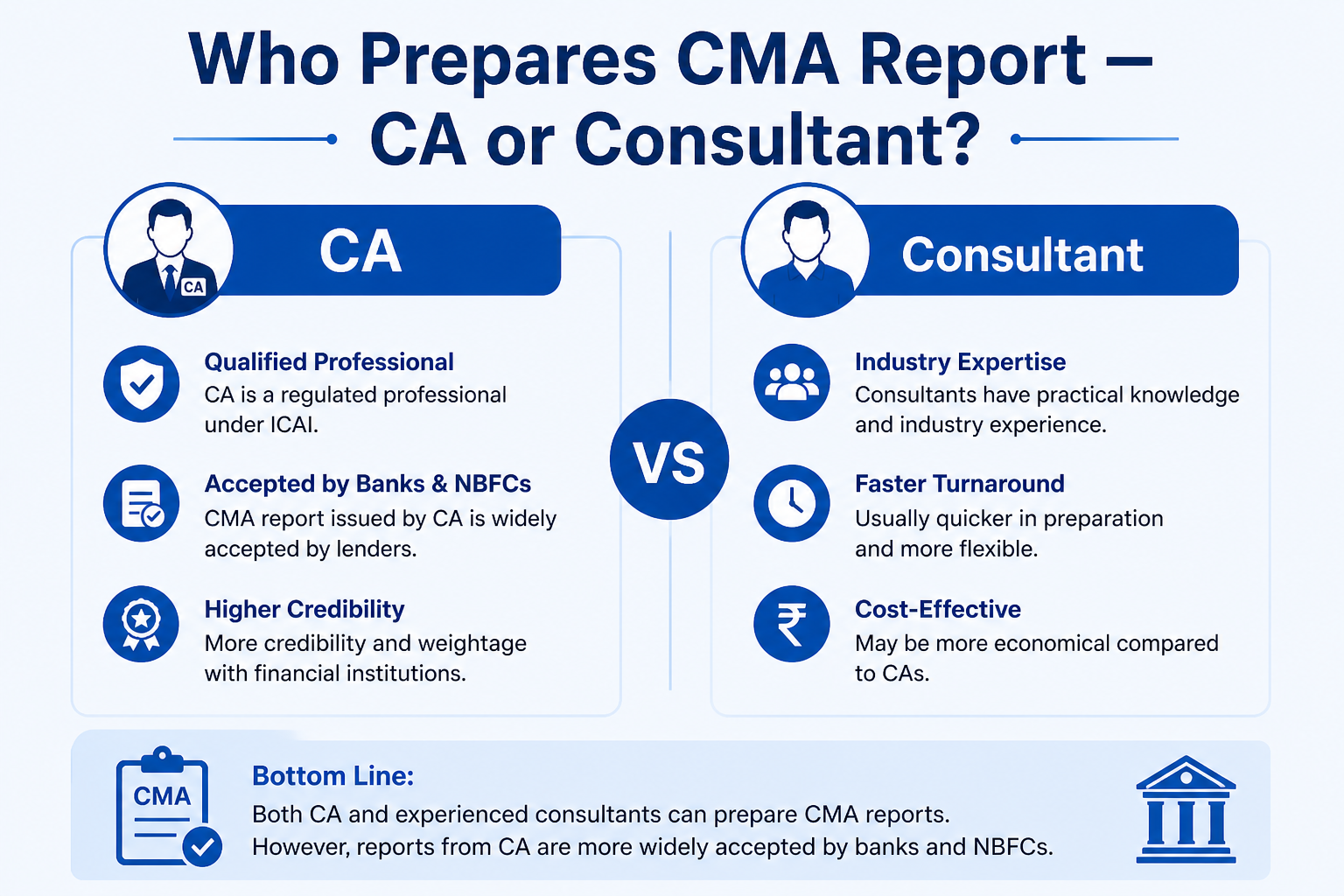
When you call or WhatsApp us at +91 89899 77769, our CA has a same-day consultation with you. You send your documents. Our CA prepares all 7 statements as a linked integrated system — no independent templates, no generic national data, no software-generated numbers.
We research current market prices for your raw materials in your district. We calculate depreciation at correct statutory rates for your asset category. We verify DSCR using the correct formula for every repayment year. We confirm Balance Sheet balance for every year column. We check MPBF using the method your specific bank requires.
Your complete CA-certified CMA Report — with our CA’s ICAI membership number on every page — reaches your inbox in 24 to 48 hours. We prepare it alongside your Project Report where required, ensuring every figure is consistent across both documents. Starting at Rs.2,999.
Conclusion
CMA Report preparation does not need to be a weeks-long exercise in frustration. The document becomes straightforward when you collect everything before you start, build statements in the correct sequence as a linked system, verify the three critical calculations before submission, and work with a CA who has done this hundreds of times.
The businesses that get their loans approved fastest are not the ones who prepared the most elaborate documents. They are the ones who prepared correct, internally consistent, bank-verified documents the first time they submitted.
Sharda Associates prepares correct CMA reports in 24 to 48 hours. That is not a marketing claim. It is the result of a preparation process built entirely around eliminating the delays and errors that make self-prepared CMA Reports take weeks and still get returned.
Call or WhatsApp +91 89899 77769
Frequently Asked Questions
1. How long does it actually take to prepare a correct CMA Report?
With all documents collected, the correct preparation sequence followed, and a CA who knows the format deeply — 24 to 48 hours. The reason most self-prepared CMA Reports take weeks is document collection delays, preparation sequence errors, and inconsistencies discovered late that require restarts.
2. What is the single biggest time-wasting mistake in CMA preparation?
Starting Statement 2 projections before collecting all historical documents — particularly the depreciation schedule from audited accounts and the complete 12-month bank statement set. When these are missing mid-preparation, everything stops while you collect them.
3. Why must CMA statements be prepared in a specific sequence?
Because each statement derives from or feeds into others. Statement 3 Balance Sheet is derived from Statement 2 operating performance and Statement 4 working capital position. Building them in the wrong order creates inconsistencies that require complete restarts — which is the primary reason self-prepared CMA Reports take weeks instead of days.
4. How do I verify my CMA Report is correct before submitting to the bank?
Run three checks. DSCR formula — confirm depreciation is added to net profit in numerator, CC interest is not in denominator. Balance Sheet balance — Total Sources equals Total Application in every year column. Cross-statement consistency — net profit matches retained earnings movement, current assets match between Statement 3 and 4, depreciation matches between statements.
5. What documents must be collected before starting CMA preparation?
Last 2 to 3 years ITR with computation sheet. Last 2 to 3 years audited Balance Sheet, P and L, and depreciation schedule. Last 12 months GSTR and bank statements. Existing loan details. Current raw material and selling prices. Machinery quotations if applying for term loan. Udyam Registration. Having every document before starting eliminates all mid-preparation interruptions.
6. Why does the MPBF method matter for preparation time?
Using the wrong MPBF method — Nayak versus Tandon Method 2 — produces an incorrect CC limit that the bank identifies immediately and returns. This adds 2 to 3 weeks to your timeline. Confirming the correct method with your bank before preparing Statement 5 eliminates this delay entirely.
7. Can I prepare a CMA Report using online software tools?
Software tools can generate a document quickly but they use generic national benchmark data, cannot verify your local market prices, and frequently produce DSCR calculation errors and internal inconsistencies that banks identify during appraisal. For loans above Rs.10 lakh, software-generated reports rarely pass first-submission bank review.
8. How much time does a CA-certified CMA save versus self-preparation?
Most MSME business owners spend 30 to 80 hours self-preparing a CMA Report across 2 to 4 weeks. Professional CA preparation at Sharda Associates takes 24 to 48 hours. The time saving is real, the error rate drops to near zero, and the bank query rate drops significantly. The Rs.2,999 preparation fee is nearly always recovered in avoided delays.
9. Do I need to visit Sharda Associates office for CMA preparation?
No. Our entire service is online. You send documents by WhatsApp or email. Our CA prepares your CMA Report and delivers it to your inbox. We serve clients across all states of India — Madhya Pradesh, Maharashtra, Gujarat, Rajasthan, Uttar Pradesh, Bihar, Karnataka, Tamil Nadu, and all others — without any office visit required.