
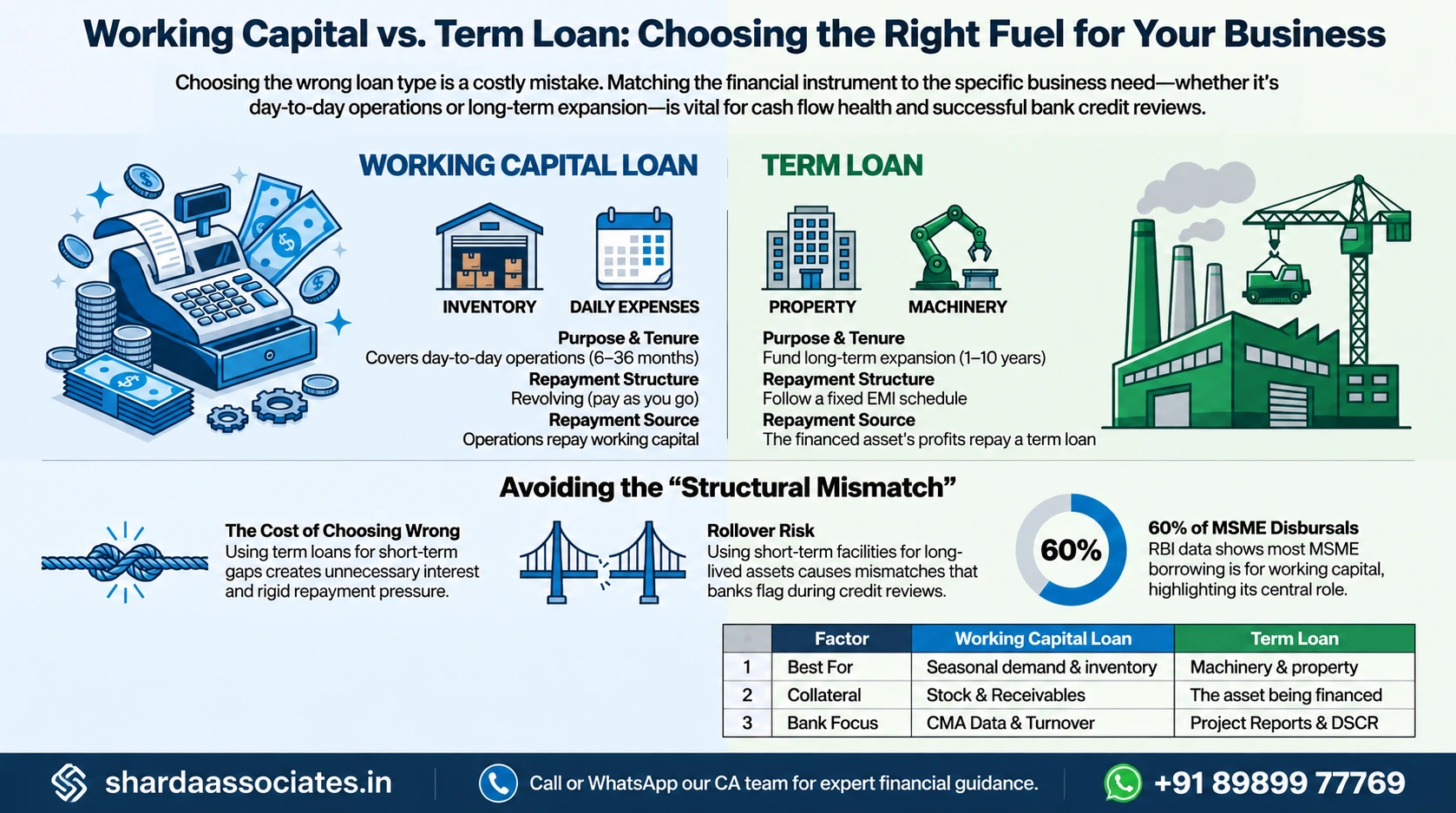
One of the most expensive mistakes a business can make isn’t choosing the wrong lender — it’s choosing the wrong type of loan for the actual need. Using a long-tenure term loan to plug a short-term cash flow gap creates unnecessary interest costs and rigid repayment pressure, while using a short-term working capital facility to fund machinery or expansion creates rollover risk and structural mismatch that banks flag during credit review.
RBI data shows that over 60% of business loan disbursals to MSMEs in India are working capital loans, which tells you how central this distinction is to how businesses actually borrow—and how important it is to match the instrument to the purpose rather than picking whichever is easier to get approved first.
At Sharda Associates, this is one of the more common gaps we help clients close before they approach a bank: making sure the loan they’re applying for actually matches what the project report or CMA data says the money is for. Here’s exactly how the two differ and how to know which one your business needs right now.
What Is a Working Capital Loan?
A working capital loan funds a business’s day-to-day operational needs — paying suppliers, covering payroll, purchasing inventory, and bridging the gap between dispatching goods and actually receiving payment. It’s typically short-term (often 6–36 months, sometimes as short as 4 months), can be structured as a revolving facility like cash credit or Overdraft, and is meant to be self-liquidating—the business’s own operating cycle generates the cash that repays what’s drawn.
What Is a Term Loan?
A term loan funds long-term, one-time investments — buying machinery, constructing or acquiring property, or funding a major expansion project. It comes with a fixed repayment schedule, typically ranging from 1 to 10 years depending on the asset being financed, and is repaid from the profit the asset generates over its useful life rather than from short-term operating cash flow.
Key Differences at a Glance
| Factor | Working Capital Loan | Term Loan |
| Purpose | Day-to-day operations, inventory, payroll | Machinery, property, expansion |
| Tenure | Typically 6 months to 3 years | Typically 1 to 10 years |
| Loan amount | Often ₹50,000 to ₹1 crore | Often ₹1 lakh to ₹5 crore or more |
| Repayment structure | Revolving; draw and repay as cash flow allows | Fixed EMI schedule |
| Repayment source | Business’s operating cycle (self-liquidating) | Profit generated by the financed asset |
| Collateral | Often unsecured, or secured by stock/receivables | Frequently secured by the asset being financed |
| Best suited for | Seasonal demand, payment gaps, inventory cycles | Capital expenditure, one-time large investments |
When Your Business Needs a Working Capital Loan
- You face seasonal or cyclical demand and need extra funds temporarily for inventory or staffing during peak periods.
- You have a gap between dispatching goods and receiving payment from customers, straining day-to-day cash flow.
- You need to pay suppliers, rent, or wages during a temporary cash crunch, even though the business is fundamentally profitable.
- Your operating cycle is short (retail, restaurants, and trading businesses collecting cash quickly) but occasionally needs a buffer.
When Your Business Needs a Term Loan
- You’re purchasing machinery, equipment, or property for the business.
- You’re planning a significant expansion — a new unit, additional capacity, or a new location.
- The funding need is well-defined, one-time, and time-bound, rather than a recurring operational gap.
- You want predictable EMIs over a multi-year period rather than a revolving facility that needs ongoing management.
Why Mixing the Two Creates Problems
Using a term loan to cover a temporary working capital shortfall means committing to fixed, long-term EMIs for what was really a short-term need — this creates unnecessary interest cost and cash-flow pressure that persists well after the original gap has closed. Conversely, using a short-term working capital facility to fund a long-lived asset like machinery creates rollover risk, since the facility may need to be renewed repeatedly to cover what should have been a one-time, amortising commitment. Banks specifically watch for this kind of structural mismatch during credit review, and it’s one of the more avoidable reasons a proposal gets flagged or restructured.
How Banks Evaluate Each Type of Loan
For a working capital facility, banks primarily look at your operating cycle length, turnover consistency (often through CMA data and bank statement analysis), and the value of stock and receivables backing the facility — this is what determines your Drawing Power on a Cash Credit account. For a term loan, banks focus more on the project report or DPR: the asset’s cost, expected returns, and the DSCR calculated against the fixed repayment schedule, since the loan is being repaid from the profitability the asset itself generates.
A Practical Way to Decide
- Need to bridge payment cycles or fund inventory? → Working capital loan.
- Buying equipment or expanding physical capacity? → Term loan.
- Not sure which category your need falls into? → Map your funding requirement against your operating cycle (how quickly your business converts inventory and receivables into cash) — short cycles typically point to working capital needs, while one-time capital expenditure points to a term loan.
- Need both? Many established businesses maintain a working capital facility for ongoing operations alongside a separate term loan for a specific expansion project, rather than trying to serve both purposes from one loan.
Conclusion
The right loan isn’t the one that’s fastest to get approved — it’s the one whose repayment structure actually matches how your business generates the cash to repay it. Getting this wrong doesn’t always show up immediately, but it tends to surface later as cash-flow strain or a bank flagging the mismatch at renewal time.
If you’re not sure which type fits your current need, or your project report needs to clearly justify one over the other, our CA team at Sharda Associates can help you think it through before you apply. Reach us at Sharda Associates or call +91 89899 77769.
Frequently Asked Questions
1. Can I use a term loan for working capital needs?
It’s possible but generally not advisable — it creates cash-flow pressure from fixed EMIs on what was really a temporary, revolving need, and banks may flag the mismatch during review.
2. Is a working capital loan always unsecured?
Not always — many are secured against stock and receivables (as with Cash Credit), though some unsecured working capital products are also available, typically at a higher interest rate.
3. Which loan type has a lower interest rate?
This varies by lender and security offered, but secured term loans for asset purchase often carry lower rates than unsecured working capital facilities, reflecting the difference in collateral and risk.
4. Can a new business get a term loan without an operating history?
Yes, particularly through scheme-linked loans like PMEGP or MUDRA, which evaluate projected financials rather than requiring an established operating history.
5. How is a Cash Credit account different from a term loan?
A CC account is a revolving working capital facility where you draw and repay flexibly up to your Drawing Power; a term loan is a one-time disbursement repaid through fixed EMIs over a set tenure.
6. Does my business need both a term loan and a working capital facility?
Many growing businesses do — a term loan for a specific expansion or asset purchase and a separate working capital facility for ongoing day-to-day operations.
7. What documents do banks check differently for each loan type?
Working capital assessment relies heavily on CMA data, stock statements, and bank statement analysis; term loan assessment relies more on a project report or DPR with asset cost and DSCR projections.
8. Can I convert a working capital loan into a term loan later?
Some banks allow restructuring in specific circumstances, but it’s not a standard conversion — it’s better to apply for the correct loan type from the outset based on your actual need.
9. Is DSCR relevant for working capital loans too?
DSCR is primarily used for term loans to assess repayment capacity against fixed EMIs; working capital assessment relies more on Drawing Power and turnover-based analysis.
10. What’s the biggest mistake businesses make when choosing between these loans?
Applying for whichever loan type seems easier to get approved, rather than matching the loan structure to the actual funding purpose — this mismatch often surfaces as cash-flow stress or a flagged file later.