
The Goods and Services Tax (GST) has undergone tremendous evolution since its inception, developing into a complex, technology-driven structure. As of April 1, with the adoption of the Income Tax Act 2025, the integration of direct and indirect taxes has reached an unprecedented level. For firms operating in the current economic cycle, recognising GST’s dual nature—its systemic benefits and inherent compliance challenges—is crucial to long-term sustainability.
GST is no longer just a tax filing requirement; it is a real-time data exchange with the government that dictates a business’s financial health. This article provides a full and completely accurate breakdown of the current GST scenario.
The GST’s structural framework
GST is a destination-based tax applied on all value added along the supply chain. It uses a dual-control paradigm to keep revenue balanced between the state and the center.
Components of the modern GST system:
- CGST (Central Goods and Services Tax): A tax levied by the central government on intrastate supplies.
- SGST/UTGST (State/Union Territory Goods and Services Tax): A tax levied by the state or union territory on intrastate supplies.
- IGST (Integrated Goods and Services Tax) is levied on all interstate supplies and imports. This tax is collected by the Center and allocated to the destination state.
GST Advantages in India 2026
Complete elimination of the cascading effect.
Prior to GST, India had a “tax-on-tax” structure. Central Excise was not creditable against State VAT, resulting in higher expenses for the end customer. Today, the smooth flow of Input Tax Credit (ITC) ensures that tax is only paid on the “value added” at each level. This transparency considerably reduces production costs for manufacturing units.
High threshold for MSME support.
To encourage the expansion of small enterprises, the current registration thresholds remain tax-friendly.
- Goods: Registration is required if annual revenue exceeds ₹40 lakh.
- Registration is required if annual turnover exceeds ₹20 lakh.
- Special Category States: Lower restrictions apply to maintain administrative practicality in hilly or northeastern areas.
Automation and Unified Compliance
The GST portal is now a “Central Nervous System” for company information. E-Invoicing (currently essential for enterprises with revenue exceeding ₹5 Crore) enables real-time reporting. This automation guarantees that GSTR-1 (sales) and GSTR-3B (tax payment) are pre-populated, hence avoiding manual errors and audit concerns.
The Composition Scheme Advantage
Small taxpayers with a turnover of up to ₹1.5 Crore can apply for the Composition Scheme. They pay a nominal, fixed percentage of their turnover in taxes and file simplified quarterly returns. This is an essential tool for local stores and small-scale producers to maintain compliance without incurring significant administrative costs.
Revolutionised Logistics: The E-Way Bill
The digital E-Way Bill system has replaced physical inspections at state borders. Current logistics data show that freight transit times have fallen considerably, resulting in faster supply chain cycles and lower fuel use across the country.
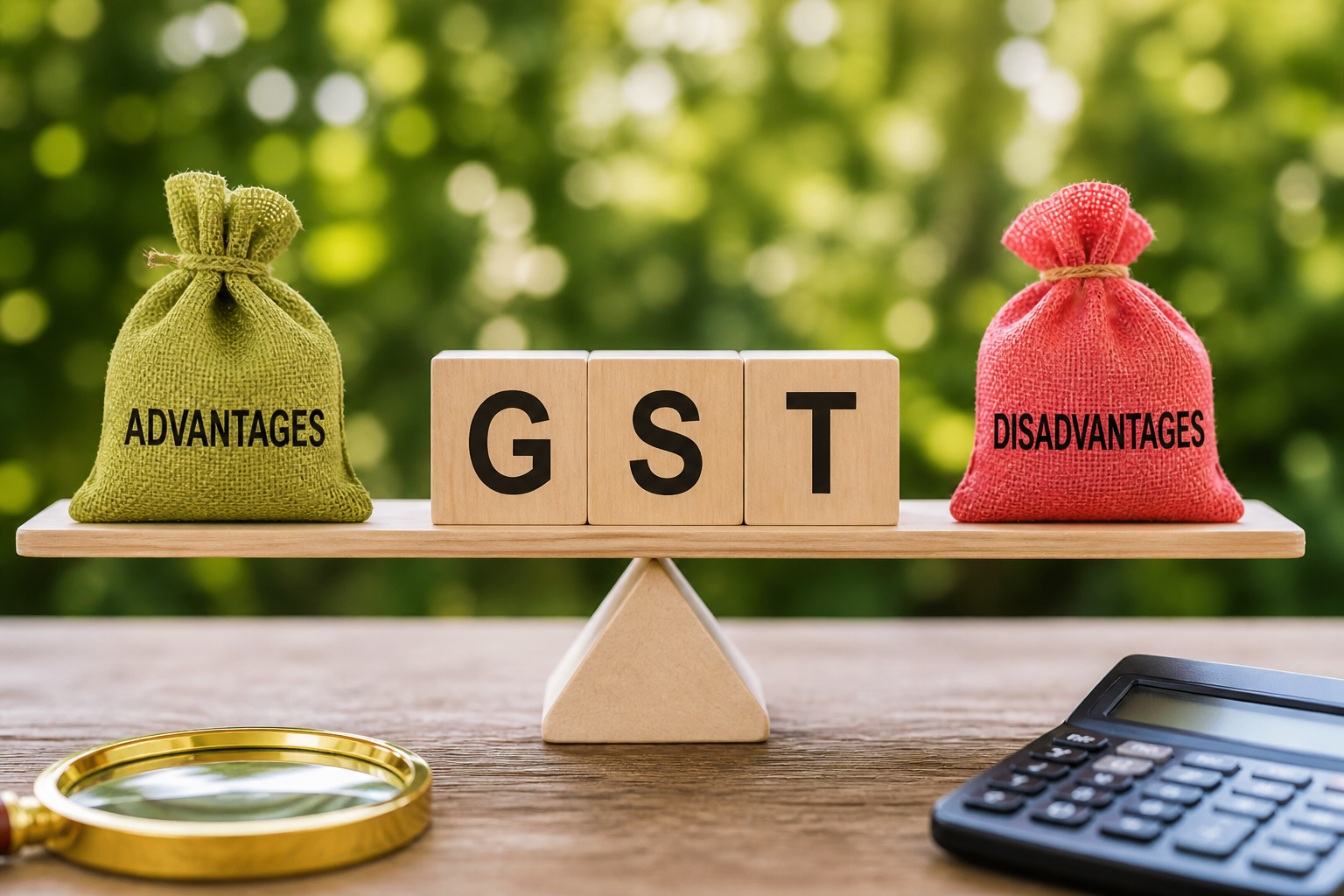
GST Disadvantages and Challenges
High rate of compliance
Although computerized, the GST system is demanding. A typical taxpayer must file monthly GSTR-1 and GSTR-3B returns, as well as an annual return (GSTR-9). This necessitates meticulous bookkeeping based on accepted accounting rules, as any delay results in automated late fines and interest.
Dependence on Supplier Compliance
According to current “Matching Concept” laws, you may only claim Input Tax Credit if your supplier uploaded the invoice and paid the tax. This is noted on your GSTR-2B. If a supplier defaults, it has a direct impact on your cash flow since you lose credit for that transaction, which effectively increases your tax bill.
The Complexity of Multiple Tax Slabs.
Unlike many worldwide models with a flat rate, India has four slabs: 5%, 12%, 18%, and 28%. Correctly recognizing the HSN (Harmonized System of Nomenclature) code for each product is critical. Misclassification can result in hefty back-tax demands and fines during departmental audits.
Technological and Digital Barriers
Businesses in places with weak connectivity or individuals lacking digital literacy find it difficult to remain compliant due to the reliance on a completely digital interface. Furthermore, peak-time traffic on the GST portal might cause technical issues, though system stability has improved significantly in the current cycle.
Integration with the Income Tax Act 2025.
The largest “silent” barrier is complete data openness between GST and Income Tax. Government AI technologies now compare the turnover reported in GST to the income reported in ITR. Any discrepancies can result in a faceless assessment notice.
Strategic Advantages of GST Compliance
- Bankability: When it comes to loan processing, banks rely on consistent GST filings as proof of firm health.
- Corporate Credibility: Large organizations only work with GST-compliant vendors to ensure that their own ITC chain is unbroken.
- Government Subsidies: Many programs, such as CMEGP and PMEGP, need GST registration before disbursing capital subsidies to industrial firms.
About Sharda Associates
Managing the intersection of GST compliance, accounting, and the Income Tax Act 2025 updates requires expert oversight. Based in Bhopal, Sharda Associates specializes in:
- End-to-End GST Management: From initial registration to complex monthly and annual filings.
- ITC Optimization: Ensuring every rupee of eligible credit is claimed while maintaining audit-ready records.
- Business Consultancy: Aligning your GST structure with government schemes like CMEGP to maximize benefits.
- Audit Support: Providing professional representation and ensuring your digital records are 100% reconciled.
Contact Sharda Associates, Bhopal today for a professional consultation. Focus on scaling your business while we handle the complexities of the modern tax regime.
Frequently Asked Questions
Q1: What are the current GST registration thresholds for businesses?
Under current guidelines, registration is mandatory for goods at ₹40 Lakh turnover and services at ₹20 Lakh turnover, excluding special category states.
Q2: How does the Input Tax Credit mechanism benefit a modern manufacturer?
ITC allows you to deduct tax paid on raw materials from tax due on sales, preventing double taxation and lowering total production costs.
Q3: Is it mandatory for all businesses to generate E-Invoices?
E-Invoicing is currently mandatory for all taxpayers with an aggregate annual turnover exceeding ₹5 Crore to facilitate real-time government data reporting.
Q4: What is the primary purpose of the GST Composition Scheme?
It offers a simplified tax payment method for businesses with turnovers up to ₹1.5 Crore, requiring fixed-rate payments and significantly reduced paperwork.
Q5: How does the E-Way Bill system impact movement of goods?
It is a digital document for transporting goods worth over ₹50,000, removing physical checkposts and ensuring faster, more efficient supply chain management.
Q6: What happens if a supplier fails to upload an invoice?
The invoice won’t appear in your GSTR-2B, making you ineligible to claim Input Tax Credit for that specific transaction until the supplier complies.
Q7: Are there specific GST exemptions available for new startups?
GST offers no specific tax holidays for startups, but registered units can claim refunds on unutilized ITC and access various capital subsidies.
Q8: Why is reconciling GST returns with Income Tax statements necessary?
Government AI compares GST sales with ITR income; reconciliation ensures 100% accuracy and prevents discrepancies that trigger modern faceless assessment protocols.